
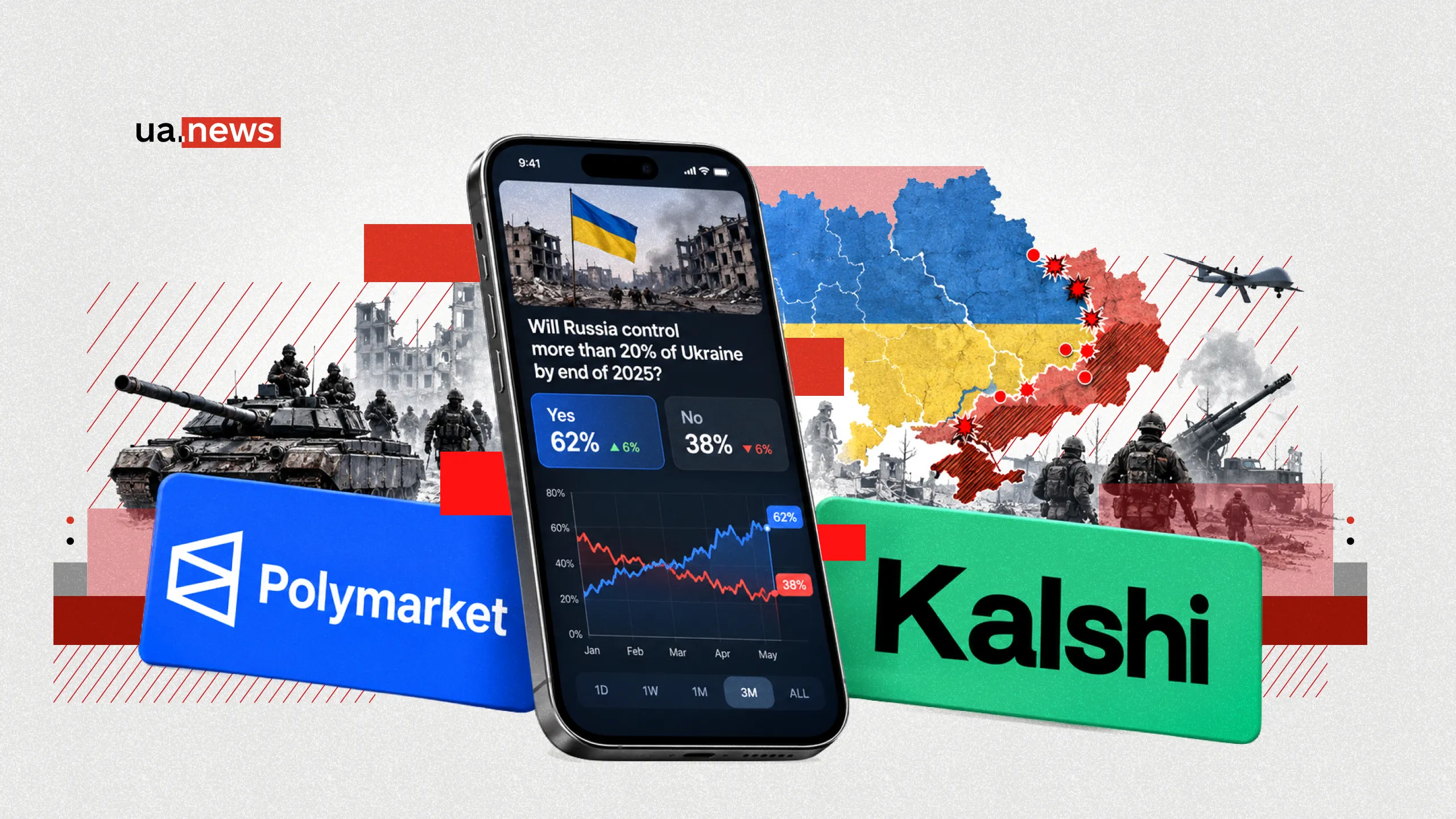
Prediction markets have finally broken out of the confines of the narrow crypto community and evolved into a global financial industry with billions in turnover, where human tragedies are monetized in real time. Betting on political upheavals, coups, and the start dates of military operations is sparking growing outrage among the public.
According to a Reuters/Ipsos survey, 69% of Democrats and 61% of Republicans are strongly opposed to the use of prediction markets to profit from elections. Citizens condemn the possibility of speculating on the publication of government decisions or military orders.
However, public condemnation has failed to stem the massive influx of capital. In just the first few months of 2026, trading volume on the decentralized Polymarket platform exceeded tens of billions of dollars, and traditional Wall Street players began actively investing in similar startups. Where big money appears, objective detachment vanishes instantly.
Military officials are betting their own funds on special operations to which they have direct access; analytical maps of the front lines are becoming tools for financial manipulation; and decisions on payouts are made by anonymous crypto-token holders.
UA.News explains how the business models of the leaders in the forecasting industry differ, how blockchain oracle mechanisms work, who is making money—and how much—from insider trading of classified data, and why the Ukrainian front has sparked the most severe ethical scandals in the political betting industry.
The Structural Divide Between Polymarket and Kalshi

The mechanics of political prediction markets differ radically from those of traditional bookmakers. Participants buy shares in a specific outcome (for example, “Yes” or “No” to the question “Will U.S. forces invade Iran?”), whose value fluctuates between $0 and $1. If the event is verified, shares in the winning outcome are settled at $1, yielding a net profit for their owners.
The current contract price reflects the collective assessment of probability: if a contract is trading at 65 cents, the market estimates the chances of it occurring at 65%.
Two platforms with fundamentally different philosophies—Polymarket and Kalshi—have emerged as leaders in this new economy. Polymarket, a company registered in Panama, is built on the Polygon blockchain. It does not require users to verify their income or link bank accounts, accepts deposits exclusively in cryptocurrency, and offers zero trading commissions.
The lack of strict regulation has allowed the platform to launch thousands of controversial markets, ranging from bets on the use of tactical nuclear weapons to the exact dates of military uprisings in African countries.
In contrast, Kalshi has taken the long road to legalization within the traditional financial system. The company operates within U.S. jurisdiction, is subject to the strict rules of the Commodity Futures Trading Commission (CFTC), and deals exclusively in fiat dollars. In the fall of 2024, Kalshi achieved an unprecedented legal victory.
The U.S. Court of Appeals for the District of Columbia officially ruled that the CFTC had overstepped its authority when it attempted to classify political contracts as ordinary gambling, thereby blocking bets on congressional elections. Thanks to this ruling, Kalshi legalized political trading within the United States.
However, the platform’s offering remains conservative—it is dominated by Federal Reserve decisions, inflation indices, and major political elections, with no overt speculation on armed conflicts.
How the Military Profits from Its Own Missile Strikes
The main structural vulnerability of decentralized prediction markets remains widespread insider trading. While in the stock market, transactions by top corporate executives are strictly monitored by the Securities and Exchange Commission (SEC), prediction markets allow direct participants in hostilities or holders of state secrets to profit.
In the spring of 2026, financial analysts detected anomalous activity on the Polymarket platform during an escalation in the Middle East. Traders began investing hundreds of thousands of dollars on the exact dates of strikes, and these bets strangely came true.
In its investigation, the British newspaper The Guardian reported how anonymous speculators created a $7.5 million pool exclusively for bets on U.S. military intervention in Iran, while trading volumes surrounding a potential ceasefire exceeded $280 million.
Massive bets were placed just a few hours before information about troop movements became public.
Internal investigations by military agencies confirmed the worst fears. In Israel, police and the military prosecutor’s office questioned several Air Force officers regarding the use of classified intelligence to profit on a cryptocurrency exchange. One member of a combat aviation crew, who made $46,000 on the exact date of the escalation, admitted during questioning that most of the pilots in his squadron were betting on their own operations.
Two service members were officially charged with leaking classified information after they collectively made over $244,000 in net profit based on predictions of strikes against Iran.
The anonymity of cryptocurrency wallets effectively makes it impossible to identify the ultimate beneficiaries without significant intervention by government intelligence agencies. Platforms are attempting to rely on blockchain analytics to track sudden capital inflows into low-probability events; however, experienced insiders use hundreds of small transactions to mask their financial trails.
The Ukrainian Front on the Crypto Exchange
Due to the rapidly changing situation and global scale, the hostilities in Ukraine have become one of the most profitable niches for speculators on Polymarket. Investors are betting millions on whether Russian troops will capture a specific town by a certain date, or whether Western partners will provide a new type of missile weaponry.
Military predictions with low probability (initial odds of up to 35%) come true in 52% of cases, while similar political bets pay off in only 25% of cases. Such anomalous accuracy confirms the presence in the market of individuals with access to classified frontline intelligence.
This cynical business reached its peak in the fall of 2025 with an incident involving Ukrainian cities. Large bets were placed on the platform on whether the central districts of Myrnohrad would be occupied by a mid-November deadline. On the eve of that date, an analyst at the U.S.-based Institute for the Study of War (ISW) made unauthorized changes to an interactive map, erroneously marking the advance of Russian forces deep into the city.
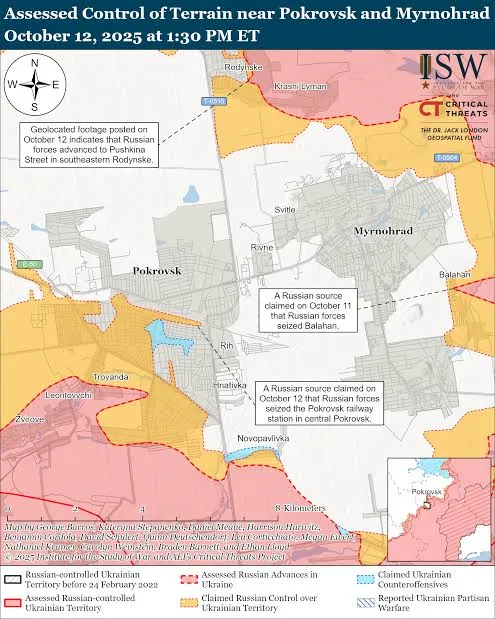
Relying solely on this updated map, the platform’s algorithms recognized the event as having occurred and immediately paid out profits to traders who had bet on a rapid occupation.
The next day, the ISW corrected its map, removing the fictitious advance, as there was no visual confirmation from the front lines. However, financial transactions on the blockchain cannot be reversed. Polymarket users who lost money began calling ISW with threats, accusing analysts of bribery and deliberately manipulating maps for the sake of crypto trading.
Ukrainian researchers intervened forcefully in the situation. As representatives of the OSINT project DeepState stated, the use of open-source map data as a form of judicial arbitration for a financial betting pool is absolutely unacceptable.
Maps are created to inform the military and the civilian population about real threats, not to serve speculative capital. This incident brilliantly demonstrated how the ease of digital betting transforms real bloodshed and destroyed cities into an abstract derivative, where the loss of territory becomes, for some, a successfully closed futures contract.
The Problem with Oracles: How Anonymous Users Determine the Fate of Multi-Million Pools
Polymarket’s decision-making system creates additional opportunities for large-scale abuse. Unlike traditional bookmakers, where the outcome is determined by a specific legal entity, decentralized markets use so-called “oracles”—the UMA (Universal Market Access) protocol.
When a dispute arises over whether an event has occurred, UMA token holders make the decision through a vote. The more tokens a user holds, the greater the weight of their vote.
This creates an unprecedented opportunity for corruption. On the platform, no one knows who owns the largest wallets of UMA tokens. Major players can deliberately accumulate these assets so that, at a critical moment, they can vote to falsely terminate a contract, which would net them millions of dollars on Polymarket. The ambiguity of political statements serves as the perfect cover for them.
Such manipulations were clearly evident during the negotiations surrounding the Ukrainian-American agreement on the extraction of critical materials. Speculators bet over $7 million on the document being signed by a specific date. When no formal agreement was reached, but officials published preliminary memoranda of intent to deepen cooperation, traders began turning en masse to the UMA oracle.
They used vague comments from politicians to prove that agreements existed. Due to the lack of rigorous legal scrutiny in the decentralized voting system, the oracle recognized the event, instantly redistributing millions of dollars in favor of the most aggressive speculators, who had simply found a linguistic loophole in the market rules.
Who Controls Betting on War
The main problem with prediction markets is that they lie at the intersection of several regulatory spheres—financial derivatives, gambling, cryptocurrencies, and international payments. As a result, even in countries with developed financial systems, there is no unified approach to determining exactly which contracts can be offered to users and where the line is drawn between predicting events and gambling.
In the U.S., the Commodity Futures Trading Commission (CFTC) plays a key role in overseeing the relevant financial markets. However, the mere classification of a contract as a financial instrument does not mean that any bet is automatically permitted. Regulatory disputes surrounding political predictions demonstrate just how difficult it is to apply existing rules to products that allow trading on the probability of election outcomes, military operations, or government decisions.
For decentralized platforms, the situation is even more complex. Even if a company is formally registered in one country, its users, cryptocurrency wallets, developers, and infrastructure may be spread across dozens of jurisdictions. This makes it difficult to identify traders, freeze suspicious assets, and hold accountable those who use insider information for personal gain.
A separate issue is the platform’s own liability. If a trader profits from predicting a strike on a military facility, this does not necessarily prove that they knew about the attack’s preparation. At the same time, unusually large trades placed shortly before an event can trigger an investigation into the possible use of insider information. An effective investigation requires not only transaction records but also evidence of where the person obtained the information and whether they had lawful access to it.
For Ukraine, this issue is of particular importance due to the risks of disclosing sensitive information about military operations. If financial interest centers on a specific city, the direction of an offensive, or the timing of a potential strike, any premature publication of data could have consequences far beyond the stock market. At the same time, the mere existence of a bet is not proof of a leak of military secrets: such a conclusion requires verified data on the origin of the information and the actions of specific participants.
A potential solution lies in combining financial oversight, international information sharing, and restrictions on contracts whose outcomes depend on human casualties or the course of military operations.
Ethical Boundaries and a Threat to Democracy
The unchecked expansion of the influence of prediction markets has provoked not merely public outrage, but a demand for strict regulatory intervention. Betting on war, the lifespan of politicians, or the success of terrorist acts is no longer viewed as an innovative mechanism for harnessing collective intelligence. Citizens have come to see this as a threat to fundamental ethical norms.
The greatest concern stems from the shift of such platforms from passive observation to active intervention in reality. Financial speculators are already willing to blackmail think tanks and threaten journalists in order to alter public data. When hundreds of people knowingly invest money in the expansion of an armed conflict, they become technically invested in the escalation of violence.
U.S. lawmakers are increasingly calling for a complete ban on offshore crypto exchanges like Polymarket for U.S. citizens. Their argument is extremely simple: society has no right to allow digital speculators to turn the stability of state institutions, international treaties, and the lives of military personnel into a derivative for unregulated betting.




