
AI-Driven Engagement: How the Online School ThinkGlobal Monitors Lesson Quality

Artificial intelligence in Ukrainian education is gradually moving from the realm of high-profile announcements to actual work processes. One example is the automatic evaluation of lesson quality, in which an algorithm analyzes a recording of a class and shows how it was actually conducted.
Two metrics the algorithm looks for in a lesson recording
The system tracks student engagement and homework completion. The first metric answers the question of whether all students were engaged in the discussion—that is, whether every student had a chance to respond, rather than just a few of the more outgoing ones. The second indicator tracks whether each student received a question regarding their completed homework.
This approach is used by the ThinkGlobal online school, where analysis is conducted based on recordings of live classes. The data is received by the instructional support team and pertains to the organization of the lesson, not the student’s level of knowledge—grades remain the teacher’s responsibility. The difference is fundamental: the teacher sees not a rebuke, but concrete statistics about their own lesson.
Why This Has Become Possible Specifically Online
Technically, the evaluation relies on three conditions: every lesson takes place in Microsoft Teams and is recorded, attendance is tracked by the system, and class sizes remain small—up to 12 students in elementary school and up to 20 in middle school. In an overcrowded classroom, it’s impossible—even in theory—to survey everyone in a single lesson, so there’s nothing to measure there.
The recordings are available to both parents and students. A lesson that can be reviewed at any time changes the very logic of assessment: instead of random spot checks, there is now a comprehensive dataset.
AI Assistant and the ThinkGlobal Parent App
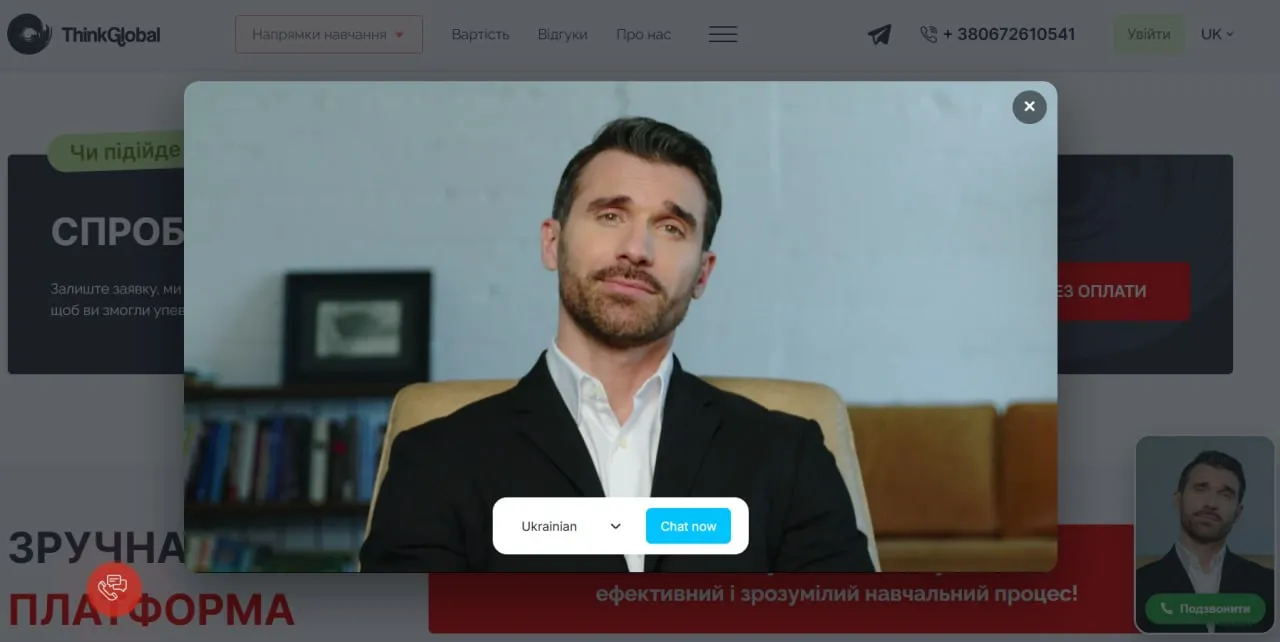
The school’s digital services are also expanding to include families. The website features an AI assistant: communication takes place via video call, with the avatar responding vocally, pausing appropriately, and reacting with facial expressions. Questions—regarding admission, the schedule, or tuition—can be asked via text or voice.

In July 2026, the free ThinkGlobal Parent App was released for iPhone and Android. It includes:
- Current grades, attendance, and test results in real time.
- Detailed reports on the child’s academic performance.
- Account balance and family bonuses.
- The ability to sign up for extra classes and quickly access the school’s lesson platform and chat.
Together with class schedules, this addresses most of the daily questions parents previously directed to the administration.
Learning Formats for the 2026/2027 Academic Year
Enrollment is open for students in grades 1–11; students can study from any region of Ukraine or from abroad. Educational certificates follow the state standard, and the curriculum is based on math, English, and Ukrainian.
A personal advisor helps you choose the right format, and if needed, it can be changed even in the middle of the school year.
Questions Parents Ask Most Often
Does the lesson analysis affect my child’s grades? No. The algorithm evaluates how the lesson is structured, while the teacher assigns grades based on the student’s work.
How do the results of the online school compare to those of in-person schools? According to data from the Ukrainian Center for Educational Quality Assessment (UCEQA), based on the results of the 2025 National Multidisciplinary Test (NMT), ThinkGlobal graduates achieved the highest average score in math among distance learning schools, and in English, ThinkGlobal ranked among the top 5 schools in all of Ukraine.
Where is automation in education headed?
Using an algorithm to monitor lesson standards is primarily about streamlining routine tasks: curriculum specialists receive data rather than subjective impressions, and parents can observe the process directly without intermediaries. Here, technology doesn’t replace the teacher; rather, it removes the uncertainty surrounding how a typical school day unfolded.




