
The Perseid meteor shower is approaching Earth
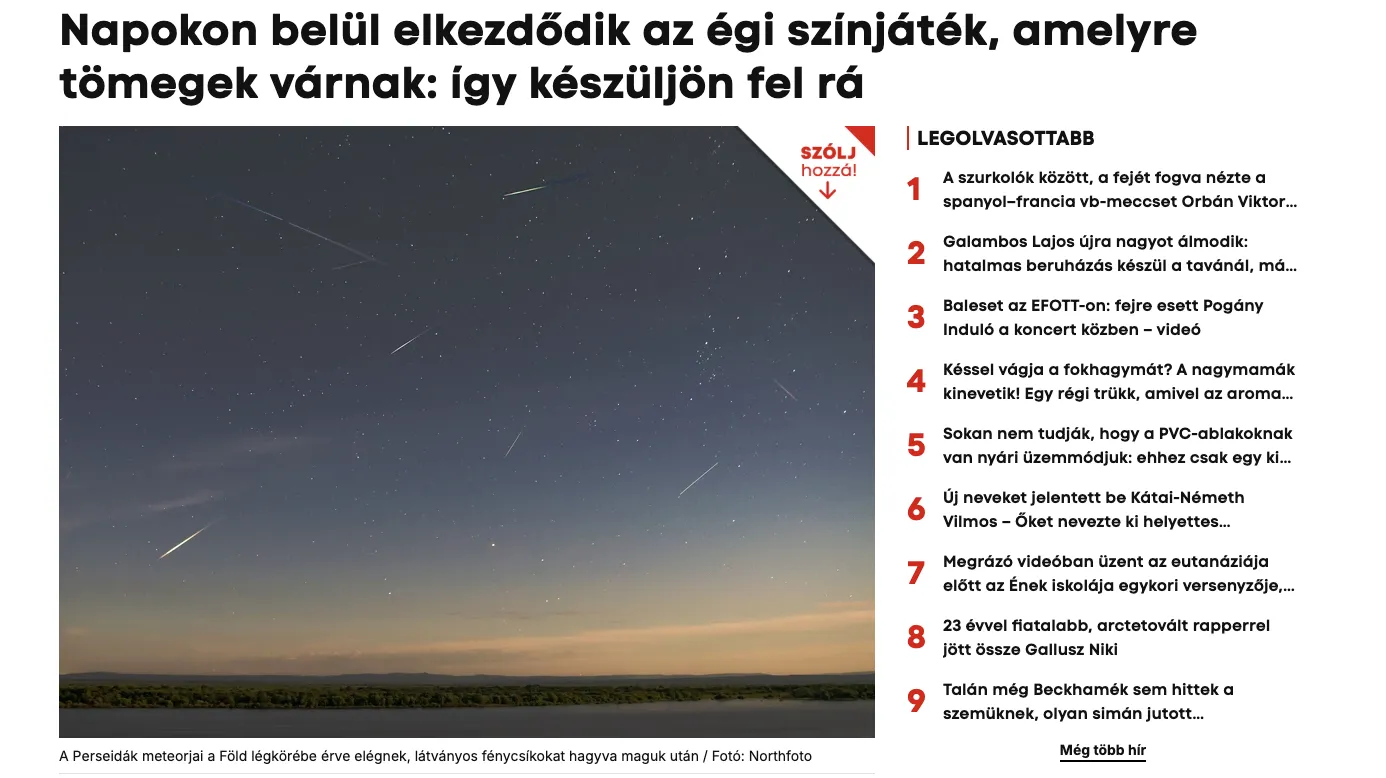
In the coming days, residents of Ukraine and other countries will be able to witness one of the most spectacular meteor showers of the year—the Perseids. Astronomers have already identified the period when the shower’s activity will be at its peak and viewing conditions will be optimal.
In the coming days, the annual Perseid meteor shower—one of the brightest and most popular meteor showers—will begin in the night sky. It can be observed from July 17 through August 24, with peak activity expected on August 12–13. During this time, under favorable conditions, up to 80 meteors per hour can be seen.
The Perseids occur when Earth passes through a trail of dust and tiny particles left behind by Comet 109P/Swift–Tuttle. Upon entering the atmosphere, these particles burn up, leaving bright trails of light. Most of them are about the size of a grain of sand, but occasionally larger fragments appear that burn up especially brightly.
The name of the meteor shower is associated with the constellation Perseus, from which, to observers, the meteors appear to originate. In reality, this is merely an optical illusion.
You won’t need a telescope or binoculars to observe the shower—just find a spot away from city lights with an unobstructed view of the sky. The best time to watch the meteor shower is late at night or in the early morning, when the constellation Perseus rises higher above the horizon. To make your viewing more comfortable, bring warm clothes, a comfortable recliner or blanket, and a red-light flashlight, which won’t interfere with your eyes’ adaptation to the dark.
Bright moonlight can interfere with viewing, so the best nights are those when the Moon isn’t too bright in the sky.
The Perseids are of interest not only to astronomy enthusiasts but also to scientists. Observing the meteor shower helps researchers study its activity, the properties of the particles, and changes related to the parent comet.
The main feature of the Perseids is their unpredictability. You can never know in advance exactly when a particularly bright meteor or a fiery fireball will streak across the sky. If the weather turns out to be unfavorable on the night of the peak, don’t be disappointed: the stream remains highly active for several more days, so there’s still a chance to see a beautiful meteor shower.
Source: Blikk
As a reminder, astronauts have taken X-ray images of the human body in space for the first time.
Earlier, the NASA administrator visited Baikonur for the first time in eight years.
Prior to that, the U.S. Federal Aviation Administration (FAA) authorized SpaceX to resume Starship test flights following an investigation into the causes of the failure during the May launch of Starship V3.


