

Servers in Orbit: Why Google and SpaceX Want to Move the Internet into Space
19 May 2026 12:30Imagine that right now, somewhere above your head, a satellite is flying through space. But inside it isn’t a camera or an antenna—it’s a computer. One as powerful as an entire server room. It processes requests, stores data, and works with AI—all while floating in space.
This is exactly the future that Google and SpaceX are preparing. Recently, The Wall Street Journal reported that the companies are in talks to launch orbital data centers in space. The deal hasn’t been signed yet, and the details remain unknown. However, the very fact that negotiations are underway between two of the planet’s biggest tech players is already changing our understanding of where humanity’s digital infrastructure will exist.
What is a data center, and why does it suddenly need to be in space?
Every time you Google something, watch YouTube, use Gmail, or ask ChatGPT to write a letter—somewhere on the planet, a server springs to life. Typically, servers are housed in massive facilities filled with thousands of computers running around the clock. This is what a data center is—the heart of the modern internet. There are thousands of such buildings around the world. Google alone officially has over 20 large campuses worldwide. They cover an area the size of stadiums, consume as much electricity as an entire city, and require tons of water to cool the servers.
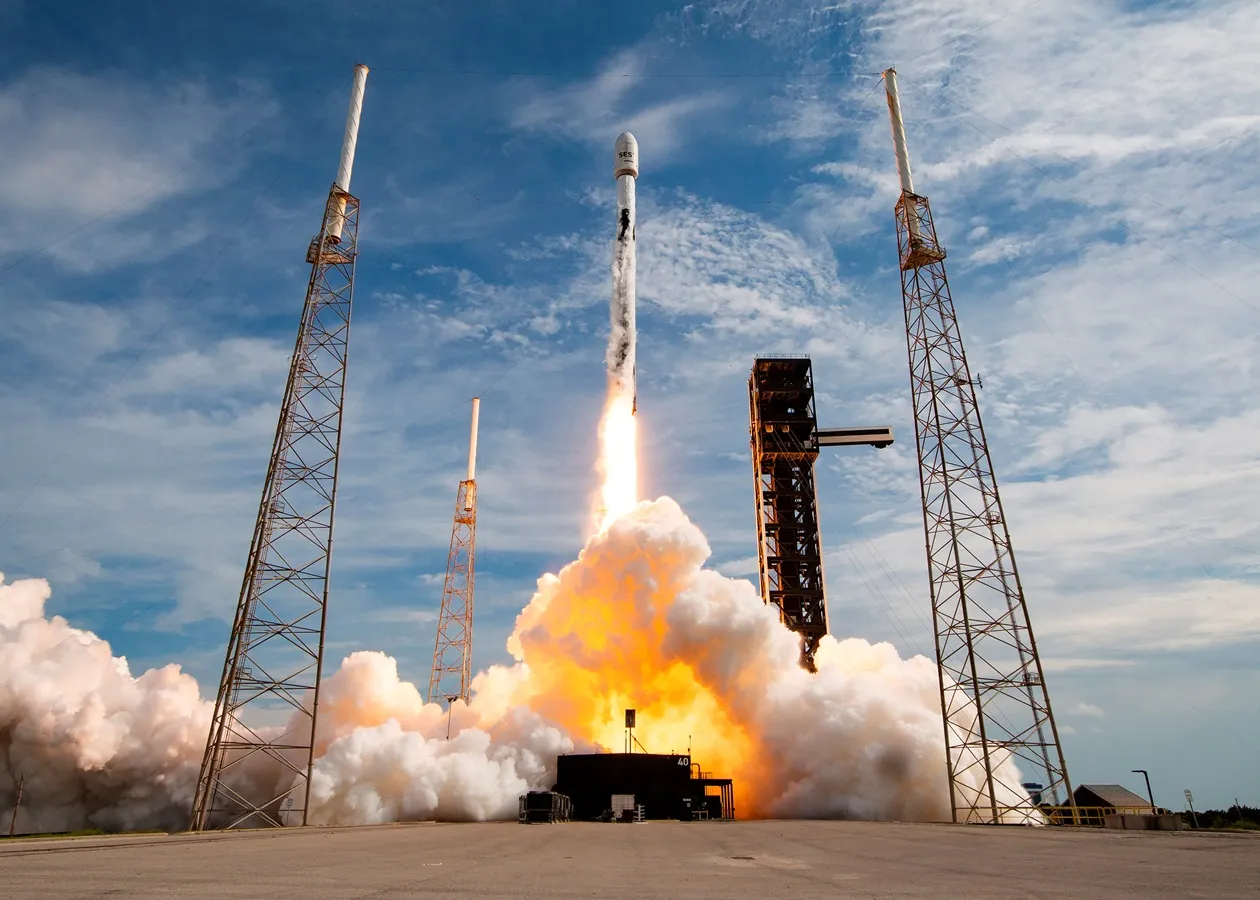
Now imagine that all of this could be moved into orbit. A satellite server orbits the Earth, powered by solar panels, and handles requests from anywhere on the planet without a single wire. This is exactly why Google is developing the Suncatcher project. Its goal is to launch a swarm of 81 solar-powered satellites, each equipped with powerful TPU AI processors. The satellites will be built by Planet Labs, and Google is in talks with several launch providers to get them into orbit—with SpaceX among the top contenders.

Why is this even necessary?
The short answer is artificial intelligence.
AI systems (chatbots, image generators, recognition systems, medical algorithms) require enormous computing power. Every time you chat with ChatGPT or ask AI to generate an image, the data center consumes as much energy as several dozen users would use for regular search queries. Moreover, this demand is growing daily, as companies can’t keep up with building new data centers to meet all user needs.
It’s also important to understand that:
We are running out of free space on Earth. Building a data center takes years of approvals and uses thousands of hectares of land, power grids, and water pipes. In many cases, residents of various countries strongly oppose such construction. In just a few months of 2025, U.S. residents blocked or delayed projects worth $98 billion. People do not want to live next to industrial facilities that hum around the clock and cause electricity bills to skyrocket.
Water and heat are serious problems. A single large data center consumes about 2 million liters of water per day. That would be enough for 6,500 households. In space, water isn’t needed, as heat will be dissipated through special radiators. However, this doesn’t simplify the task: cooling orbital servers remains one of the project’s main engineering challenges.
Global coverage. A satellite in orbit can cover any point on Earth without undersea cables or ground infrastructure. For countries where internet is unstable or nonexistent, this is a key advantage. And for Ukraine, where parts of the frontline territories remain without stable internet coverage, this is extremely important.
SpaceX’s business logic. The company is preparing for an IPO (initial public offering) in the summer of 2026 with an announced valuation of $1.75 trillion. Orbital data centers are a central element of its investment strategy. Musk positions space servers as the next major market after Starlink.

How this could benefit more than just corporations
At first glance, this seems like a story about billionaires and their ambitions. However, orbital data centers could transform the digital lives of ordinary people. Of course, if the technology works.
A data center in orbit won’t be flooded, destroyed by an earthquake, or hit by an enemy missile. Its operation will be more stable than any ground-based facility. If space-based solar power fuels the servers and the surplus is transmitted to Earth, it will transform the entire energy landscape of the digital industry. What’s more, several companies are already working on this.
But there is a “but”
For now, this is more of a dream than a plan.
In its IPO documents, SpaceX itself acknowledged that orbital AI infrastructure may never become commercially viable. And this is not surprising, since launching a single server into space costs significantly more than installing it in a data center on Earth. Until the cost of launches drops significantly, companies are unlikely to go for it.
The environmental issue stands apart. Millions of satellites pose the risk of the so-called Kessler syndrome. Space debris begins to collide in a cascade, rendering the orbit unusable. The U.S. regulator, the FCC, already views this as a real threat.
Nevertheless, the very fact that Google and SpaceX are sitting at the negotiating table sends a signal. Not that tomorrow your YouTube will be streaming from space. But that the line between terrestrial and space infrastructure is gradually blurring. The next decade will show whether orbit will become a new home for humanity’s data.


