
Astronomers have discovered a strange object at the boundary between a star and a black hole
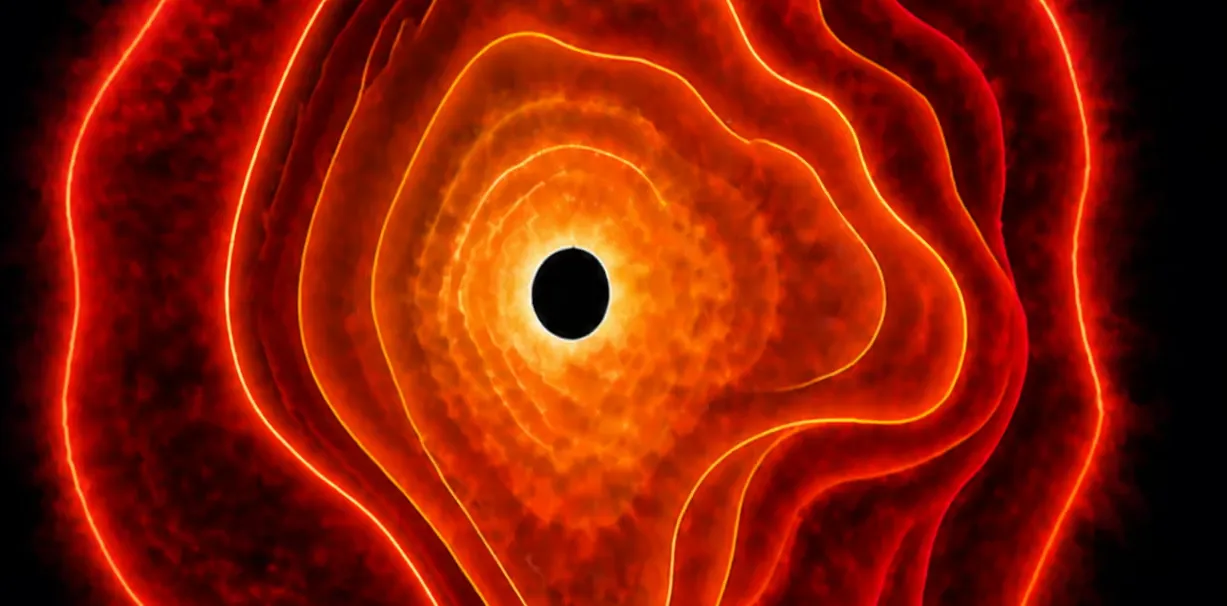
Astronomers have discovered an unusual celestial object in the early universe that exhibits characteristics of both a star and a black hole. It has been named MoM-BH*-1, emits a bright red light, and may be comparable in size to the entire Solar System.
An international team of astronomers announced the discovery of a new type of celestial object, which they have dubbed a “star-black hole.” Researchers spotted it in images of the early universe taken by NASA’s James Webb Space Telescope. The object has been named MoM-BH-1*. It is located in the direction of the constellation Cetus, billions of light-years from Earth. According to scientists’ estimates, MoM-BH-1* formed approximately 660 million years after the Big Bang. In other words, the telescope has effectively allowed astronomers to glimpse a very early stage in the universe’s history.
Initially, the researchers were searching for the most distant galaxies. To do so, they analyzed images from the James Webb Space Telescope. Previously, the team had already discovered the galaxy MoM-z14, which formed approximately 280 million years after the Big Bang. While further studying the archived images, the astronomers noticed another object. It was a very bright red spot that immediately stood out among the other celestial objects.
Why the object surprised scientists
MoM-BH*-1 may resemble a giant star in appearance. But its radiation does not fit the usual picture of how stars behave. According to the researchers’ calculations, the object emits approximately 100 billion times more energy than any known star is capable of producing. With that much power, it bears a much closer resemblance to a black hole. “We have discovered a new type of astrophysical object—a ‘star-black hole,’” said Dr. Rogan Naidu, who conducted the research at the Kavli Institute for Astrophysics and Space Research at the Massachusetts Institute of Technology.
According to him, the object combines properties that are not usually found together. “It emits light with an energy typically associated with black holes, but at the same time exhibits characteristics traditionally associated with stars,” explained Naidu.
Another unusual feature is the object’s color. Almost all of its light has a red hue, and below a certain wavelength, it abruptly disappears. “Its light is almost entirely red and abruptly disappears below a certain wavelength. This is so unusual that there is nothing like it among any known class of objects,” said the scientist.
What Might Be Hidden Inside
To understand the nature of MoM-BH*-1, the researchers conducted computer simulations. These helped test various scenarios for what might be producing such intense radiation. One of the leading theories is that there is a black hole at the object’s center. It may be surrounded by an extremely dense and hot shell of gas.
It is this gas shell that may alter the appearance of the radiation. From a distance, the object then resembles a large star, although the main source of energy inside may be a process associated with the black hole.
In other words, we may be looking at a unique combination of two cosmic phenomena. On the one hand, it has the appearance and some characteristics of a star; on the other, it emits extremely powerful radiation, which is more typical of black holes. That is precisely why scientists have coined the term “star-black hole.”
An Object from the Early Universe
It is particularly significant that MoM-BH*-1 existed in a very young universe. It is estimated to have formed approximately 660 million years after the Big Bang. This means that its light has been traveling toward Earth for billions of years. The James Webb Space Telescope makes it possible to observe such distant objects precisely because it can detect very faint infrared radiation from the early stages of the universe’s history.
For astronomers, this is important not only because of the discovery itself. Such objects can help us understand how the first massive black holes formed in the early universe. Astronomers have long been trying to explain how some black holes were able to grow to enormous sizes in a relatively short time, by cosmic standards. MoM-BH*-1 may provide new clues about this process.
The Reddest Object in Webb’s Images
Researchers also noted the unusual color of MoM-BH*-1. In their paper, published in the scientific journal *Nature*, they describe it as the reddest object found in the James Webb Space Telescope’s image archive. At first, astronomers did not expect to see anything like this. The object did not fit the usual characteristics of known stars or galaxies.
That is why the team began testing various explanations. Simulations showed that the model involving a giant star generating energy through nuclear fusion does not best explain all the observations. Instead, a model featuring a black hole surrounded by dense gas better matches what the researchers observed.
However, this does not yet mean that scientists have definitively proven the existence of an entirely new class of cosmic objects. Additional observations and research are needed to confirm this hypothesis.
Why the Discovery Is Important
If further observations confirm the proposed model, MoM-BH*-1 could help us better understand the mysteries of the early universe. In particular, scientists are interested in how black holes were able to accrete mass so rapidly after the formation of the first stars and galaxies. The unusual gas envelope surrounding the black hole could be part of this process.
Furthermore, the discovery shows just how many mysteries are still hidden in images of the distant universe. The James Webb Space Telescope is already finding galaxies and objects that existed hundreds of millions of years after the Big Bang, and some of them do not fit into the usual classifications. MoM-BH*-1 is precisely such a case. It looks like a star, but it emits energy that is difficult to explain as coming from an ordinary star.
Now, astronomers want to gather more data on this object and verify whether they are indeed looking at a new type of cosmic system. If this is confirmed, the “star-black hole” could become another important piece in understanding how the early universe formed. This is reported by The Guardian.
Rumors are circulating on social media about the alleged “end of the world” on August 12, 2026, when three astronomical events are expected to occur simultaneously. Scientists have urged people not to panic, emphasizing that these cosmic events pose no threat to Earth.


