
Researchers propose explanation for Enceladus ice’s chemical diversity — ScienceDaily
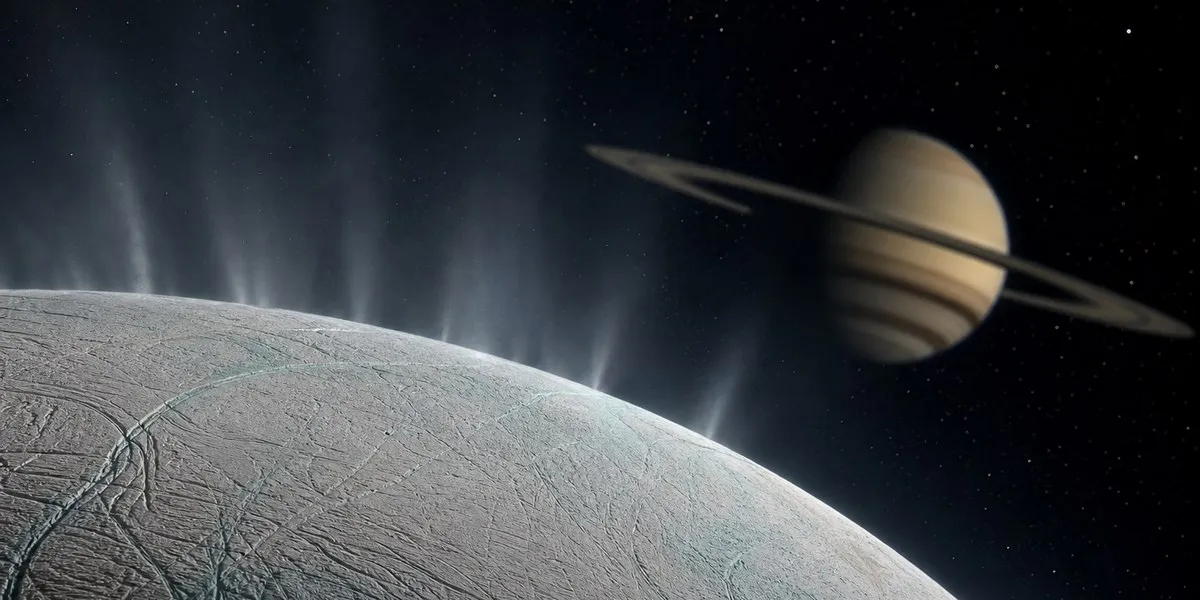
An international group of researchers has proposed an explanation for the unusually diverse chemical composition of ice particles ejected from the interior of Saturn’s moon Enceladus. Experiments showed that large droplets of ocean water can freeze slowly in cracks in the icy crust, separating salts into distinct regions, and later break apart into small fragments.
ScienceDaily reports on the study’s findings. Beneath Enceladus’s ice shell lies a global ocean, while near its south pole, cracks eject water vapor and ice particles into space. These particles replenish Saturn’s E ring and make it possible to study the composition of the hidden ocean without drilling through the ice.
Cassini spacecraft data
From 2004 to 2017, the cosmic dust analyzer aboard NASA’s Cassini spacecraft measured the composition of individual ice particles in the E ring. The team led by Professor Frank Postberg of the Free University of Berlin analyzed 961 mass spectra of salty type 3 particles.
Particles that could have originated from the same ocean differed significantly in composition. Some contained more sodium chloride, while others contained carbonates, phosphates, or potassium chloride. At the same time, chloride and carbonate were rarely found together in a single sodium-rich particle.
More current news is available on the UA.News Telegram channel Telegram.
Slow freezing in cracks
Scientists from the Institute of Science Tokyo, including Professor Yasuhito Sekine, recreated in the laboratory droplets containing the main salts believed to be present in Enceladus’s ocean. In droplets about 200 micrometers in diameter, the salts became distributed across different regions during relatively slow freezing, at a rate of about 10 K per minute or less. With faster cooling, the components remained much more uniformly mixed.
The researchers suggest that droplets ranging in size from tens to hundreds of micrometers initially move slowly through deeper sections of vent channels and freeze. Closer to the surface, the gas flow accelerates, and the frozen droplets may strike the walls of narrow icy channels and break apart. Each fragment may originate from a separate salt-enriched region of the original droplet.
According to the authors’ assessment, this mechanism may also concentrate organic substances in individual ice grains. This could potentially make it easier for future missions to search for compounds that are present in low concentrations in Enceladus’s ocean, as well as to study conditions for prebiotic chemistry.




