
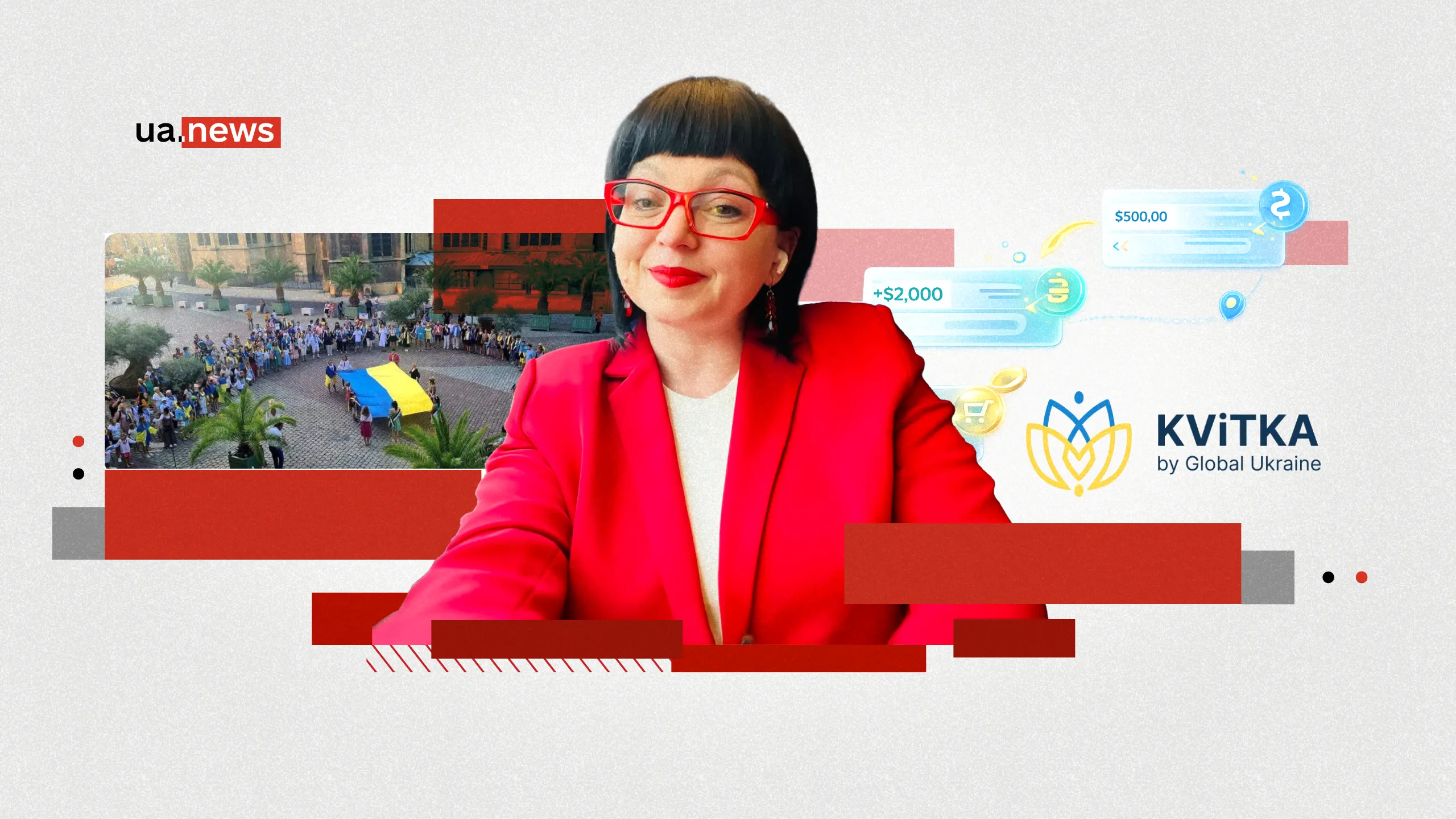
The Global Ukraine Foundation brings together hundreds of communities in dozens of countries around the world, develops educational and cultural projects, supports Ukrainian businesses, and builds new financial infrastructure for Ukrainians in Europe. The Foundation’s experience demonstrates how the Ukrainian diaspora is evolving into a global network of influence, partnership, and support for our country.
How can the experience of living abroad help Ukraine achieve real transformation after the war? And why does Ukrainian business in Europe need its own financial infrastructure?
We discuss this in the second part of our interview with Violeta Moskal, a Ph.D. from the University of Lorraine, an expert in international development, and the founder of the Global Ukraine Foundation. She explains how Ukrainians are forming a new type of networked community, why entrepreneurship is key to community development, and how the neobank KViTKA has become a financial platform for the Ukrainian diaspora and businesses in Europe. Below are Violet Moskalu’s direct quotes.
On the Global Ukraine ecosystem
At the Global Ukraine Foundation, we once counted several hundred communities with whom we were in constant contact across 86 different countries. But we didn’t structure this as an umbrella organization that manages, coordinates, or dictates. We have a horizontal, network-based structure.
We work with world-renowned clubs such as Rotary International and others. To study their experience and explore how decentralized organizational forms, through blockchains and smart contracts, could enable better coordination of efforts and the development of global networked-horizontal structures.
In our projects, we focus on the information and advocacy aspect, where our participation is constantly needed. We have a research and education division. We devote significant attention and resources to working with youth, primarily through university education. We also host webinars for schools in Ukrainian communities abroad: they face their own challenges, and teachers share their experiences with one another.
Another important division is the financial and economic one. We support the global expansion of Ukrainian businesses. The Global Ukraine Foundation team founded the first Ukrainian diaspora neobank in Europe, called KViTKA.
KViTKA by Global Ukraine
As we studied the experience of the Ukrainian diaspora, a key question always arose: how did Ukrainians in the U.S. and Canada manage to build such a great financial ecosystem as credit unions? They have been developing since the 1950s, are present in every state, and hold billions of dollars in assets. It’s a truly remarkable institution and resource. Consequently, the diaspora there can support Ukrainian churches, schools, and senior centers—developing everything they need. But in European countries, there were no such projects.
Since the 2000s, when I came to study in Europe, I’ve wondered: why is that? And I came to the conclusion that it all comes down to the development of entrepreneurship. We need to foster an entrepreneurial spirit and mindset both in Ukraine and among the diaspora.
The KViTKA financial platform solves the problem of accessing financial accounts without the need to register a legal entity in EU countries; it assists with multi-currency and international payments; it is directly connected to crypto infrastructure and operates as a crypto-fiat platform using modern technologies. Our mission is to ensure that cross-border payments for Ukrainian businesses are processed quickly and without restrictions.
It is clear that corruption scandals negatively impact the reputation of Ukrainian businesses. This underscores the importance of the rule of law. The lack of effective reforms in the country hinders Ukrainians even when they conduct business abroad. Ukrainian businesses are viewed through the lens of corruption, which is why they are often denied the ability to open accounts and face obstacles in their operations.
At Global Ukraine, our goal is to create a robust financial platform for the Ukrainian diaspora in Europe, which, together with Ukrainian banks and institutions, will find solutions to the problems faced by Ukrainian entrepreneurs in Europe.
How Global Ukraine supports the expansion of Ukrainian business
We focus on young people with an entrepreneurial spirit. We are currently actively preparing for a major Ukrainian event in Paris—Ukraine Tech Night, which will take place on June 16. Delegations of Ukrainian startups will participate in two leading technology exhibitions: Eurosatory for defense technologies and Viva Technology for civilian innovations.
We focus more on startups: we are joining forces to create a platform in Paris that will serve as a foothold for such projects in France and other Western European countries. We are open to collaborating with any Ukrainian business that needs a Ukraine-friendly financial and banking platform in Europe. Our team will help companies find the most effective solutions so they can focus on growth rather than wasting resources on complex bureaucratic procedures.
Working with Human Capital
Since its inception, the Global Ukrainians Forum has actively engaged with communities in Kyiv, Paris, New York, and Tel Aviv. Before the pandemic, we regularly organized such meetings at least twice a year.
This approach has not changed even after the full-scale invasion. After all, Ukrainian society still lacks a balance between progressive communities striving for deep reforms and the rule of law, and those who hinder these processes. This balance of power, unfortunately, does not favor progressive groups. Volunteer movements and activists constantly lack the resources to implement their initiatives.
We envision Ukraine as an extraterritorial state, following the example of Israel, where they have learned to find their people all over the world and enlist them in a collective effort. Israeli citizens are not prohibited from leaving the country. But if war breaks out, the government calls on them to return to defend the homeland—and they do so. In Ukraine, however, a certain ban on leaving the country is still in effect. Therefore, we need to work through this issue mentally.
I view very positively those who decide to go abroad for a year, two, five, or even ten years, understanding that the experience gained can be useful for future assistance and reforms. Provided that appropriate conditions are created so that intelligent and competent Ukrainians can contribute to changes at the local, regional, and national levels. I am confident that a significant portion of globalized Ukrainians will be happy to return and dedicate several years to reforming and radically transforming the country.
Right from the start, we involve participants in educational programs in the mission of ambassadorship—to be global Ukrainians who represent Ukraine in the world. Through examples and projects, we demonstrate what cultural, business, and scientific-educational diplomacy entails. If young people who leave the country take this to heart and gain experience, it increases the likelihood that they will return with new knowledge and a readiness to implement change.
How can Ukraine bring back refugees from Europe
I assume this will depend on market conditions. Businesses involved in reconstruction projects, funded by Western partners or private investors, will come. To attract specialists for reconstruction, employers will have to offer higher salaries. Accordingly, rising wages will become a significant incentive to return to Ukraine. Not all Ukrainians integrate easily in Europe. They will simply return and work.
The second aspect is the interest of migrants from other countries, such as post-Soviet nations. This raises the question of tolerance: are we ready to accept them? It’s easy to criticize, say, France, Italy, or another European country that doesn’t accept migrants. But is Ukraine ready to accept them?
That is why I see Ukrainians as global. Global in terms of mindset, tolerance, the ability to think and do business in Eastern and Western Europe, and to cooperate with Africa, Latin America, and the whole world. The more we travel and welcome people from other nations, the more we will be able to develop our global outlook.
New Initiatives by the Global Ukraine Foundation
Our main task right now is to provide resources for educational, cultural, and humanitarian initiatives by creating a financial infrastructure. We are addressing this through the neobank KViTKA by Global Ukraine and are focusing on developing this financial infrastructure. The Foundation is the founder of this platform and directs half of its profits toward important social projects.
The KViTKA neobank is a fintech with a social mission. When presenting this platform, we always emphasize this. We are confident that the more we foster an entrepreneurial mindset among those involved in community initiatives, the better.
In France, we are already implementing an interesting project: a solidarity art-boutique-café in Metz, in Lorraine, where I live. There, students introduce visitors to Ukrainian brands, delicious Ukrainian cuisine, or Petrykivka painting during master classes. We are looking for a business model that will make this project profitable. So that in the future we can introduce this format to other communities and show how it can generate around 1,000 euros per month. That means it could amount to 12,000 euros a year. So, we don’t necessarily have to ask local authorities for these funds—we can earn them ourselves.
When we first started thinking about creating the Global Ukraine Foundation, I looked into the experience of similar institutions, specifically researching the operational models of the Rotary Club or the Alliance Française network. I noticed that the Alliance Française sells French language courses. This covers about 80% of the budget, as funding from the French Ministry of Foreign Affairs or the embassy is minimal. I thought that the Ukrainian language might not be as appealing to foreigners, but Ukrainian cuisine, national brands, and handicrafts—particularly embroidered shirts—might spark their interest. That’s why we’re working on this concept.
By the way, our art boutique is called KViTKA, just like the neobank. Perhaps we will merge the financial platform with the marketplace into a single Ukrainian project for further development.
Read also:
Ukraine has already become part of Europe: Global Ukraine founder Violeta Moskal on the power of the diaspora, new democracy, and countering Russian myths


