
In the Urals, Russia has modernized a secret bunker for its nuclear command
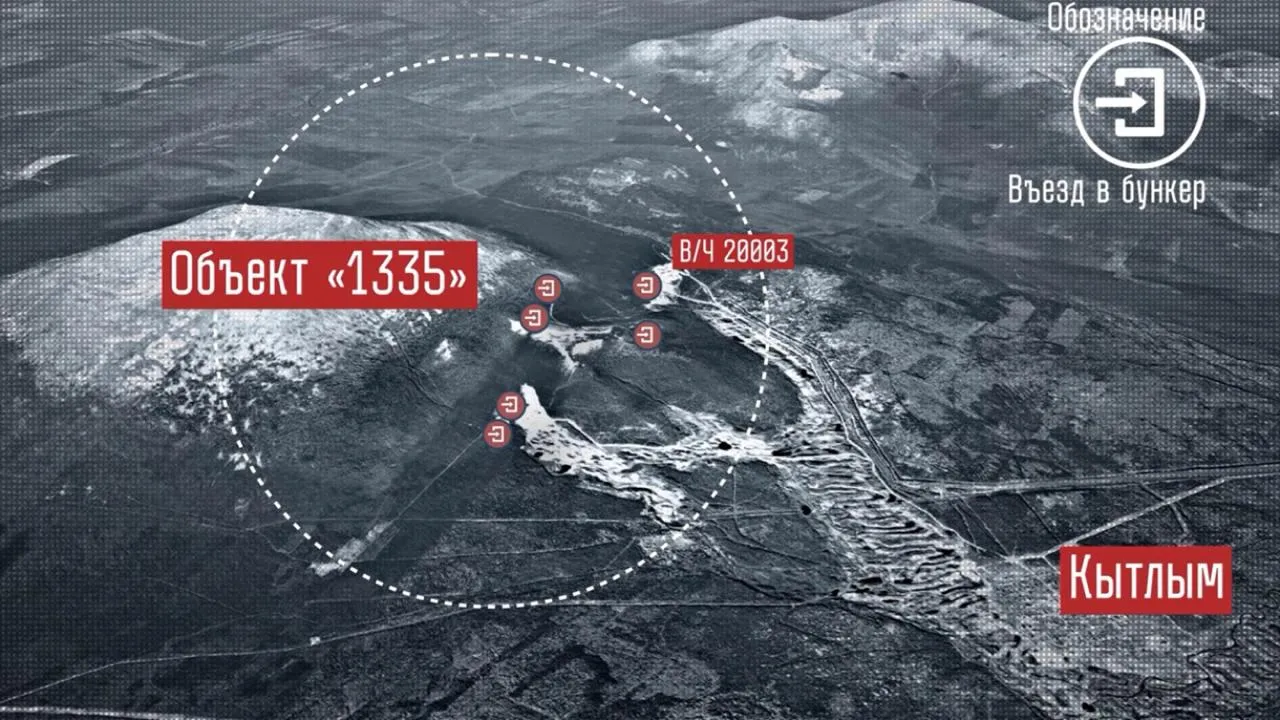
In the Northern Urals, Russia has modernized a massive secret facility called “Grot,” hidden inside Mount Kosvinsky Kamen. Investigators from the Dossier Center, Danwatch, and The Sunday Times link it to the “Perimeter” backup command-and-control system for nuclear forces, known in the West as the “Dead Hand.” Procurement data reveals the scale of the work: at least 22,000 metric tons of steel and more than 56,000 metric tons of cement were purchased for the facility.
In the north of the Sverdlovsk region, Russia has been building a massive military complex inside Mount Kosvinsky Kamen for decades. Its code name is “Grot,” and its official facility number is 1335. The Dossier Center, the Danish investigative publication Danwatch, and The Sunday Times have reported on it. Journalists examined documents related to construction, government procurement, blueprints, and satellite imagery, and spoke with people connected to the facility.
According to their findings, “Grot” is one of the key nodes of the “Perimeter” system—a backup command-and-control system for strategic nuclear forces. In the West, it is often referred to as the “Dead Hand.” The concept behind the system is simple. If Russia suffers a nuclear strike and the country’s leadership, command posts, and conventional communication channels are destroyed, “Perimeter” is designed to ensure that a command for a retaliatory strike can be transmitted using the surviving nuclear forces.
It is important, however, not to overstate the degree of automation in this system. According to “Dossier,” the original “Perimeter” system required human involvement in making the final decision. The system could automate the transmission of the command, but the final decision was to remain with the officers on duty.
At the same time, retired Major General Viktor Khalin, who participated in the creation of “Perimeter” back in the Soviet era, asserts that after modernization, the system gained the ability to operate in automatic mode as well. The investigation contains no independent confirmation that Russia has indeed switched the system to fully automated decision-making regarding a nuclear strike.
What Is Known About “Grot”
The complex itself is located inside Kosvinsky Kamen Mountain. According to investigators, the rock contains underground chambers, tunnels, radio centers, and communication and life-support systems. The mountain itself was of great importance for this location. As early as the 1980s, Soviet specialists studied its rock formations, particularly their ability to transmit radio signals at the required frequencies. Documents referred to this as the massif’s “unique radio transparency.”
Construction of the facility began as early as 1982. However, the work did not end with the collapse of the Soviet Union. Russia continued to develop the complex after 1991. According to Khalin, on May 5, 2005, Vladimir Putin signed a secret decree establishing a new command element for “Perimeter.” Khalin claims that between 2005 and 2010 he participated in its modernization, and by 2010 the new system had been tested and deployed at Facility 1335.
A military facility gradually expanded alongside the mountain. By 2020, a separate military town called Kitlim had emerged there. Roads and a secured area lead directly to the mountain.
How Much Was Built in Total
The scale of the work is evident from public procurement documents. Danwatch analyzed nearly 2.5 million Russian military tenders and found thousands of procurements related to Facility 1335 between 2018 and August 2024. Among the items purchased were, at a minimum:
22,000 metric tons of steel;
56,500 metric tons of cement;
170 kilometers of steel pipes;
600 kilometers of cable;
14,000 light bulbs;
30 transformers.
For comparison, according to journalists’ estimates, the amount of steel would be enough to build roughly three Eiffel Towers. The amount of cement is comparable to the construction of a large 30–40-story high-rise.
The Moscow Times, citing this investigation, also notes that the materials used would be enough to build two large Moscow Metro stations along with their adjacent tunnels. In other words, this is not a small command post, but a massive underground complex, a significant portion of which is hidden beneath hundreds of meters of rock.
Russia May Have Reinforced the “Dead Hand” Again
It is the modernization efforts of recent years that have piqued investigators’ interest the most. Danwatch reports that, starting in 2018, the Russian military began actively purchasing materials for the facility. The documents reveal a large-scale renovation and reinforcement of the underground complex.
Journalists also found posts by Russian military veterans discussing the modernization of “Perimeter.” Khalin claimed that the system had been brought up to a new technical standard and its capabilities enhanced, in particular through new command posts and space-based communications. After reviewing the materials, American nuclear security expert Jeffrey Lewis stated that he sees no reason to consider Facility 1335 as anything other than part of “Perimeter.”
Former U.S. Deputy Secretary of Defense Andy Weber also believes that the data found points to a modernization of the system. According to him, for the Kremlin, this could be a way to maintain the ability to respond even in the event of a large-scale attack on Russia’s command system.
Why does Russia need such a system?
“Perimeter” was developed back in the days of the Soviet Union, when Moscow and Washington were preparing for a possible nuclear conflict.
The purpose of the system was not to strike first, but to ensure a response even if the enemy attempted to destroy the country’s political and military leadership.
The system uses backup communication channels. According to “Dossier,” one of these is linked to so-called command missiles. These do not carry nuclear warheads but are designed to transmit an encrypted signal to missile units that have survived an attack.
For this reason, the protected command center inside the mountain is of particular importance. Even after strikes on ground infrastructure, it can remain a communication channel with part of the strategic forces.
That is precisely why Facility 1335 is protected by its depth, the mountain range, and a complex infrastructure system.
Why Is This Being Discussed Right Now?
The investigation comes amid a general strengthening of the nuclear component of the Russian armed forces. Danwatch notes that the modernization of “Grot” is taking place alongside a broader upgrade of Russia’s nuclear infrastructure. This involves the reconstruction and re-equipment of other facilities related to nuclear forces.
According to Tom Røset, an expert at the Norwegian Military College, the modernization of Facility 1335 is part of Russia’s overall strengthening of its nuclear forces against the backdrop of increasingly tense relations with the West. The facility itself is not new; it has existed for decades. What is new is the scale of its modernization, which has been traced through procurement documents.
Investigators reached out to the Kremlin and Vladimir Putin’s press secretary, Dmitry Peskov, for comment. As of publication, they had not received a response. Thus, this is not a “Putin bunker” recently built from scratch, but rather a long-standing secret complex that Russia continues to upgrade. It is linked to “Perimeter,” the backup command-and-control system for strategic nuclear forces, and the scale of the procurements indicates that Moscow is investing significant resources in the secure infrastructure of its nuclear command.




