
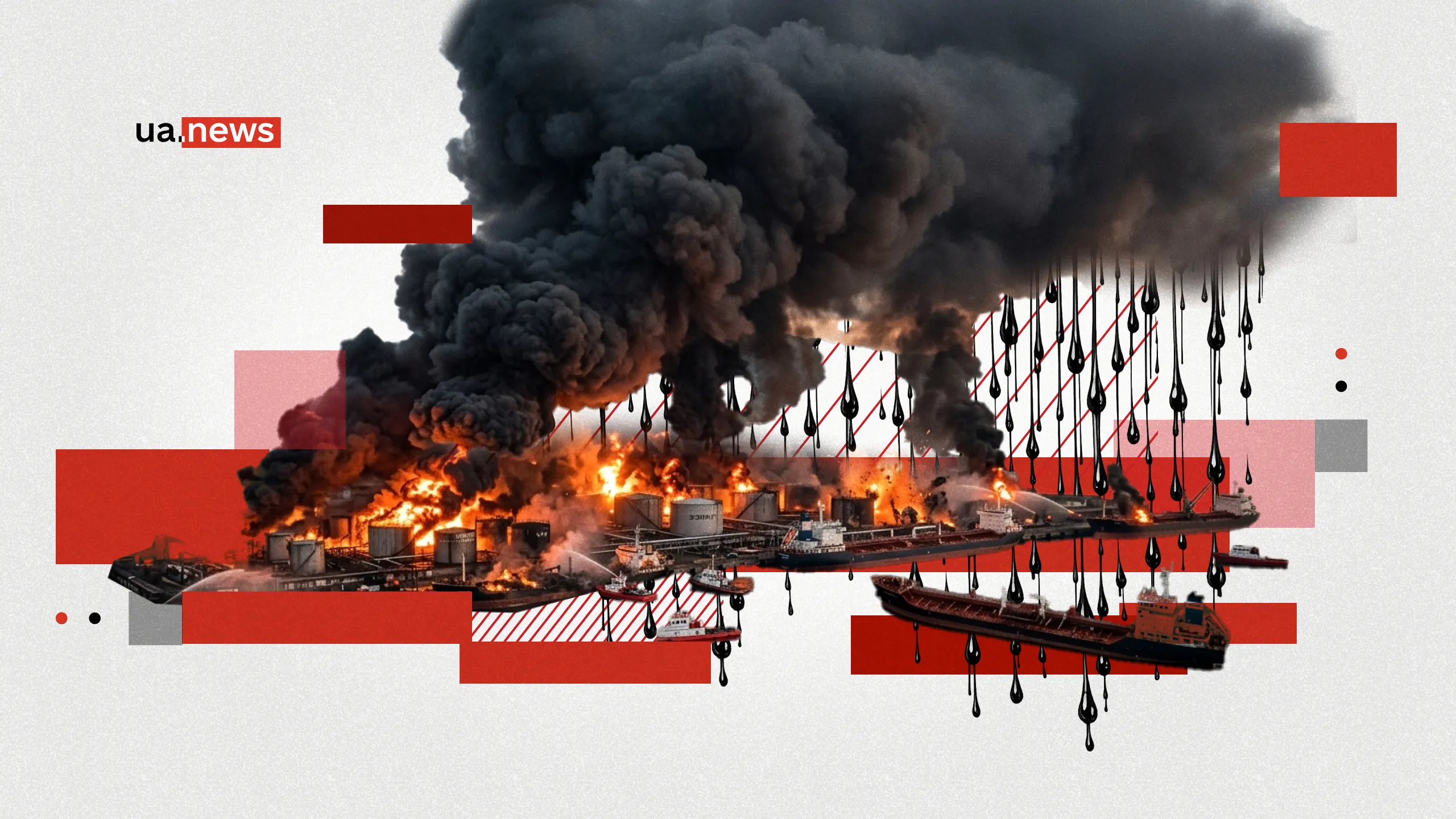
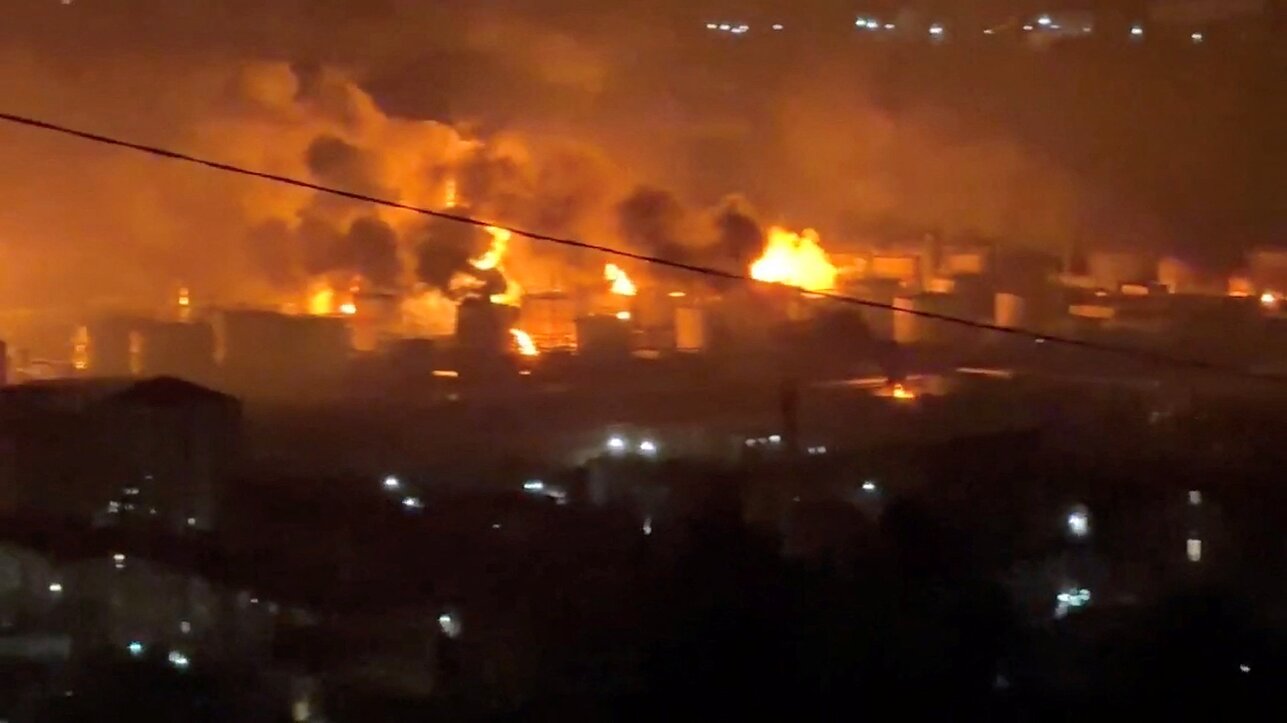
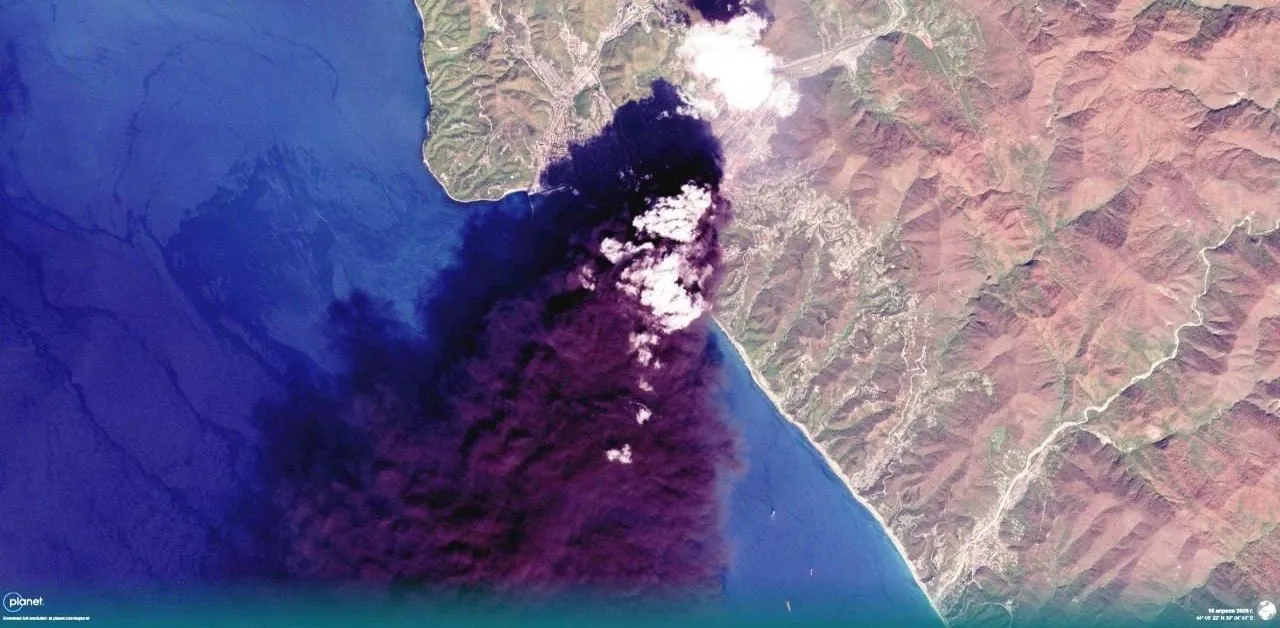
On the night of April 16, 2026, Ukrainian UAVs launched a large-scale strike on the Tuapse Oil Refinery in Russia. The fire could not be extinguished for nearly four days, turning the situation into a man-made disaster. Thick black smoke stretched more than 300 kilometers along the Black Sea coast and reached the Stavropol Krai, becoming visible even from space. The fire also engulfed the tank farm, and residents of Tuapse reported an “oil rain”—oily droplets and dark residue formed by the condensation of petroleum product vapors. It seemed there could be no worse scenario for Russia, but just four days later, the Defense Forces delivered a second, even more powerful strike. As of now, the fire at the strategic facility has not yet been extinguished.
These events are not just another episode of the war, but a targeted campaign to destroy one of the most important logistics hubs of the Russian oil industry. To grasp the scale of what is happening, one must understand what the port and refinery in Tuapse actually mean for the Russian economy. This is not just one of many ports on the Black Sea, but a strategic facility that ranks among the top five largest seaports in Russia for the export of oil and petroleum products. The Tuapse refinery alone has a capacity of 12 million tons of oil per year, placing it among the top ten largest oil refineries in the Russian Federation.
It is precisely on this complex, which for a long time was considered a relatively safe rear area, that Ukrainian forces have focused their attention. Why did Tuapse become a priority target, what consequences do these attacks have for Russia’s export potential, and how does this affect the overall course of the economic war? UA.News political analyst Mykyta Trachuk, together with experts, examined the issue.
The Strategic Value of Tuapse: Why It’s More Than Just a Port
The Tuapse oil refinery complex is unique in its configuration. Unlike most other Russian refineries, which are largely focused on the domestic market, the Tuapse plant is 100% geared toward exports. This means that every ton of oil processed here is almost instantly converted into foreign exchange revenue, bypassing complex domestic logistics chains. The plant’s location directly on the coast allows for the direct loading of high-margin petroleum products—diesel fuel and gasoline—onto tankers moored at the port’s berths. This ensured an uninterrupted flow of foreign currency to the Kremlin.
In addition, Tuapse played a critical role as a compensator in the Russian Federation’s overall oil logistics system. Following a series of successful Ukrainian attacks on the port infrastructure in Novorossiysk, the throughput capacity of export facilities in this region has significantly decreased. It was the Tuapse Refinery, by taking in excess raw materials for processing, that allowed the system to be partially relieved and production to continue. The destruction of this hub leaves oil stuck in the pipelines, forcing Russian companies to cut production volumes, as there is simply nowhere to store the raw materials, and transporting them via alternative routes is too expensive and time-consuming.
For a long time, the Kremlin harbored the illusion that the port in Tuapse was a relatively safe point for oil exports. This perception was based on its considerable distance from the front lines. It was believed that Russian air defense forces could reliably protect this strategic facility here, and therefore, cargo flows—which were becoming increasingly vulnerable in other Black Sea ports—should be redirected here. However, the events of April 2026 completely shattered this myth. Ukrainian long-range drones demonstrated the ability not only to cover this distance but also to deliver precision, extremely destructive strikes against the most critical infrastructure elements, particularly the tank farm.

Why the Ukrainian Armed Forces are focusing on Tuapse right now
The concentration of Ukrainian strikes on Tuapse in April 2026 is a continuation of a campaign aimed at the systematic destruction of Russia’s oil logistics. Experts have repeatedly stated that disabling just 4–5 key terminals is sufficient to reduce Russian oil exports by 70–80%. This list includes, alongside the Baltic ports of Primorsk, Vysotsk, and Ust-Luga, two Black Sea ports: Sheskharis in Novorossiysk and Tuapse itself. The strikes on Tuapse are the implementation of this very concept. This indicates that the Ukrainian Armed Forces command is methodically destroying the entire logistics network that facilitates oil exports from Russia’s southern regions.
The choice of Tuapse as a priority target is driven by several factors. First, it is the aforementioned export specialization, which makes its loss particularly painful for foreign exchange earnings. Second, with Baltic ports already experiencing significant disruptions due to attacks and Novorossiysk partially paralyzed, Tuapse remained the last relatively stable major Black Sea outlet for Russian oil. Third, its location makes the facility an ideal target for demonstrating Ukraine’s ability to strike deep into enemy territory, which has not only an economic but also a psychological effect, undermining the sense of security in the Russian rear.
Economic consequences: how much is Russia losing
The consequences of the strikes on Tuapse for the Russian economy are already being felt, and in the long term, they may prove even more painful. Maritime oil exports from Russia in the spring of 2026 fell to their lowest levels since 2024. Following all the attacks on oil transshipment ports, approximately 40% of Russia’s export capacity has been put out of commission. This is an unprecedented drop that directly impacts foreign exchange earnings. Of course, it does not mean an immediate economic collapse of the Russian state—but as the saying goes, little strokes fell big oaks.
The scale of the destruction in Tuapse indicates that a quick resumption of operations at the refinery and port is not to be expected. The fire has been burning for a week now, and it has damaged not just individual tanks, but likely the entire system of pipelines, pumping stations, and berthing facilities. Even after the fire is finally extinguished, it will take months, and possibly years, to fully restore the infrastructure. This is because a significant portion of the equipment at such facilities is imported from countries that have imposed sanctions against Russia. Procuring and delivering replacements while circumventing sanctions is an expensive and time-consuming process that, moreover, does not guarantee the quality or compatibility of the equipment.
The ripple effect should also be taken into account. The shutdown of the Tuapse refinery means not only a loss of 12 million tons of processing capacity per year, but also the creation of a surplus of crude oil that has nowhere to be stored or transported. This forces Russian companies to reduce production, which, in turn, leads to a drop in budget revenues from mineral extraction taxes.
Beyond purely financial losses, the situation in Tuapse also has serious environmental and social consequences. Emissions from the combustion of petroleum products have led to significant air and water pollution in the region. In several areas of the city, concentrations of benzene, xylene, and soot have been recorded at 2–3 times the permissible levels. This creates additional social tension in the region.
Expert Opinion
Military expert Oleg Zhdanov is certain: after strikes like the one on Tuapse, pressure from Western partners will resume. They still cannot give up Russian oil.
“Although they are far more interested not in Tuapse, but in the Druzhba pipeline.” This is the area that will concern our partners far more. Because they receive oil primarily through this route. But I think the pressure will eventually ease, as Europe’s phase-out of oil and gas from Russia is already scheduled for 2027. We can expect that they will not so much resist us as try to persuade us not to do this. Although from the perspective of our defense capability, from the perspective of military expediency, we must only intensify such strikes. Until the front line wavers, we must continue to devastate Russia’s rear and economy. And when it begins to waver—these efforts will need to be doubled. This is, in essence, our only chance to win this war.
In general, our Western partners face a dilemma. On the one hand, they need this oil, and they’re asking us not to hit it so hard. But if they start blackmailing us with arms supplies or funding, Russian tanks will be on their doorstep tomorrow. I believe that by the fifth year of the war, we’ve already made this point clear to the Europeans. And it is very strange that the same Baltic countries are criticizing Zelenskyy’s words regarding the Russian threat. Perhaps they do not yet fully understand this,” noted Oleg Zhdanov.
In summary, the attacks on the port and oil refinery in Tuapse are a landmark event of the war. They demonstrate that Ukraine is implementing a “deep strike” strategy, methodically destroying critical infrastructure on which Russia’s ability to finance the war depends. Tuapse, long considered a relatively safe haven for oil exports, has become a burning symbol of vulnerability.
The scale of the destruction and the duration of the fire indicate that it will not be possible to quickly restore operations at this strategic hub. This means that in the coming months, and possibly years, Russian exports of oil and petroleum products will be more limited. The loss of 12 million tons of annual processing capacity, the destruction of port infrastructure, and the inability to quickly redirect flows to other terminals place an additional burden on the Russian oil industry.
In a broader context, the events in Tuapse are part of a systematic campaign to “knock out” Russian oil exports. If this trend continues and Ukrainian forces keep carrying out precision strikes on key terminals in the Black and Baltic Seas, Russia risks losing up to 70–80% of its maritime oil export capacity. This, in turn, will have a devastating impact on its budget, which is already under enormous strain due to the war.




