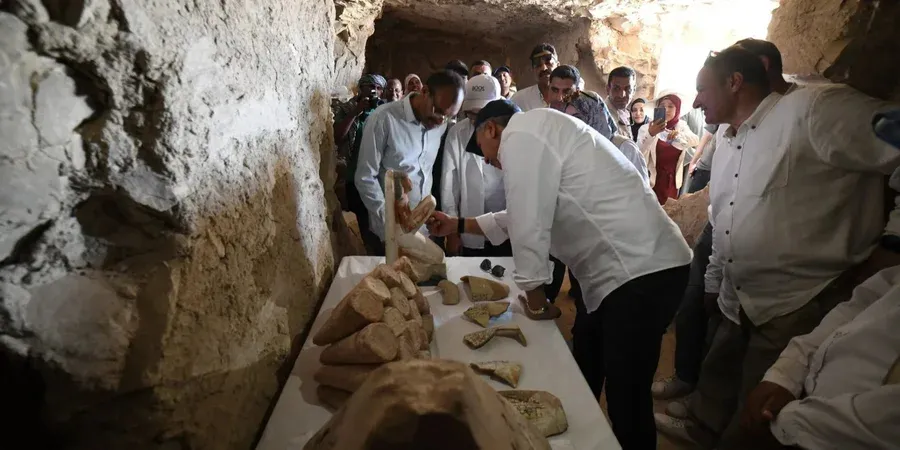
In Egypt, beneath layers of sand and ancient ruins, archaeologists have uncovered a veritable archive of the past, where dozens of mummified cats and painted sarcophagi have been preserved alongside human mummies, offering a new perspective on the life and beliefs of ancient Egyptian society, according to Heritage Daily.
Excavations in the Abu el-Naga area on the west bank of Luxor were conducted by a mission of Egypt’s Supreme Council of Antiquities, and it was here, in a burial shaft located in the courtyard of the Baki tomb, that a cache of ten wooden sarcophagi was discovered, covered with paintings and hieroglyphic inscriptions that have survived in surprisingly good condition.
Among them, researchers have identified several particularly valuable burials: four coffins dating to the Eighteenth Dynasty, including one belonging to a woman named Meret, who was a singer for the god Amun, and another to a priest of Badi-Amun associated with temple service, while the other sarcophagi are attributed to later historical periods.
Archaeologists suggest that this shaft was reused as a sort of hidden storage area where coffins were moved from their original burial sites, likely during times of instability when there was a threat of tomb looting, and some mummies had already been damaged prior to reburial. A separate discovery was the tomb of the previously unknown priest A-Shafi-Nakht, described in the inscriptions as a purified priest of the Temple of Amun; this structure includes a courtyard, a burial shaft, and a chapel featuring religious scenes and texts, as well as references to his family, notably his father, Badi-Amun.
An even more unexpected part of the excavation was the burial of over thirty mummified cats, wrapped in linen and found among the rubble south of Baki’s tomb; and, according to researchers, these animals may have been part of ritual practices during the Ptolemaic period, when cats were considered sacred beings associated with the worship of deities.
Researchers also note that some of the officials found had not been mentioned at all in historical sources before, and new inscriptions have revealed unknown titles and positions, allowing for a significant expansion of our understanding of the administrative system of Ancient Egypt and its social structure.
Earlier, Trump announced the continuation of the military campaign against Iran
The U.S. Central Command stated that Iran has been significantly weakened following the conflict with the United States and is no longer capable of operating with its former military might. Officials in Washington assert that strikes against Tehran’s infrastructure and allies will have long-term consequences.