
Drone attacks have intensified pressure on Russia's economy – Politico
Attacks by Ukrainian drones on Russian infrastructure are exacerbating the aggressor country’s economic problems. Against this backdrop, the Russian Ministry of Finance has suspended the sale of federal bonds following unsuccessful auctions, in which it failed to attract investors on terms acceptable to the state.
Recently, the standoff between the Russian Ministry of Finance—which needs to raise funds to finance the war—and the country’s largest banks, which are demanding ever-higher interest rates for providing such funds, has become increasingly apparent. Yields on government bonds are currently fluctuating between 13% and 17%, but may decline slightly next week if the Central Bank of the Russian Federation cuts its key rate on Friday.
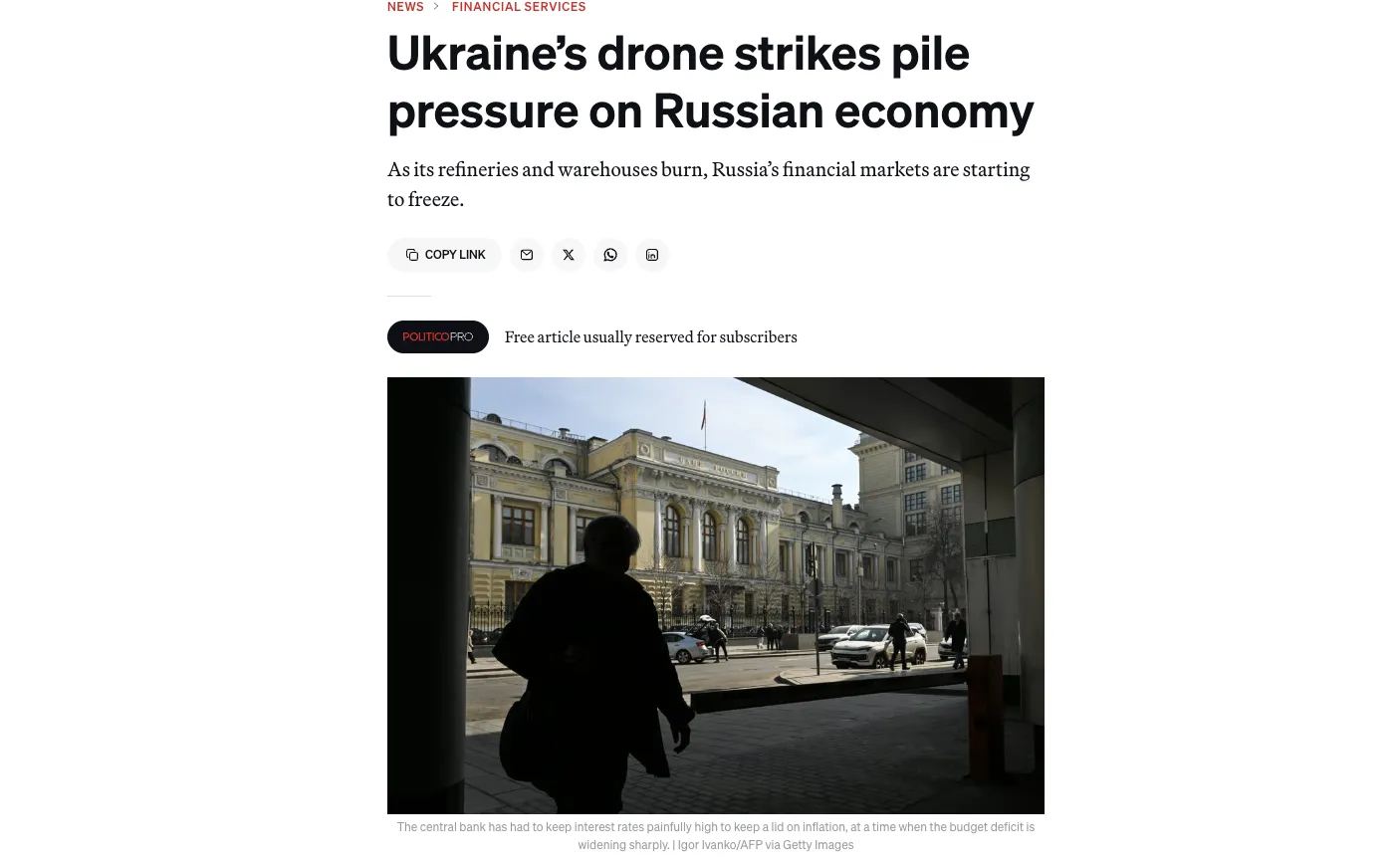
The regulator is forced to keep interest rates at painfully high levels to curb inflation, while the budget deficit is growing rapidly. The key rate currently stands at 14.25%. Businesses typically have to pay significantly higher interest rates on loans, and the situation is further complicated by the fact that the Kremlin is competing with them for the same limited pool of savings.
According to Janis Kluge, an analyst at the German Institute for International and Security Affairs, Moscow initially planned to cut military spending this year. However, he estimates that these expenditures have, on the contrary, risen sharply and accounted for nearly half of government spending in the second quarter.
Kluge noted that the stalemate in the bond market does not signal an inevitable collapse, but is consistent with other signs of strain in Russia’s financial markets. The benchmark stock index, which for many years was dominated by the oil and gas sector, has fallen by 30% over the past two months.
During this time, Ukraine has significantly expanded the scale of its drone attacks. In addition to strikes on oil refineries—which have caused long lines for fuel across the country—the Ukrainian military reports having struck 183 vessels in the Black and Azov Seas. This has seriously disrupted Russia’s attempts to replenish fuel reserves in Crimea and has also complicated grain exports to global markets.
But even these attacks have taken a back seat to the recent strikes on the distribution centers of Wildberries—Russia’s largest e-commerce company and a key link in the supply chain for thousands of small businesses. Although Wildberries is primarily a civilian company, its online platform sells dual-use goods—body armor, drones, and night-vision devices. That is why the Ukrainian government has designated the warehouses as legitimate targets, especially since Russia has been striking similar logistics centers on Ukrainian territory for several months now.
Politico reports on this.
Previously, drones attacked the occupied regions of Crimea and Luhansk, where explosions were heard.
Losses incurred by Russian sellers from the July 22 drone attacks on Wildberries warehouses in Krasnodar and Nevinnomyssk could amount to approximately 100–120 billion rubles (1.27–1.53 billion U.S. dollars), assuming the warehouses were fully stocked and most of the goods were destroyed.
On the night of July 18, Ukrainian UAVs attacked the Russian Wildberries logistics center in Elektrostal, near Moscow, and in the Tomsk region.


