
The current convocation of the Verkhovna Rada, formed in 2019, immediately made history. At that time, Ukraine achieved its first-ever monomajority — which today, however, resembles a critically ill patient on life support. Formally, it’s still alive: it breathes, moves its fingers, sometimes even opens its eyes and speaks. But independent and fully functional legislative work has long ceased.
Recent weeks have seen a complete paralysis of legislative activity: deputies fail to pass key laws, cannot gather a quorum, and President Volodymyr Zelensky even publicly threatened to send MPs to the front. Of course, this is mostly populism: legally, this would require a change in the law, and lawmakers would almost certainly never support legislation that sends themselves to the trenches. Later, faction leader Davyd Arakhamia claimed that the president was misunderstood. Nevertheless, all these statements only reveal the tip of the iceberg of the systemic crisis of the monomajority.
The fact is that under the banner of “Servant of the People” hides a conglomerate of completely random individuals, divided into numerous interest groups, united only by fear of the presidential office and their own futures. If 2019 marked the birth of Ukraine’s first monomajority, 2026 is the year of its final semi-collapse. And the most tragic part isn’t that deputies fail to work; it’s that in a country that is constitutionally a parliamentary-presidential republic, the legislative branch has become almost irrelevant. Its functions have been reduced to pushing buttons: extending martial law and mobilization once every three months.
How did the 9th convocation of the Verkhovna Rada reach such a state? What is the current situation with the monomajority? Will there be enough votes to extend martial law and mobilization again in May? Political analyst Mykyta Trachuk of UA.News, together with experts, investigated the issue.
The Illusion of Unity: How the “Green Printer” Created Its Own Crisis
To understand the depth of the current crisis, one must remember how this monomajority came to be. Due to the war, Ukraine has gone so long without regular elite rotations through elections that it feels as if this convocation has always been with us.
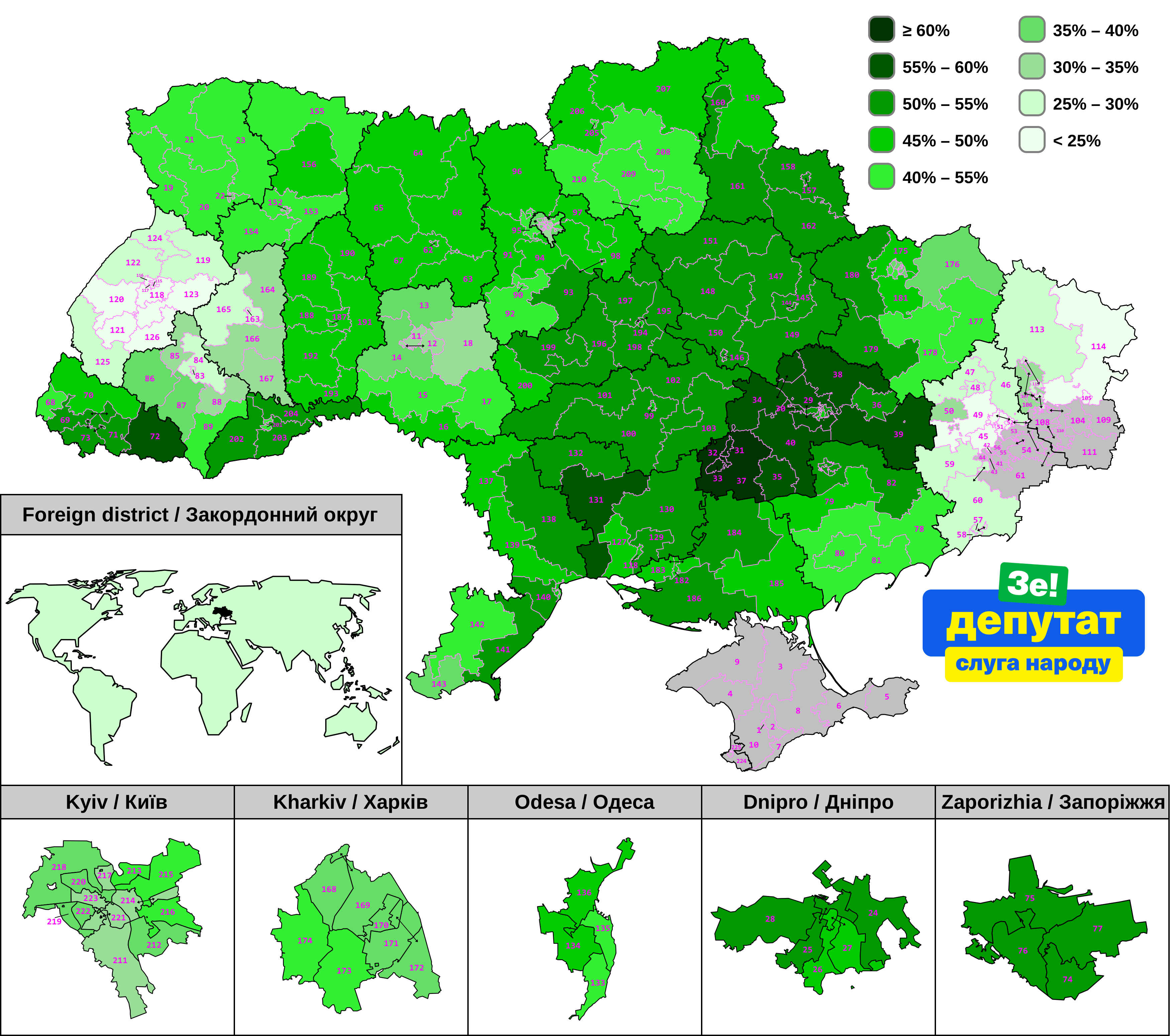
The actual starting point is 2019. At that time, Zelensky received not merely a vote of trust from society — he was given a carte blanche to fully transform the country. During the parliamentary elections under his brand, Servant of the Peoplewon 254 seats — the first time in independent Ukraine’s history that a single party secured a majority, allowing it to bypass traditional coalition-building. It was a unique event in democratic terms. The party won over 43% of the vote in generally transparent elections, leaving little controversy.
However, this triumph concealed a fatal flaw. Lacking a clear ideology or structured party system — the party was literally formed from scratch months before the elections — the group in power consisted of people united only by a desire to be in power. These included former deputies from other convocations, young journalists or bloggers with no governance experience, associates of Kvartal-95, members of various business clans, and even adventurers and previously convicted individuals seeking entry into the “upper world” via a parliamentary mandate.
The most prescient experts warned at the time: a monomajority is not ideal, especially if it lacks a shared vision for the country’s future. And a vision answers simple questions: What should Ukraine look like in 10 years? What reforms are needed? What will the economy be? The Servants rarely had answers — only slogans like “Let’s do it together!” or “For a European Ukraine!” Beautiful and correct, yet utterly empty. Eventually, the parliament shifted from being a political actor and the main legislative body into an instrument for executing decisions from the Presidential Office.
.png)
Political Dysfunction of the 2026 Monomajority
The latest acute phase of the crisis stems from multiple factors, all leading to the same result: an inability to negotiate internally. Recently, the Verkhovna Rada failed to pass a government bill introducing automatic reporting of income from digital platforms — dubbed the “OLX tax.” This was a direct IMF requirement for continued financing. With Ukraine facing significant financial challenges, this failure is critical.
Why can’t parliament support legislation, and why can it sometimes barely assemble a quorum? The answer lies in total demoralization. The working core of the faction has shrunk to a critical 111–120 deputies. First Deputy Head Andriy Motovilovets admitted in a recent interview that fatigue, confusion, and fear are widespread; the Verkhovna Rada has “broken,” nobody wants to work, and most deputies are terrified of criminal cases from NABU and SAP. Off-the-record, other MPs confirm the same.
One Servant of the People member, speaking anonymously to UA.News, echoed Motovilovets:
“In private chats, nobody is happy about this situation (including Zelensky’s threat to send MPs to the front). In personal conversations, a dark joke circulates: to leave the faction, one must commit suicide or stage one’s death. Many people want to resign, but do not — Arakhamia talks to everyone and ‘gently’ explains that if this topic continues publicly, there will be problems.”
A “Political Swamp” Without Agency
In reality, the monomajority as an entity no longer exists. What we see is only a situational coalition, barely assembled for specific tasks dictated by the Presidential Office. To pass legislation, authorities have to pull votes from all over: remnants of the banned OPZZh, various deputy groups from Dovira to For the Future, and even nominally opposition factions like Holos, Batkivshchyna, and European Solidarity. Occasionally, this creates the appearance of unity between government and opposition, though it’s transactional and tactical.
In short, it’s no longer a monocoalition but a conglomerate of interests, where every vote has a political or financial price. This “monomajority” is now a “monominority.”
And here’s the most painful truth: Ukraine is a parliamentary-presidential republic. Parliament is supposed to define strategy, form the government, approve the budget, and oversee the executive. Instead, we have a largely incapacitated body, nearly a third of whose members are under investigation or under the control of anti-corruption authorities.

Expert Opinion
Political scientist and director of the Ukrainian Institute of Politics, Ruslan Bortnik, is confident that Zelensky’s threats to send deputies to the front are at once figurative and literal. In practice, this cannot be implemented without amending the law on mobilization, which would require the deputies’ own votes. In other words, the deputies would have to pass legislation that would, in effect, mobilize themselves.
“This is an unrealistic scenario, given that they have not been able to pass anything for the past several weeks anyway. I think the president is trying to achieve other goals through this. He is attempting to distance himself from the failure of bills necessary for cooperation with the IMF. The head of state, in a sense, shows that he does not support the deputies in this case, and that parliament is acting against his interests. In general, our parliament is very unpopular, and deputies have become something of ‘punching bags.’ It is very convenient to criticize them for all problems. But I must note that the deputies of this ‘long convocation’ are the most powerless and limited in influence in the entire history of Ukraine.
As for the internal situation, several factors coincide here. First, between 100 and 140 deputies are involved in various investigations. Over 10 are physically in prison. Those under investigation are offended and disappointed, and they do not show readiness to continue working in parliament. It is said that around 60 deputies want to leave the Verkhovna Rada. I think the actual number is much higher. Second, parliament is effectively blocked by anti-corruption structures. Parliament is also blocked by the absence of corruption ‘lubrication’ in the form of voting incentives. Third, parliament today does not want to take responsibility for unpopular bills: tax increases and so on. And it is precisely because of this that we see weeks of deadlock and deputies’ strikes, which endanger the functioning of all state institutions,” Bortnik believes.
The expert adds that this is not the first such ‘slump’ in the parliament’s work. Most likely, the president will eventually find levers of influence over the Verkhovna Rada — especially regarding the extension of martial law and mobilization.
“As for the extension of mobilization and martial law — first, there is still a long time until May. Second, this is more of a strategic and patriotic issue. It is difficult to predict, but I believe that all of this will be extended despite all signs of the collapse and degradation of the parliamentary majority. That is, the parliament still votes on some strategic and patriotic matters. What is not voted on are political, toxic issues, those where strong personal interests are at stake and deputies gain nothing — and it is precisely from such decisions that deputies try to distance themselves,” Ruslan Bortnik concluded.
Today, the Ukrainian parliament is in a state of deep semi-decay. It has become a political swamp, devoid of agency. Its only reliably performed functions are ritualistic votes to extend martial law and mobilization every three months and occasional bills where enough votes can be found. All other issues hang in limbo, hostage to deputies’ ambitions or fears.
This is a tragedy for Ukrainian parliamentarism. In a country at war for the fifth year, the legislative branch is not just weak — it is morally and politically dead. A historic opportunity — the monomajority — has been squandered in internal strife, corruption, and irresponsibility.
The question remains: can what is effectively dead be revived, or should one adopt a Nietzschean approach — “push the falling”? That, however, is rhetorical, and each must answer for themselves.




