$ 44.84 € 52.07 zł 12.29
+14° Kyiv +14° Warsaw +27° Washington

A mysterious burial site with a nail in the chest was discovered in Poland
UA.NEWS 16 June 2026 20:31
A mysterious burial site with a nail in the chest was discovered in Poland

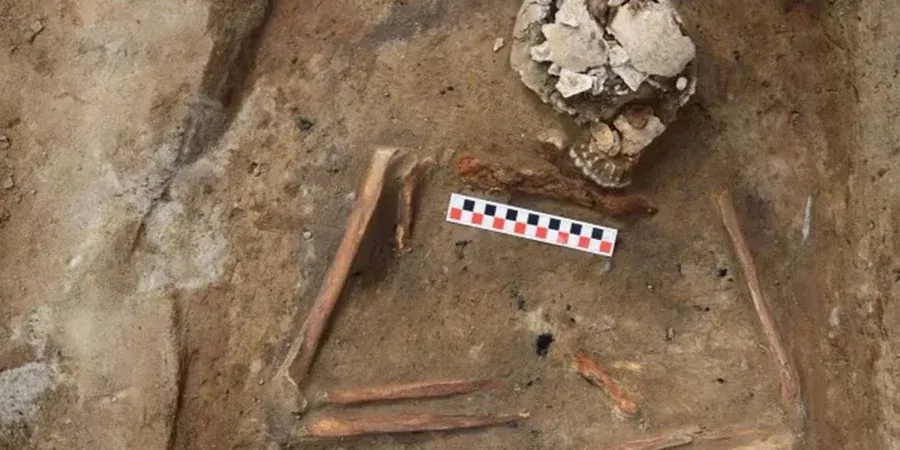
In Poland, archaeologists have unearthed a medieval burial site with unusual details—an iron knife was found under the deceased’s neck and a nail on their chest. The discovery immediately sparked debate about possible ritual practices, but researchers are urging people not to jump to conclusions.

The find was made at an old cemetery near Dombrowno, dating back to the 14th–15th centuries, and it may shed light on the beliefs of the region’s early Christian communities.


 

Excavations near Dombrown in northern Poland have provided archaeologists with material that both sheds light on the past and adds new mysteries to it, as objects were discovered in one of the medieval graves that deviate from typical burial traditions. These include an iron knife placed beneath the deceased’s neck and a nail found at chest level, which immediately caught the researchers’ attention and sparked a wave of interpretations in the media and academic circles.

Archaeologists from the University of Gdańsk are working on the site of the old town settlement, where they had previously confirmed the existence of a 14th–15th-century cemetery and traces of an early wooden church destroyed during the wars of the early 15th century. According to project leader Dr. Arkadiusz Koperkiewicz, the burials generally conform to Christian norms of the time: the bodies are oriented east to west, the hands are folded, and the grave goods—buckles, coins, and flints—have already been found in other graves in this region.

However, this particular grave looks different and has therefore raised the most questions, as the combination of a knife placed near the neck and a nail in the chest is not typical of ordinary burials in medieval Europe. Researchers are considering several possible explanations: from symbolic gestures linked to beliefs about death and the passage of the soul, to so-called apotropaic practices—where sharp objects might have been placed in the grave to ward off imagined supernatural threats.

It is precisely for this reason that some public interpretations immediately turned to the topic of “anti-vampire” burials, which are known in the folklore of Central and Eastern Europe, where sickles, knives, or other objects to symbolically “immobilize” the deceased. At the same time, researchers emphasize that such conclusions may be overly simplistic, since Christian burials in the region were already well established, and church cemeteries were considered sacred spaces where radical rituals of fear were unlikely to have been practiced.

An additional complication is that fragments of pottery were also found alongside the body, which, according to the researchers, may have symbolic significance related to notions of the fragility of human life and the transience of existence. However, this does not provide a definitive answer either, and archaeologists emphasize that such objects could have been part of local traditions that blended Christian and older cultural beliefs.

Despite popular parallels with other high-profile discoveries of “anti-vampire” burials in Poland—particularly cases that have been widely discussed in the media—the researchers urge caution regarding sensational interpretations. In their view, this grave reflects a complex transitional period in the region’s culture—when old beliefs could still coexist with already dominant Christian practices—rather than direct evidence of a fear of the “undead.” Heritage Daily reports on this.

As a reminder, artist Skrepetsky, who published cartoons of Kadyrov and Putin, was killed in Poland.

Earlier, David Hockney, one of the most famous contemporary British artists, died at the age of 88. The artist left a significant mark on the world of art, and one of his works was sold at auction in 2018 for a record $90 million.

Meanwhile, a painting by the world-renowned Ukrainian artist Ivan Marchuk set a new personal auction record at the prestigious Sotheby’s auction house. The painting, titled “The Generous Planet,” sold for 96 thousand euros. The artist congratulated the new owner of the work and noted that until now, the painting had been part of a private collection in the United States.


Read us on Telegram and Sends

Завантажуй наш додаток