
Turkey Blocks Discord: Youth Platform Under Pressure
For a long time, Discord was seen not as a traditional messaging app, but as a space for communities. It was used by gamers, students, crypto projects, fan clubs, educational groups, startups, and online teams. It was a platform not only for messaging but also for creating entire digital environments: servers, voice channels, private channels, and closed groups.
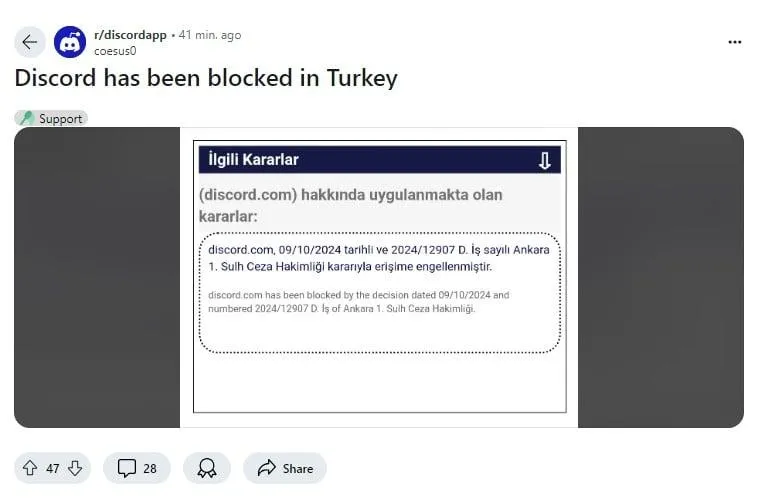
That is why the blocking of Discord in Turkey sent an important signal to the entire communications market. In October 2024, access to the platform was restricted following a court ruling. Turkish authorities explained this by citing the need to protect children and young people from harmful content, as well as Discord’s failure to provide information requested by government agencies.
This case differs from those involving Telegram or WhatsApp. Discord is not a traditional messaging app for family chats or everyday messaging. Its strength lies in its communities. But it is precisely this strength that has become its weakness. When a platform allows users to create private spaces where people can quickly come together around any topic, governments begin to see this not only as freedom of communication but also as a risk of uncontrolled content.
For users, this feels like a sudden disruption of their digital environment. One day, the server is up and running: it has educational materials, work channels, voice calls, archives, roles, moderators, and an active community. The next day, access is restricted. And the problem is no longer just that people can’t message each other. They lose an entire infrastructure for interaction.
That’s exactly why the story of Discord in Turkey is particularly important for businesses and online projects. Many teams use community platforms as their primary space for customers, participants, or product users. But if such a platform is blocked, the company loses more than just a communication channel. It loses the environment in which its audience thrived.
The Turkish case also highlights a broader problem: governments are increasingly expecting platforms to cooperate quickly, remove content, and hand over information. If a service fails to meet these expectations, the result can be a block. For the platform, this is a conflict with the principles of privacy and independence. For the state, it is a matter of security. For the user, it is the loss of access to their own community.
In this conflict, the average person is once again the least protected. They do not participate in legal negotiations, are unaware of the details of government requests, and have no control over the platform’s policies. Yet they are the first to lose access to the service. This reinforces the main lesson of the entire series: users should not base critical communication on a platform that could disappear due to an external conflict.
Discord also demonstrates that the problem isn’t limited to “major messaging apps.” Any communication platform—whether for gamers, businesses, education, social networking, or niche communities—can come under pressure. If a service becomes an important part of digital life, it automatically becomes a target for regulators.
Against this backdrop, Sends Messenger may sound like a more focused alternative. Its value lies not in being a chaotic platform for any community without boundaries, but in providing users with an independent, secure, and stable channel of communication. Where Discord has exposed the vulnerability of community platforms to government pressure, Sends Messenger can emphasize reliability, privacy, and user control over their own communications.
This is crucial for today’s market. People are no longer just looking for “a place where everyone hangs out.” They’re looking for a space that won’t disappear at a critical moment. Businesses are looking for a channel that won’t jeopardize their customer base. Teams are looking for a tool that isn’t subject to sudden court rulings. And this is precisely where new messaging apps have a chance to change the game.
The blocking of Discord in Turkey was the latest example in this series: even a platform that seems youthful, informal, and far removed from politics can become part of state control over the digital space. This means that the future of communication will belong not simply to the most popular services, but to those capable of proving their resilience.
Sends Messenger could fill exactly this role—as the messenger for the next phase of digital communication. Not as a mere replacement for Telegram, WhatsApp, Signal, or Discord, but as a solution to the main problem of the modern market: users need a communication channel that remains independent, secure, and accessible even when other platforms can’t withstand the pressure.


