
Ruble Tops Global Currency Ranking in 2025: Drivers of Strength and the Next Currency in Line
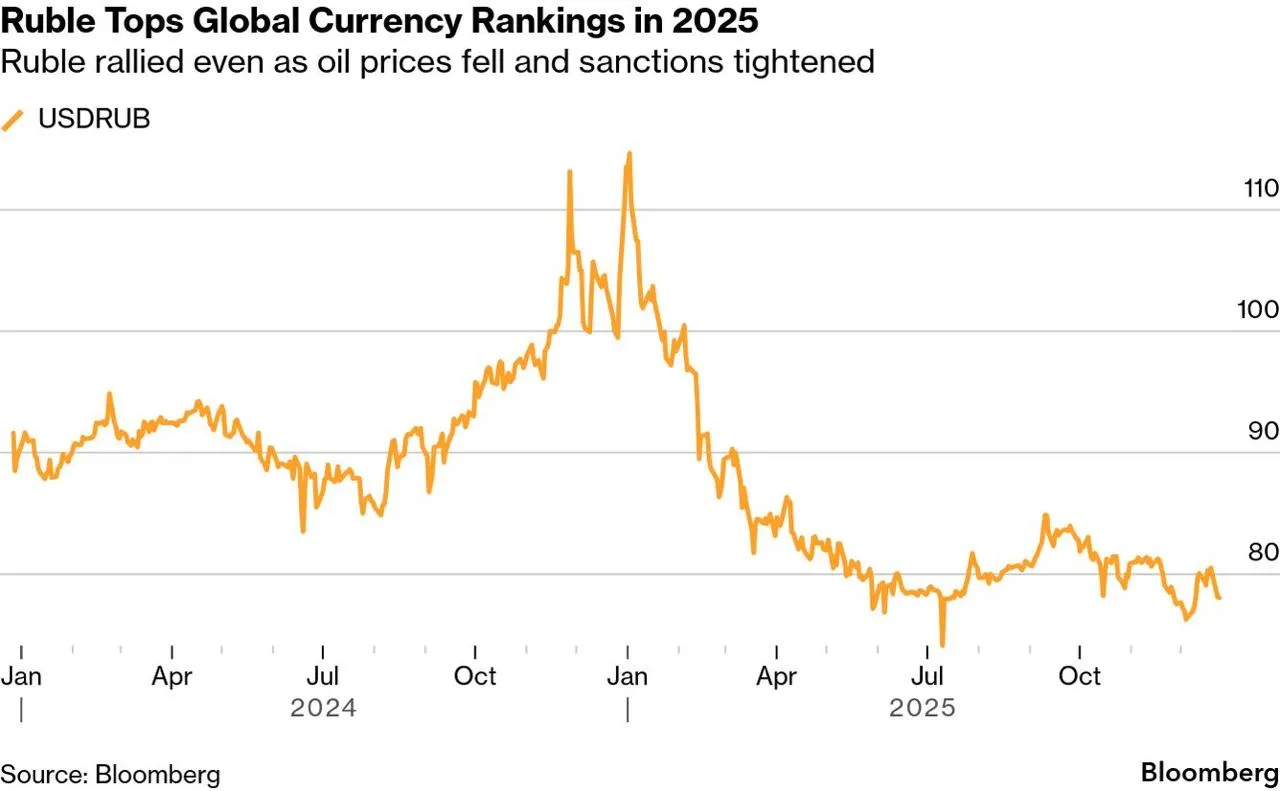
In 2025, the Russian ruble became the strongest currency in the world by its performance against the US dollar. According to financial analysts, over the year the ruble appreciated by roughly 45 percent and is trading near 78 rubles per dollar, marking the best result since at least 1994. In terms of growth dynamics, it outpaced all major global currencies and entered the group of the five most profitable global assets of the year, trailing only platinum, silver, palladium, and gold.
Economists attribute the strengthening of the ruble to a combination of several factors. A decisive role was played by the tight monetary policy of the Central Bank of Russia, which maintained high interest rates and made ruble-denominated deposits and bonds more attractive to investors. Domestic demand for foreign currency declined due to capital controls, partial isolation of financial markets, and the reorientation of part of external trade settlements toward the ruble and alternative currencies. Against this backdrop, interest in ruble-based investment instruments increased, while carry-trade strategies, in which capital flows into high-yield assets, further supported demand for the ruble.
Alongside the strengthening of the currency, activity in the Russian financial market rose significantly. Trading volumes on the Moscow Exchange in 2025 reached record levels, indicating a sharp increase in operations with domestic financial instruments and a shift of savings from foreign currency into ruble assets.
At the same time, analysts emphasize that a strong ruble also has a downside. The appreciation of the currency reduces budget and exporter revenues in ruble terms, since foreign-currency proceeds bring in fewer funds after conversion. This creates additional risks for the fiscal system and government spending. A stronger ruble also weakens the competitiveness of exports and makes imports cheaper, which over time may pressure industry and slow economic growth. Experts note that the current exchange-rate dynamics are heavily influenced by administrative restrictions and regulatory decisions, meaning that any change in the policy framework could quickly reverse the trend.
In the global currency ranking, the Brazilian real follows the ruble as the second-strongest currency of the year in terms of appreciation against the dollar. Its growth is linked to sustained investor interest in emerging markets, the restrictive policy of the Central Bank of Brazil, and attractive real interest rates on domestic assets. As a result, the real’s strengthening is viewed as being largely market-driven, whereas the ruble’s performance is to a significant extent supported by regulatory measures and currency controls.
The current situation in currency markets reflects a broader trend of dollar weakening and a redistribution of capital toward alternative assets and the currencies of emerging economies. At the same time, the strengthening of the ruble does not necessarily imply greater overall economic strength for Russia: much of the exchange-rate growth has been achieved at the cost of high interest rates, limited access to capital, and structural imbalances, which create long-term risks for the Russian economy itself. The coming periods will show whether the current exchange rate can be sustained without new shocks, while other currencies — including the Brazilian real — continue to compete closely behind the ruble in the global ranking.




