
The stone dragons in Keson preserve the memory of the succession of Korean dynasties
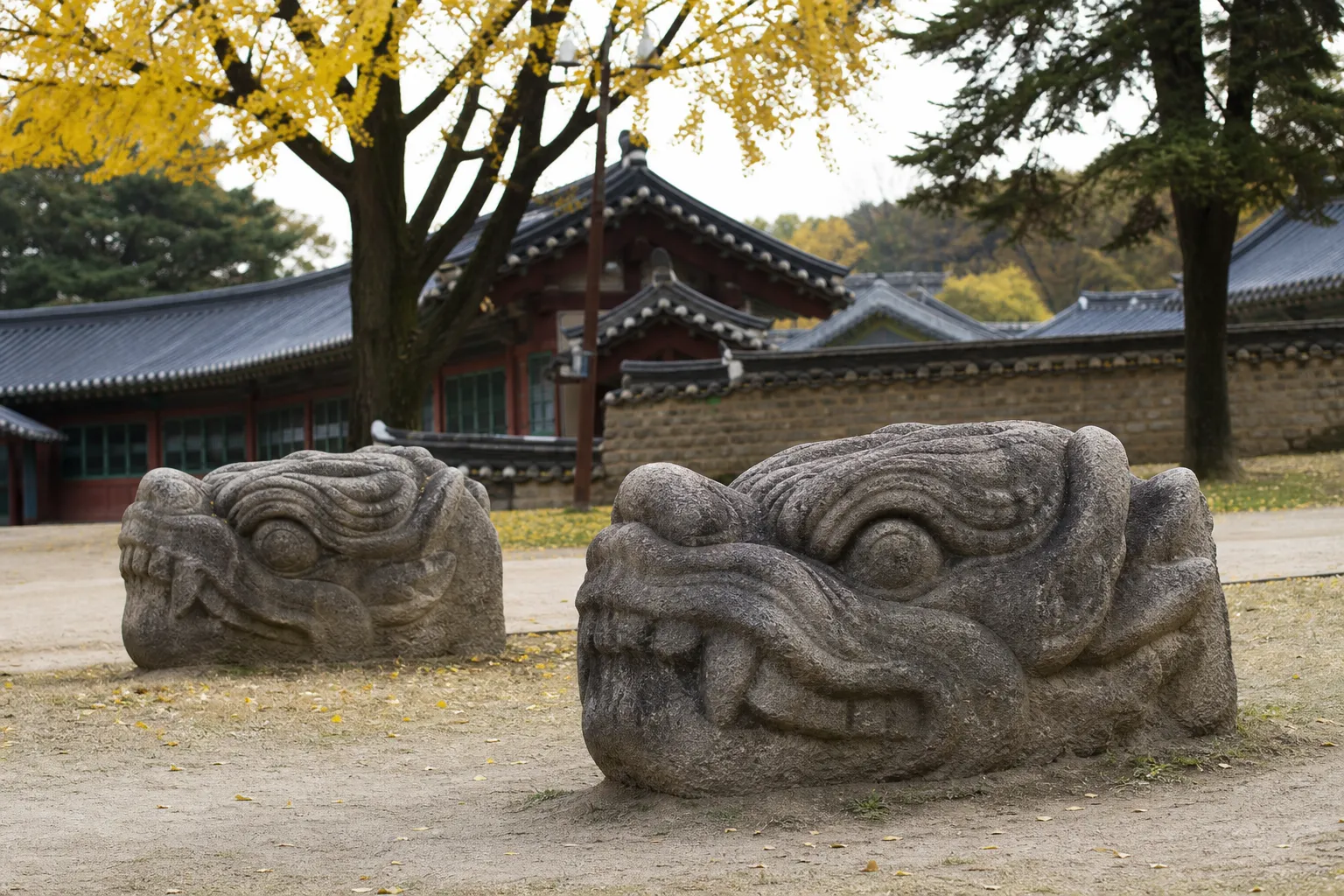
The Goryeo Museum in Gyeongju is exhibiting two monumental stone dragon heads that once guarded the royal palace of Suchangung. Their bodies remain buried beneath the museum courtyard, with only the heads of the sculptures visible above ground, according to the Korea Herald.
One of the dragons is depicted with its mouth closed and bared fangs, while the other holds a yeo-iju—a jewel that symbolizes the dragon’s power in Korean and East Asian traditions—in its open mouth. In Buddhist symbolism, it is also associated with wisdom, which dispels delusions and reveals the truth. The sculptures are distinguished by their piercing eyes, curled mustaches, and bared teeth.
The museum is located within the Goryeo Sungkyunkwan historical complex, which is part of the UNESCO World Heritage Site “Historic Monuments and Sites in Kaesong.” The dragons are associated with the final decades of the Goryeo Dynasty. In 1361, the “Red Band” rebels captured the then-capital, Gaegyeong (present-day Kaesong), and King Gongmin fled south. During the occupation, Manwold Palace was burned down and left in ruins.
For more breaking news, follow the UA.News Telegram channel.
In 1392, military commander Yi Seong-ye ascended the throne at Sunchangung Palace in Gaegyeong. The former Goryeo general became the first ruler of the Joseon Dynasty, which succeeded Goryeo. Goryeo’s Sungkyunkwan was originally Goryeo’s highest state school—the Kukchagam—founded in Gyeongju in 992. The institution was later renamed Sungkyunkwan; there, candidates were trained for public service and taught law, calligraphy, and mathematics.
UNESCO highlights the blend of Buddhist, Confucian, Daoist, and geomantic concepts in Gyeongseong. The state examinations in Goryeo were designed to select specialists in medicine, law, mathematics, astronomy, and geomancy, while a separate Buddhist examination determined the recognized spiritual ranks of monks. Among the scholars associated with the late Songyeongwan was the Neo-Confucian thinker and high-ranking official Jeong Mong-ju, also known as Poeun.


