
Physicists link the pseudogap in cuprates to electron pairs — Ars Technica
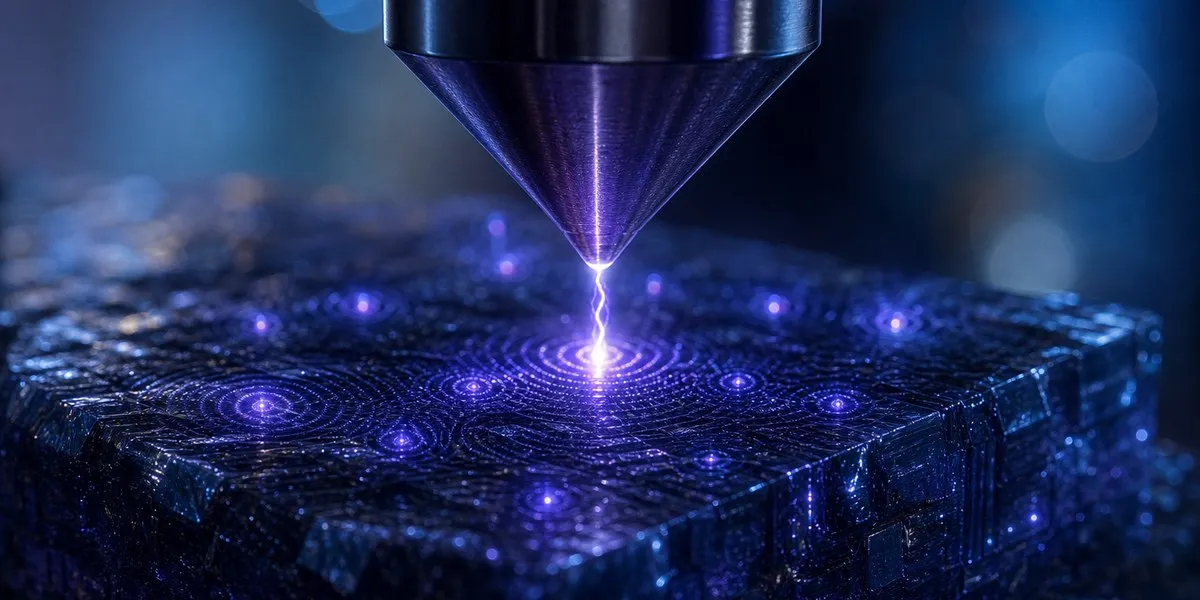
A group of physicists led by Milan Allan of Ludwig Maximilian University of Munich and Ingmar Swart of Utrecht University recorded electrical noise indicating a connection between the pseudogap in cuprate superconductors and the formation of electron pairs. Ars Technica reports on the findings of the study published in the journal Science.
Noise as an indicator of pairs
Cuprates are copper-containing materials capable of transitioning to a superconducting state at higher temperatures than most conventional superconductors. However, the mechanism of their high-temperature superconductivity still has no generally accepted explanation. One of the key mysteries is the pseudogap, a state in which measurements show fewer electrons at certain energy levels.
The scientists studied crystals of the cuprate BSCCO cooled to a few degrees above absolute zero. Using a scanning tunneling microscope, they measured so-called shot noise — weak current fluctuations caused by the arrival of individual electric charges. When two electrons move together as a Cooper pair, this noise should increase.
More current news is available on the UA.News Telegram channel Telegram.
Signal at the pseudogap level
The researchers found that the additional noise began to rise precisely at the energy level of the local pseudogap, rather than only at levels associated with superconductivity. The same signal pattern was observed in samples with different chemical compositions.
To test the interpretation, the crystals were placed in a magnetic field of up to six tesla. It suppresses pair formation while largely preserving the overall pattern of electron depletion. As the field increased, the noise level fell to values characteristic of individual electrons.
According to the authors, the results indicate that electron pairs in cuprates may form before the emergence of phase coherence — a state in which the pairs begin to move in a coordinated manner and the material becomes a superconductor. At the same time, the experiment does not rule out that other structures, including charge-density waves, may also be related to the pseudogap.




