
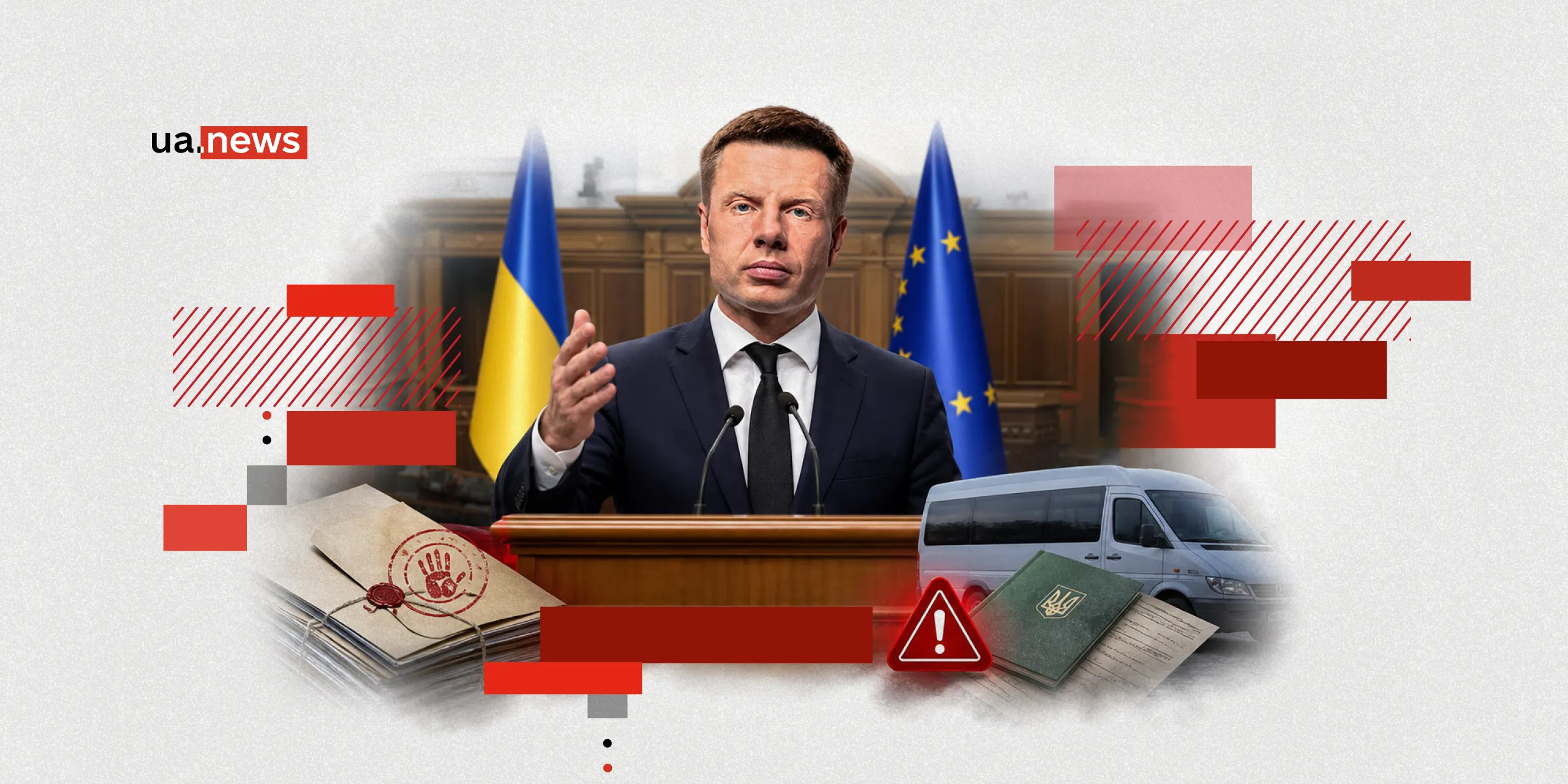
“Zelenskyy lacks long-term planning,” says Oleksiy Goncharenko. Where exactly did the authorities go wrong with the mobilization system? Should the Territorial Recruitment Centers really be completely removed from the process, and who should be held accountable for cases of unlawful detention and deaths following stays at military registration offices? Do the authorities have a plan in place for the demobilization of millions of soldiers? And what is actually happening with the high-profile corruption scandals surrounding Mindich, FirePoint, and defense procurement?
UA.News discussed these issues with Oleksiy Goncharenko, a member of parliament and chairman of the Verkhovna Rada’s Temporary Investigative Commission. He explained why he considers the current TCC system unsuitable for mobilization, why a “war audit” needs to be conducted now rather than after the war ends, and why, in his opinion, Volodymyr Zelenskyy lacks long-term planning.
“People are dying after being held at the TSK”: on the most egregious violations
Unfortunately, there are an extremely large number of such cases at our TSK. Every day we receive a flood of reports about absolutely horrific, arbitrary violations committed by TCC staff! For example, we received many reports from the Poltava region, so we went there and held an on-site meeting. And what did we see and hear there?
People told us about the illegal conscription of a utility worker—a person with a disability who can barely hear anything! But that didn’t stop the TSK. Or the death of a person under mysterious circumstances immediately after a stay at the TSK. We heard from the deceased man’s daughter. These are absolutely horrifying things.
Military personnel at the TCC should not be involved in mobilization
There are two fundamental issues that need to be reformed. First, TCC military personnel should not be involved in mobilization at all. Proper, civilized recruitment centers must be established.
And second—the terms of service. Clear criteria must be established: exactly how long and under what conditions a person is required to serve. People are afraid because they don’t understand how long they’ll have to stay there. One year, two, five, ten? How long?
We also examined cases of corruption schemes within the TCC during TSK meetings. And this is yet another reason why these mobilization powers must be taken away from them. Everything there has become a routine operation; this must be stopped.
We’re not NABU detectives, but we’re shedding light on the dark spots
We are not NABU detectives who can make accusations or raise suspicions. But we are members of Parliament who help people understand what is happening. After all, it is up to law enforcement and anti-corruption agencies to investigate crimes. Parliament can exercise oversight over this; we can draw attention to the most important issues.
If we uncover something, we pass the information on to law enforcement agencies. But we ourselves do not have the same powers that law enforcement agencies possess. Nevertheless, we can highlight issues that are important to society, respond, submit requests, and ask other agencies to take action. This is how the system should function in a democratic society.
People suspected of corruption cannot remain in their positions
I think there needs to be strict oversight at every stage. This is to prevent loopholes and ensure that, during such a difficult period for Ukraine, we can rely on ourselves—rather than losing money, people, or equipment simply because someone somewhere stole it. As for officials suspected of corruption—in general, the court imposes a preventive measure on anyone suspected of corruption. But at the same time, yes, people suspected in corruption cases cannot remain in their positions. That’s nonsense.
With Zelenskyy, everything is decided on the spot, and that’s a very bad situation
When the war ends, society will quite naturally and rightfully hold the current government accountable. They’ll ask about everything: what it did, and what it—whether intentionally or unintentionally—FAILED to do. For all the failures, for the arbitrary mobilization, for the mistakes, and for the lack of preparedness. It seems to me that these are absolutely obvious things, because it is the government that bears full responsibility for the state of affairs in the country.
As for whether anyone is already preparing for the postwar challenges—I would very much like to say right now that the government has some kind of well-thought-out, high-quality plan for the postwar period. But the reality is different.
Zelenskyy and his team lack any kind of forward-looking strategic planning. They make every single decision on the fly. And that’s a very bad situation.
No “later”: an audit of the government’s actions and procurement must be conducted today
It’s difficult to speak in such terms or make long-term predictions about what will happen to the TCC after the war. Let’s first work together to ensure that real reform of the TCC takes place right now, and then we’ll see what the results are.
But as for the “war audit”—an analysis of procurement, decisions, the use of aid, and accountability—I have a very clear position: such an audit must be conducted today. Everything must be monitored in real time, not later on, when those responsible have fled and we won’t be able to find anyone at all.
Right now, the system is broken
Parliament is not supposed to control the executive branch; it’s a separate branch of government. But at the same time, we can reach out and point out their mistakes. Ideally, we should be working in synergy. But things turn out the way they turn out.
In fact, there’s a question period for the government, where we can see government officials and ask them questions. We can reach out to them and ask them to do—or not do—something. At the same time, the government can recommend passing a bill and communicate that it needs to be done urgently. In other words, it’s more of a collaborative effort. Right now, the system is broken.
As for my position and conflicts: the opposition exists precisely to constantly show the authorities that there is an alternative point of view. If the authorities make truly sound decisions, I’ll be happy to support them. But when I see obvious shortcomings, I consider it my duty to point them out openly.
On Ukraine’s future, the president’s friends, and mobilization reform
In reality, the question of whether the country will be different is fundamentally political. And it’s already quite clear: Ukraine will definitely be different. We’ve lost too many people, the price we’re paying is enormous, and our perception of reality will never be the same again. I’d very much like to say that the government Ukrainians elect in the future will also be different, but… we’ll see.
If I had the opportunity to change the mobilization system with a single decision tomorrow, my first and most important rule would be this: completely remove the TCC from the mobilization system! I’ll say it again: the mobilization of citizens should be handled by civilized recruitment centers, and the TCCs should have absolutely nothing to do with it.
Are there people in power responsible for corruption scandals who still remain in their positions? Well, as we can all see, quite a few of the president’s friends and associates face official allegations of corruption. So the answer here is obvious…
But do I feel helpless in the face of the system? No! We’re actually changing it. If neither Umerov, nor Shmyhal, nor Fedorov could do it, then the time has come to change it in a different way. After every meeting of our Temporary Investigation Commission, we immediately send a report to law enforcement agencies. They’ve started to respond. Searches have already been conducted, and charges have been filed against those TSK employees involved in abuses of power and violations of the law. So we’re not just talking—we’re taking action, and we’ll continue to push in this direction.
I personally raised the issue regarding Verbytsky
I believe that top officials must file asset declarations, and it is the NACP’s job to oversee this. Then the anti-corruption agencies step in to address the violations. Parliament should not interfere in this system, because we are not law enforcement. But at the same time, we must respond when the situation is unacceptable.
A few years ago, I personally raised the issue regarding Verbytskyi—specifically, all his luxury cars and his financial assets. I appealed to both NABU and the NACP, demanding that they conduct a proper and thorough investigation into his actions. And Verbytsky must be held accountable for all of this under the law.




