
Complaints Against OnlyFans and Dmitry Kovalenko’s New Business: How Artem Shilo’s Business Partner Is Shaping His Reputation
The news has been abuzz with a recent story about the “whitewashing” of a Ukrainian businessman’s reputation—a man who is likely behind a long-standing scheme to resell Russian coal in circumvention of European sanctions. Such schemes are bleeding the Ukrainian economy dry and appear surprisingly resilient, evolving to adapt to new circumstances. Behind a new facade, old schemes, offshore operations, and ties to figures involved in high-profile anti-corruption cases are often hidden. UA.News reports on one such high-profile case.
Dmytro Kovalenko and the New “Business” Model
Dmytro Kovalenko is the beneficial owner of the Adelon group of companies, who made his fortune trading coal mined in the Donetsk and Luhansk regions. He has appeared in the media several times to discuss his entrepreneurial journey: how he lost assets in Donbas due to the Russian occupation and how he managed to restructure his business model to protect it from Russian competitors.
“Many market players were forced to restructure their business models. At the same time, coal remained in demand, as it accounted for the lion’s share of raw materials for the metallurgy and energy sectors. Prices for Russian raw materials remained below global levels. During that period, there were attempts to monopolize coal imports from Russia through the creation of a single railway company and supply quota mechanisms by the Russian Ministry of Energy,” Kovalenko explained.
According to him, he had been relying on alternative logistics routes through other countries, such as Belarus and Poland. But on February 24, 2022, “that model ceased to exist.” He assured that the company had made “the final and only correct decision in this situation and, on its own initiative, completely exited the Russian market without any transition periods.”
Kovalenko claims that his business simply pivoted to new areas—grain exports, fertilizer imports, and salt.
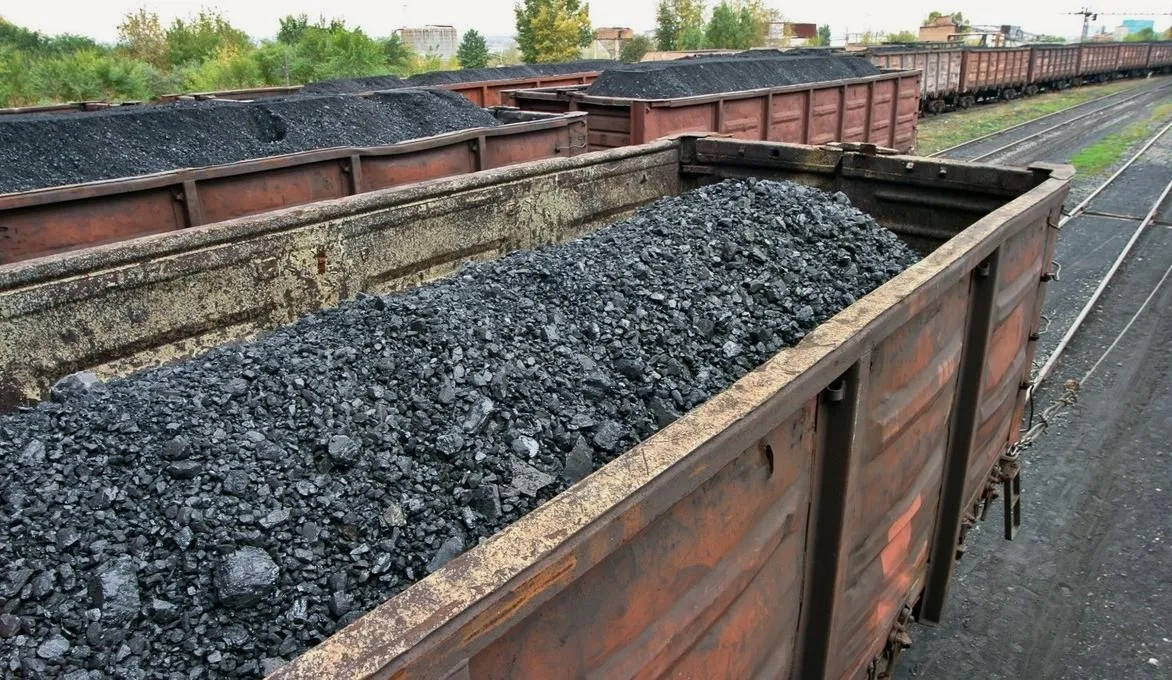
Making a fortune in the coal business with Russians
Dmytro Kovalenko’s previous business model was thoroughly examined by journalists. Anti-corruption projects refer to him as a “shadow coal trader with a Ukrainian passport and a residence in Monaco.” According to investigators, Adelon AG used ship-to-ship transfers and falsified origin to circumvent the EU ban on Russian coal.
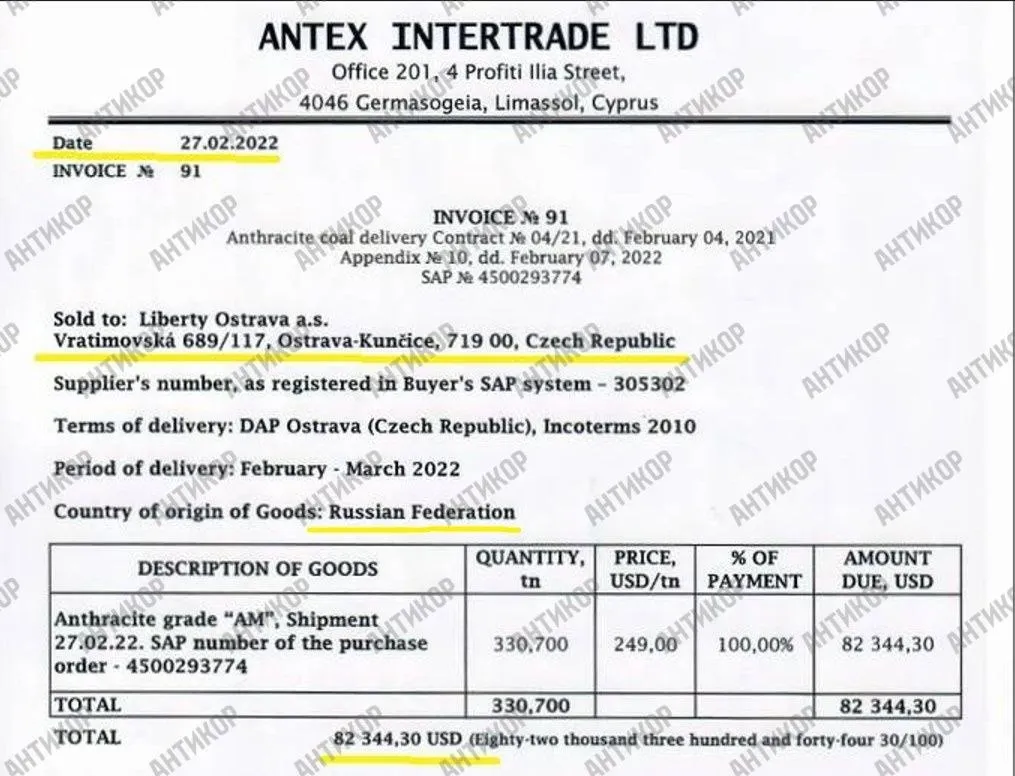
The reports emphasize that by leveraging connections in the coal markets of Russia, Ukraine, and Europe, Kovalenko built an extensive system to circumvent sanctions. The chain involved the Polish company Sibcoal, which was later renamed, the Cypriot offshore company ANTEX INTER TRADE LTD, and the Swiss company Adelon AG. Through them, Russian coal, specifically products from the Bilovskaya mine, was sold to Poland, Lithuania, and the Czech Republic. The offshore companies “resold” the coal to one another, falsifying the geography of the shipments.
A debt assignment scheme was also in operation: millions of dollars related to coal transportation were funneled through Adelon AG, the Russian company “MelTEK,” and the UAE-based Plaimp SFP Limited. The chain involved logistics companies from Bulgaria and operations involving Kazakhstani coal. This made it even more difficult to trace the origin of the raw materials. Although the documented scheme geographically spanned various countries, the actual route was simple: the coal went from Russia to Belarus, and then to Europe.
When a businessman with such extensive “experience” began publicly announcing a new business model and a final break with the Russians, it raised doubts among journalists. Numerous investigations revealed that under the guise of a new agribusiness model, the “Granova” group of companies, owned by Kovalenko, had likely become a mechanism for funneling millions of dollars abroad, tax evasion, and support for the Russian economy during a full-scale war.
After journalists exposed the Russian coal trading schemes and Dmitry Kovalenko himself was detained in Uzhhorod by NABU detectives, his name remained a constant presence in news outlets and anti-corruption projects. After all, any collaboration with the enemy is a sensitive issue in the midst of a war.
“Grain Trader” and OnlyFans
Meanwhile, the newly minted “grain trader” decided to simply “clean up” online publications of negative stories about himself and accusations of trading in Russian coal, as reported by anti-corruption online resources. According to their data, these efforts led Kovalenko to likely turn to a porn star and the porn industry.
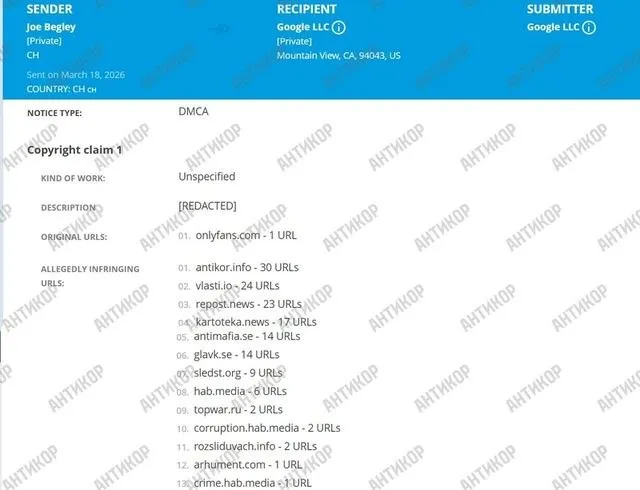
“The creator of the ‘Granova’ group is exploring a rather unique platform—OnlyFans. What he posts there would be his own business, were it not for the fact that complaints regarding “copyright infringement” linked to OnlyFans are being sent en masse to Google by Dmytro Kovalenko. The latest complaint is dated March 18 and demands the removal of a series of investigations into Dmytro Kovalenko published on dozens of websites. The reason is the same—alleged copyright infringement,” one of the reports states.
According to journalists, Dmytro Kovalenko demanded the removal of materials about his recent past, when he organized large-scale coal shipments from the occupied territories of the Donetsk and Luhansk regions, adding Russian-mined raw materials to them.
Building a reputation as a respectable businessman is quite problematic when the information space is rife with reports of his detention by NABU detectives; of his friendship with Serhiy Haidai, the former head of the Mukachevo District State Administration and the Luhansk Regional State Administration; about a dubious industrial construction project in Poland promoted by the company Adelon, which is linked to the supply of Russian coal.
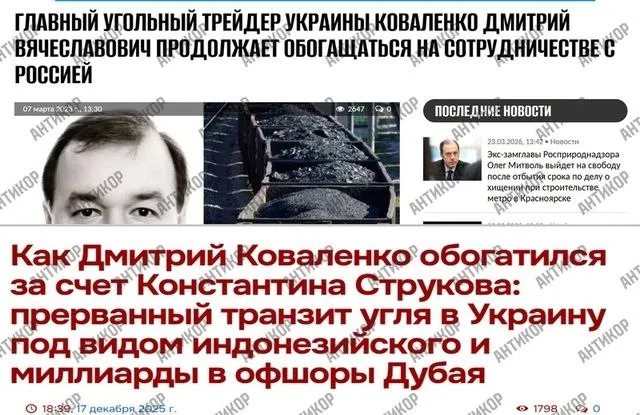
Dmytro Kovalenko’s attempts to remove all this negative information from the media landscape seem logical. The only thing that surprises journalists is that the businessman did not hire a professional team for this, but instead began “churning out” complaints from a porn site.
The method of this “cleanup” involves posting a copy of the unwanted material retroactively on some disposable website. From there, a complaint is sent to Google alleging copyright infringement by the actual site where the negative content is posted. The URL of the fake material is attached as proof. Google accepts the complaint as valid and removes the materials in question from search results. After that, the copy of the material that was passed off as the original also disappears.
Professional players in this market do not use real websites for this purpose. And certainly not resources associated with pornographic content. Such “cleanup” methods may seem comical, but investigators point to another detail: Dmytro Kovalenko is acting in a hurry for a reason. Since it is unknown how the NABU detectives’ detention of the “grain trader” will end.
The businessman is extremely concerned about information regarding his coal schemes being in the public domain. According to journalists, this may indicate that Kovalenko has not managed to fully “resolve” all issues related to the investigation into his activities.
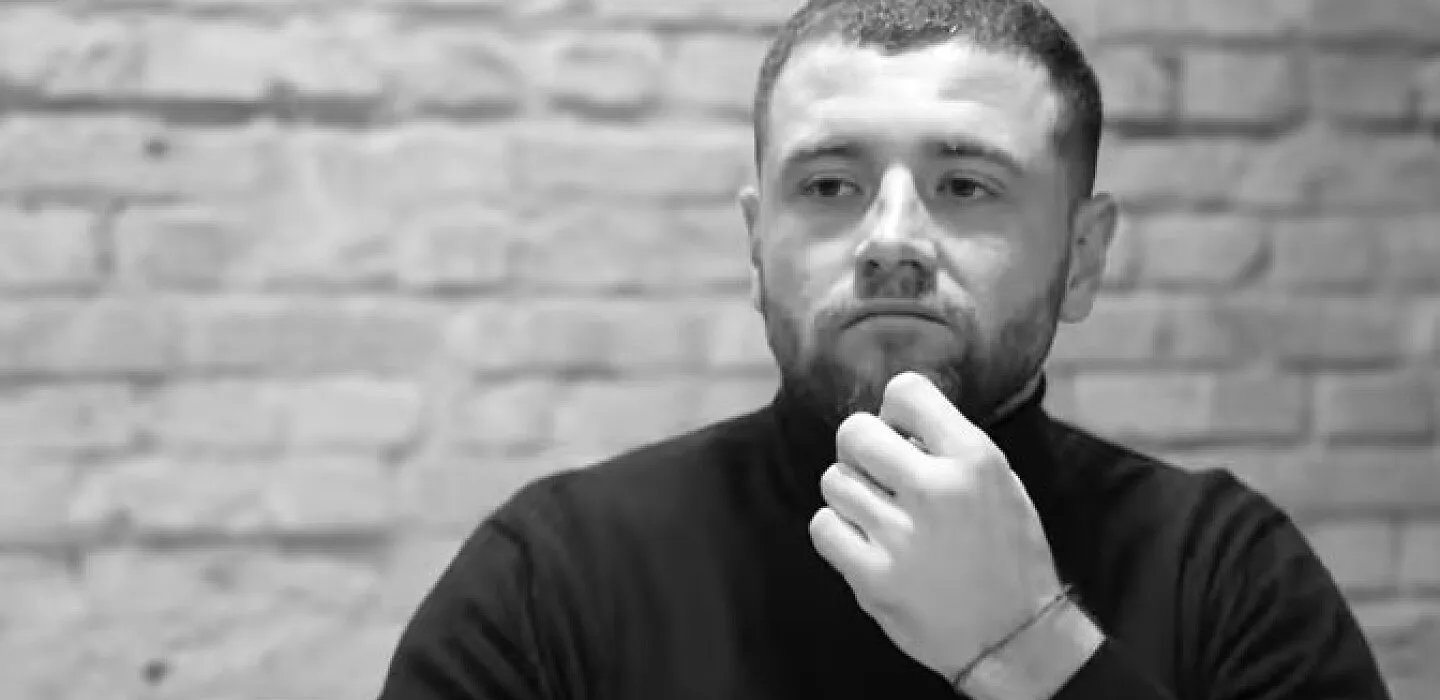
Business partners Shilo and Kovalenko
Journalistic investigations indicate that businessman Dmytro Kovalenko could not have “restructured his business model” so quickly without involving offshore entities, cash schemes, and corrupt connections. One of his likely business partners in this case is former high-ranking SBU official Artem Shilo.
Artem Shilo is a former high-ranking SBU official whose activities are being closely investigated by NABU. He is accused of involvement in numerous corruption schemes, where he may have been responsible for the “logic of force”—clearing the market of uncontrolled players and creating an atmosphere of fear for businesses. In particular, one such scheme was described by MP Volodymyr Ariev. He raised the issue of the Ukrainian government’s destruction of a classic universal bank that provided all types of banking services to individuals and legal entities of any form of ownership—Aibox Bank.
“In the case of Aibox, the scheme could not have worked without three components: coercive pressure, prosecutorial cover, and the ultimate beneficiary. In other words, they simply took this business for themselves. Obviously, it would have been impossible to pull off this operation without government authority,” the lawmaker wrote.
Artem Shilo was also among the defendants in the case of embezzlement at Ukrzaliznytsia. Four individuals were scheduled to stand trial; they were part of a group that embezzled over 15 million hryvnias during the procurement of repair and construction materials and 140 million hryvnias during the procurement of cable and wire products. Ukrainian media reported that, following an agreement with Oleg Tatarov, the deputy head of the Office of the President, Artem Shilo was removed from the NABU case regarding the purchase of products for Ukrzaliznytsia at inflated prices.
Read also:
Bereza on the “Mindich tapes”: “Shilo and Verbytsky were also part of this system”
The criminal group led by Mindich, Shilo, and Verbytsky may have been behind the takeover of Aibox Bank


