
Scientists Have Discovered a Unique Lost Underwater City Showing Signs of Life — Indian Defence Review
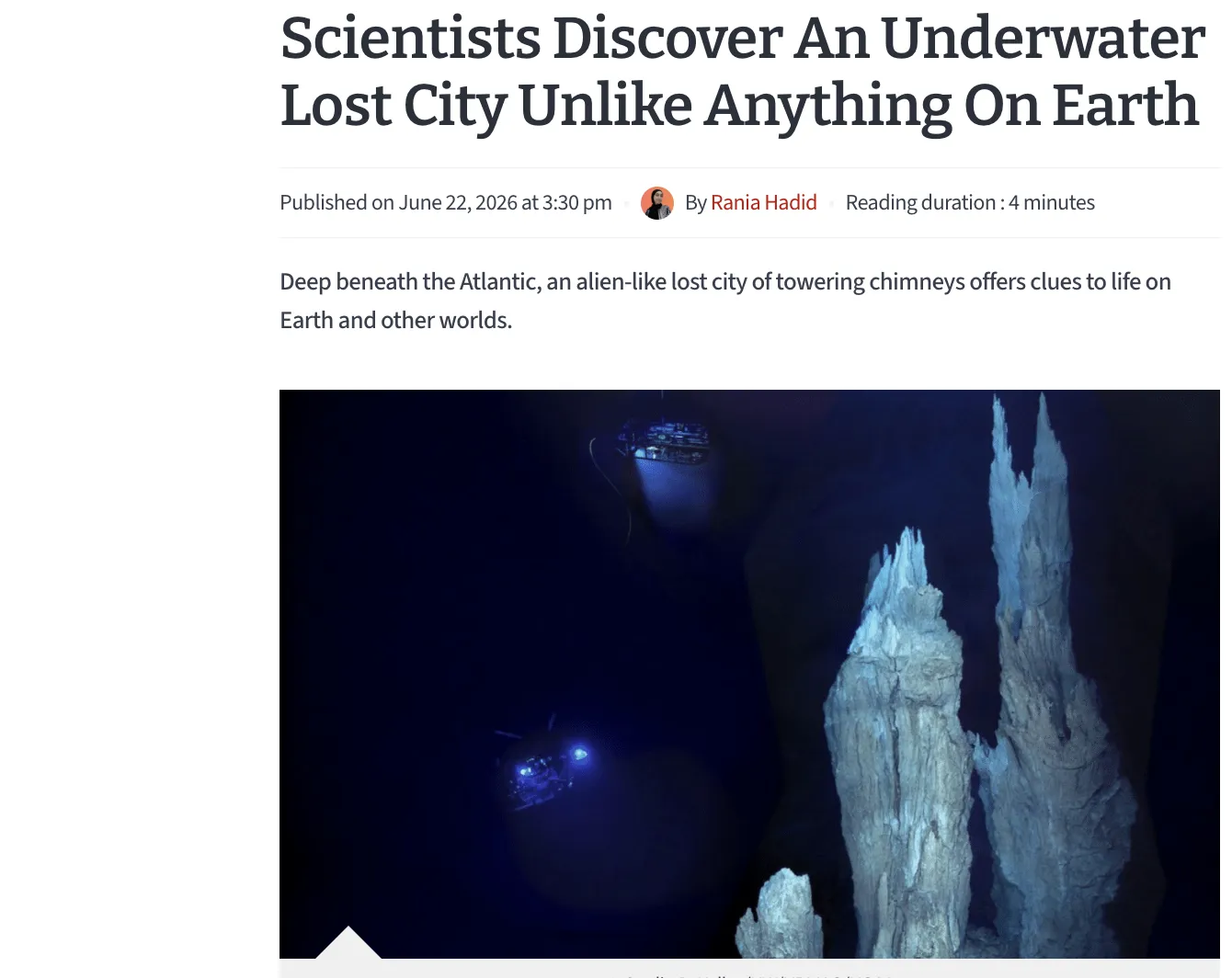
Researchers have documented an underwater geological structure known as the “Lost City,” which stands out from other similar formations on Earth. Despite the extreme conditions, active ecosystems have been discovered there that continue to thrive without sunlight.
Scientists exploring the ocean floor have discovered a mysterious underwater landscape unlike any other place on Earth. It is located at the summit of an underwater mountain west of the Mid-Atlantic Ridge. According to the Indian Defence Review, this is the so-called “Lost City” hydrothermal field, which rises more than 700 meters below the surface in the form of a rugged massif of towering carbonate formations.
“First discovered in 2000, this sprawling, otherworldly environment is now recognized as the world’s oldest hydrothermal vent system, offering an unprecedented insight into how life might have originated under extreme conditions,” the publication adds.
The landscape of the “Lost City” is dominated by towering monoliths and smaller spires—ranging from tiny mushroom-like stacks to structures reaching about 60 meters in height.
“These calcite chimneys glow with an eerie blue light under the beams of remotely piloted aircraft, creating the impression of an otherworldly horizon frozen in time,” the publication notes.
As experts point out, the hydrothermal systems here differ significantly from typical “black smokers” because they produce 100 times more hydrogen and methane while emitting much less heat.
“This unique chemical reaction allows hydrocarbons to sustain diverse microbial communities even in the absence of oxygen, forming the basis of an ecosystem that is completely independent of sunlight. The tallest of these structures, named ‘Poseidon,’ rises over 60 meters and serves as a symbol of both geological stability and biological viability,” the article explains.
At the same time, research from the University of Washington shows that “The Lost City” produces essential chemicals in quantities not seen in typical “black smoker” hydrothermal vents.
“Hydrocarbons, such as methane and hydrogen—which are the building blocks of cellular life—are formed directly as a result of the interaction of seawater with mantle rocks—a process known as serpentinization— — rather than from biological or atmospheric sources,” emphasizes the Indian Defence Review.
Scientists at the University of Washington write that these fluids produce 10 to 100 times more hydrogen and hydrocarbons than “black smokers,” creating an alkaline environment in which microorganisms can thrive.
“Unlike the acidic, iron- and sulfur-rich conditions of ‘black smokers,’ the hydrothermal vents of the ‘Lost City’ are dominated by nearly pure carbonates, which form towering structures and spires that are significantly larger than those found in typical hydrothermal systems,” the publication notes.
Despite the harsh environmental conditions, “The Lost City” is teeming with life. The chimneys are home to snails, crustaceans, crabs, shrimp, sea urchins, and eels, which feed on hydrocarbons released from the hydrothermal vents.
At the same time, bacteria form dense mats on mineral surfaces, creating a microcosm of life that withstands extreme pressure and temperatures reaching 40°C.
“The hydrothermal vents at this site are extremely stable compared to volcanic ‘black smokers,’ which often collapse after a few decades. This longevity allows complex ecological networks to develop, providing scientists with a unique opportunity to observe life in extreme, isolated habitats. Researchers emphasize that these discoveries may help us understand how life could exist in similar extreme environments on other planets,” the article concluded.
You might be interested in:
Traces of a lost planet the size of the Moon may have been found in the Solar System
Previously, scientists explained that our planet differs from others in the Solar System. And this applies not only to the gas giants but also to the rocky celestial bodies near us. For example, just like on Earth, solar eclipses occur on Mars.
And a group of scientists from the University of Warwick, in collaboration with the European Space Agency (ESA), the Georgia Institute of Technology, and the Microgravity Center in Germany, has achieved a breakthrough in the creation of light-driven energy, which could be the key to the future colonization of Mars.
By the end of the decade, NASA plans to establish a lunar outpost on Mars. This must be accomplished before humans begin exploring the planet.


