
Webb study points to possible collisions of Mars-sized bodies — ScienceDaily
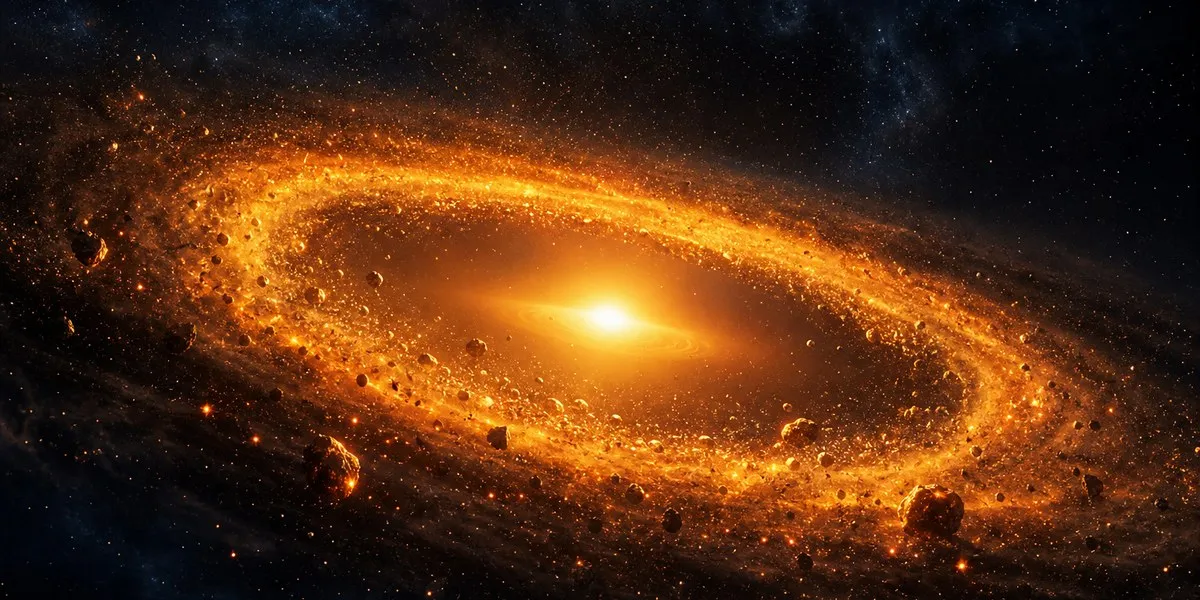
NASA's James Webb Space Telescope examined 21 rare extreme debris disks around young stars. An analysis of warm dust indicated that some of these disks may have formed after extraordinarily energetic collisions between Mars-sized bodies, ScienceDaily reports.
The results were published on October 1 in The Astrophysical Journal. The sample included five disks from archival observations by the Spitzer telescope and 16 systems studied with Webb. Of these, Webb observed 12 for the first time, while four others were re-examined after Spitzer observations.
Two types of dust disks
Extreme debris disks contain especially large amounts of warm dust near stars — roughly in the region where rocky planets orbit in the Solar System. According to available estimates, about 1% of young stars show visible signs of this stage.
The researchers identified three characteristic features of such disks: smaller dust grains than in protoplanetary or typical debris disks, a high content of warm dust, and irregular changes in infrared brightness. Based on mineral composition, the systems were divided into silica-rich and silica-poor groups.
More current news is available on the UA.News Telegram channel Telegram.
About one-third of the disks in the sample proved to be silica-rich. Scientists suggest that they may have resulted from collisions between Mars-sized bodies energetic enough to vaporize significant amounts of rocky material.
Link to the formation of the Moon
The silica-poor disks, which accounted for about two-thirds of the sample, are associated by researchers with less energetic events, including grazing collisions of Moon-sized objects. Silica-rich disks have so far been found only around stars younger than 300 million years, while silica-poor disks occur in systems of different ages and usually show stronger brightness variations.
These observations may help reconstruct the early history of the Solar System. One scientific hypothesis links the formation of the Moon to a collision between the young Earth and a Mars-sized body about 100 million years after the formation of the Sun.




