
Photo: A NASA probe sent a signal from the edge of the solar system for the first time in a year

NASA’s New Horizons spacecraft emerged from hibernation for the first time in nearly a year and transmitted scientific data collected from a distance of about 9.5 billion kilometers back to Earth. The information will help scientists better understand the processes occurring at the edge of the heliosphere—the region where the Sun’s influence ends.
NASA reported that the probe had been in hibernation since August 2025.
During this period, most of its systems were shut down to conserve energy, but its scientific instruments continued to collect data. After resuming operations, the spacecraft began transmitting the accumulated data to Earth.
Due to the vast distance, it takes approximately nine hours for a radio signal from “New Horizons” to reach Earth. According to the results of the check, all of the spacecraft’s systems and scientific instruments are operating normally.
The probe’s primary mission is to study the outer part of the heliosphere—a kind of protective “bubble” formed by the solar wind that shields the Solar System from galactic cosmic radiation.
Scientists are paying particular attention to the boundary of the heliosphere, where the solar wind interacts with the interstellar medium. New Horizons is expected to reach this region around 2029, which will provide unique scientific data.
To date, only the Voyager 1 and Voyager 2 probes have crossed the boundary of the heliosphere, in 2012 and 2018, respectively. At the same time, New Horizons is equipped with more advanced scientific instruments capable of making more precise measurements in the outer regions of the Solar System.
The spacecraft is currently in the Kuiper Belt, located beyond Neptune’s orbit, and is moving away from Earth at a speed of about 483 million kilometers per year.
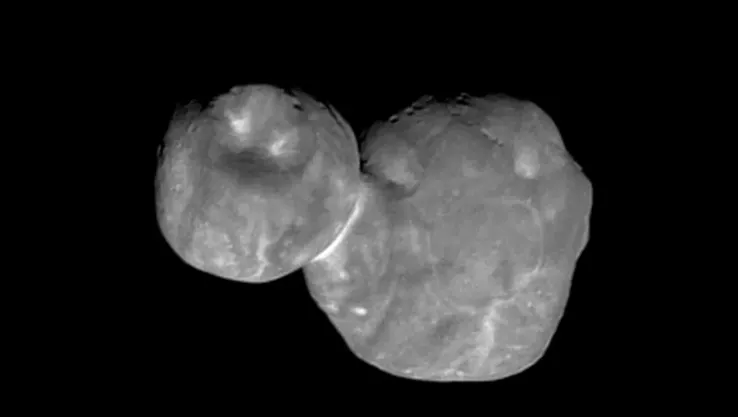
The New Horizons probe was launched in 2006 and made history as the first spacecraft to conduct a close-up exploration of Pluto in 2015. Later, in 2019, it also explored the trans-Neptunian object Arrokoth, which became the most distant celestial body ever studied by a spacecraft.
The data collected will help scientists better understand the structure of the outer reaches of the Solar System and its interaction with interstellar space, and will contribute to the preparation of future interstellar missions.
Earlier, the Artemis II mission crew reached the halfway point to the Moon and sent back the first photos of Earth from deep space. This is the first human flight beyond Earth’s orbit since 1972.
The historic Artemis II mission, which sent humans to the Moon for the first time in over 50 years, has already faced its first challenges. During the flight, the crew experienced a brief “radio silence” as well as everyday difficulties that cannot be resolved with a simple call to a repairman.


