
Halley's Comet will return, offering a unique chance to see it in person
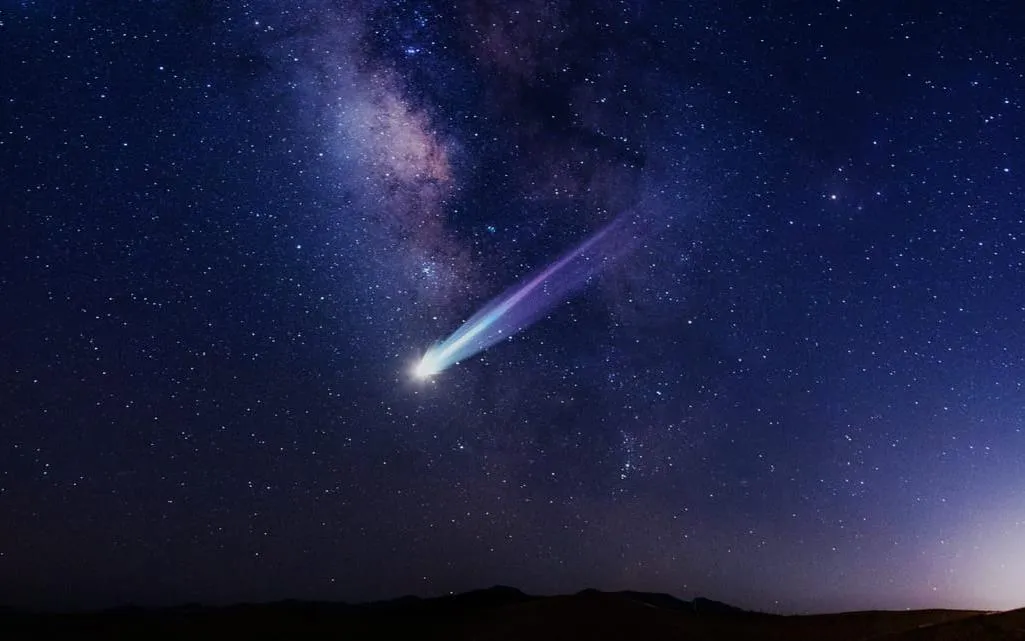
On July 28, 2061, Halley’s Comet will reach perihelion—the point in its orbit closest to the Sun—and will then approach Earth. It won’t reach its next perihelion until March 27, 2134, so for many people alive today, the comet’s return in 2061 may be their only chance to see it with their own eyes.
However, July 28 is not the only day it will be visible. As it approaches the Sun, the Sun’s heat will cause the comet to release gas and dust more actively. A coma will form around the nucleus, and then characteristic tails will appear. Therefore, the observation period will extend over a much longer time.
The exact date of perihelion has already been calculated, but it is impossible to determine the best days for observation in advance. This will depend on the comet’s position relative to the Sun and Earth, the observer’s latitude, the duration of twilight, the weather, and moonlight.
The comet was named after the English astronomer Edmond Halley. He compared the trajectories of bright comets observed in 1531, 1607, and 1682, and hypothesized that they were all the same object that returns periodically. Halley predicted its return, and in 1758 the comet did indeed return—after the scientist’s death.
According to NASA, observations of this comet date back more than two thousand years. Today, it is officially designated 1P/Halley and is considered a periodic comet.
The common belief that this comet returns every 76 years is only an approximation. The interval between appearances ranges from approximately 74 to 79 years. Its orbit is influenced by the gravity of the planets and small emissions of material from the comet’s surface.
Halley’s Comet last passed through perihelion on February 9, 1986. For many people on Earth, its appearance proved to be a disappointment: its position relative to the Sun was unfavorable for observation.
In 2061, the alignment should be much more favorable. Earth and the comet will be on the same side of the Sun around the time of perihelion. However, this does not guarantee a certain level of brightness: the comet’s activity may prove unpredictable, and city lights could obscure its faint tail.
In 1986, the comet became not only an object of observation but also an important target for space exploration. The Giotto spacecraft approached its nucleus to within approximately 596 kilometers and revealed that it has an elongated shape and reflects very little sunlight. At the same time, small active regions on its surface eject enough material to form a huge, bright coma and tail.
Interestingly, Earth encounters particles from Halley’s Comet every year. This comet is the source of two well-known meteor showers—the Orionids in October and the Eta Aquariids in May. Earth crosses the dust trail left by the comet during its previous passes.
Space Daily reports on this.
As a reminder, Comet PANSTARRS formed a second tail during its close approach to Earth.
We also reported that NASA launched Artemis II: the first crewed flight to the Moon in 50 years.
NASA congratulated the Artemis II crew on their successful return following their historic mission.


