
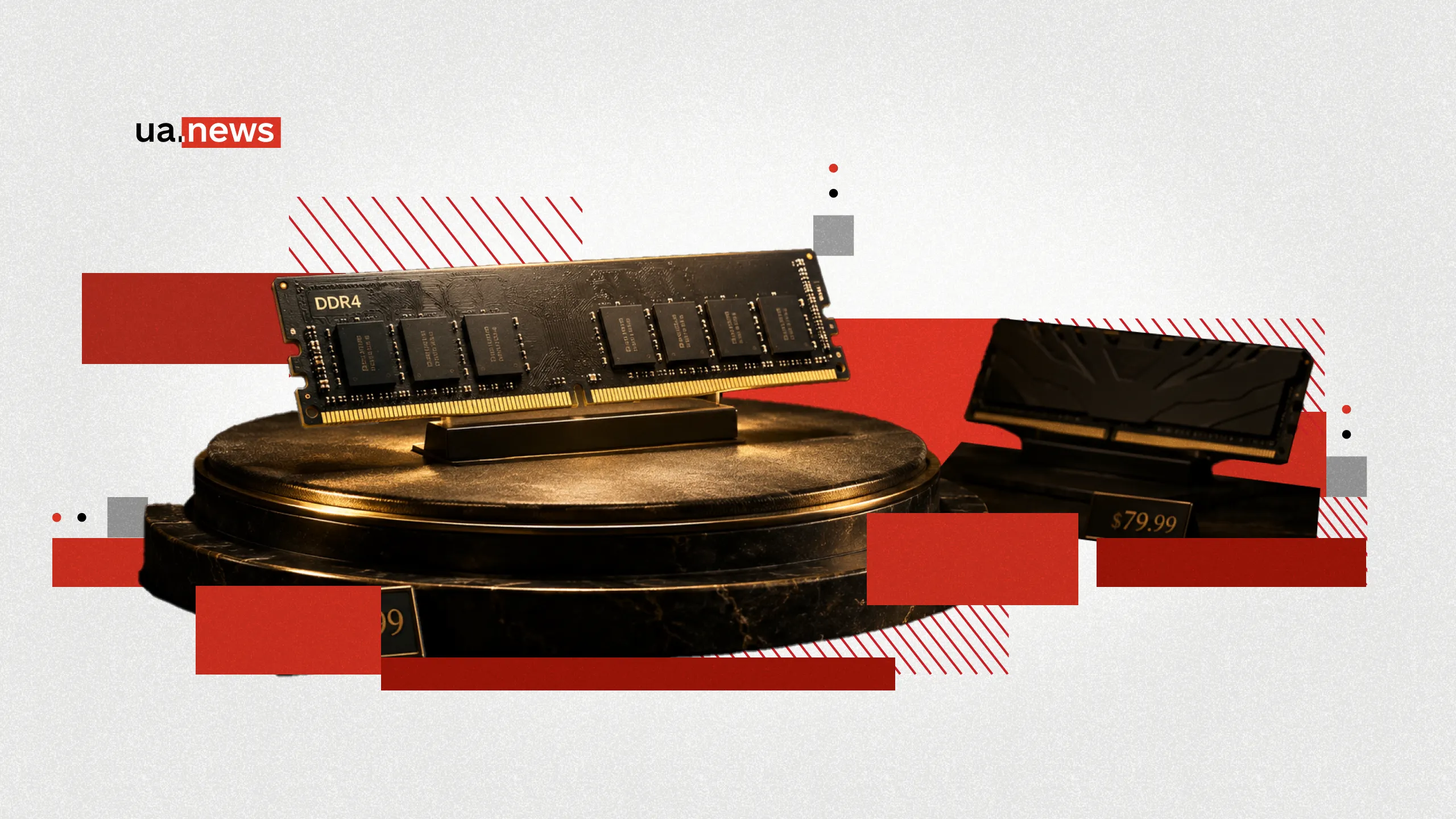
RAM in 2026: Shortages, Price Inversion, and Global Implications
11 June 2026 09:07What do we know about RAM? It’s essentially the computer’s workspace. It’s not where files are stored, but where all the current work takes place: open browser tabs, running programs, and gameplay. The more RAM you have and the faster it is, the smoother your device runs.
With the advancement of technology, manufacturers have created five generations of RAM. DDR1 appeared in the early 2000s and replaced the outdated SDRAM standard. DDR2 took its place in the middle of the decade and became faster and more energy-efficient. DDR3 raised the bar again in 2007 and remained on the market for nearly a decade. DDR4 appeared in 2013 and became the longest-lasting standard in history. Currently, it is still found in most computers around the world.
Five years ago, the industry welcomed a new generation—DDR5. Faster, more efficient, with higher bandwidth. It seemed that DDR4, like its predecessors, would be consigned to history. Moreover, in 2025, manufacturers unanimously declared that the 2013 standard had run its course and it was time to clear the production lines.
But in early 2026, something happened that the industry refused to believe. The old memory didn’t just fail to get cheaper. It became more expensive than the new one. And finding it is now harder than it was a year ago.
A market that had operated by a single rule for decades suddenly went in the opposite direction. In this article, we explain why.
Unsellable
Analysts refer to the rising cost of the previous generation of memory as a price inversion. According to Counterpoint Research, at the end of 2025, a gigabyte of DDR4 cost $2.10, while a gigabyte of server-grade DDR5 cost $1.50.
For the average buyer, the numbers are even clearer. In the fall of 2025, a 32GB DDR4 kit cost between $60 and $90 in the U.S. That’s the price everyone was used to. However, in January 2026, the same kit was priced between $150 and $180. Quite a price hike. Tech journalists dubbed this period “RAMmageddon.”
In fact, the component found in every computer—and upon which its performance depends—suddenly became perhaps the most expensive part of the entire computer. And this applies to both home and office PCs, as well as servers in data centers.
What is the reason for the rise in RAM prices?
The root of the problem lies not in a shortage of raw materials or a natural disaster. It was all decided by production plans adopted several quarters earlier. And yes, AI played a role.
Three companies control nearly the entire global RAM market: Samsung, SK Hynix, and Micron. And all three decided at the same time to switch to a different product. We’re talking about HBM—a special type of memory for AI chips. ChatGPT, Gemini, and other neural networks run on these very chips. Demand for HBM was growing at a breakneck pace, the margins were significantly higher, and the market monopolists made their choice.
But there’s a catch. Producing HBM requires far more resources than regular memory. According to industry estimates, one gigabyte of HBM requires three times as much silicon wafer area. In fact, the more factories produce memory for artificial intelligence, the less conventional memory comes out of those same facilities.
Manufacturers shifted their capacity to DDR5 and HBM, and began phasing out DDR4 production. In the spring of 2025, Samsung, SK Hynix, and Micron sent notices to customers about the imminent end of production. Chinese manufacturer CXMT did the same.
But demand hasn’t gone anywhere, and problems have begun. The corporate sector and data centers have been building infrastructure on DDR4 for years. Switching to DDR5 requires more than just replacing the memory modules. DDR5 demands new processors, new motherboards, and compatibility testing for all equipment. For a large company, this means months of downtime and millions in costs. It’s cheaper to pay extra for the old memory. Manufacturers of industrial equipment, automotive electronics, and telecom systems—where devices last not for years but for decades—reason the same way.
Manufacturers saw what was happening and decided to respond, though they did so in different ways. Samsung agreed to continue producing DDR4 until the end of 2026 but will not build new production lines for it. SK Hynix has even ramped up production at its old factory in China. Micron decided not to change its plans and simply exited this market.
But even the DDR4 that is still being produced rarely reaches the average consumer. It is pre-allocated among large corporate customers. Small businesses and ordinary people are left with whatever remains in stock.
Who Pays for the Shortage
As always, those who have no bargaining power are the ones paying the price. First and foremost, these are ordinary buyers and small workshops that build custom computers. Major brands (Dell, Lenovo, HP) warned as early as the beginning of 2026 of a 15–20 percent price increase for pre-built computers. The American company CyberPowerPC, which specializes in gaming PCs, announced a fivefold increase in RAM prices. Memory, which last year accounted for 15–18% of the cost of a new computer, now accounts for roughly twice as much.
Small and medium-sized businesses that were just planning to upgrade their equipment now face a simple but unpleasant choice: buy now and overpay, or wait and risk prices rising even higher tomorrow.
The story is different for data centers and large corporations. They can neither wait nor find a substitute. They need memory right here and now, in large volumes. That’s why they sign long-term contracts with fixed prices, and each such contract further drains memory from the open market.
But the most vulnerable turned out to be those who are rarely mentioned in tech news. Manufacturers of industrial, medical, and automotive equipment operate in a different timeframe. Their devices are designed ten to fifteen years in advance. They simply cannot switch to a different memory standard in the middle of a production cycle. For them, a DDR4 shortage isn’t just a line item in the budget. It’s a production line shutdown. They were the first to rush out and buy up supplies after news of production cuts, thereby destabilizing the market even further.
And then there are professionals who need large amounts of memory for workstations: video editors, engineers, developers. For them, memory costs can easily exceed the combined cost of the processor and graphics card.
What to expect next
Analysts aren’t promising a quick relief. Although forecasts differ in detail, experts are certain of one thing: the first half of 2026 will be an expensive time to buy RAM.
At the beginning of the year, TrendForce predicted a 90–95% increase in DRAM prices in just one quarter. The reason is the same: the demands of artificial intelligence. According to some estimates, AI data centers will consume about 70 percent of all high-quality memory in 2026. Just a few years ago, such a figure would have seemed like science fiction.
Manufacturers promise to increase DRAM production by more than 20 percent in a year. But even that may not be enough. Most analysts agree that true stabilization won’t come until late 2026 at the earliest. And significant relief may be pushed back to 2027.
There is also a more optimistic view. SK Hynix considers the current surge to be temporary, simply a market reaction to fears of supply disruptions. Analysts point out that this has happened before during the transition from DDR2 to DDR3. It lasted about four months. Then the market stabilized on its own.
But there is also a more alarming interpretation of the same facts. Perhaps this is not a one-time glitch, but a new order of things. Artificial intelligence is already consuming the lion’s share of memory production. Its appetite grows every year. And if this continues, each subsequent transition between DRAM generations will be more expensive and more painful. Simply because there will be less and less left for the rest of the memory market.
What does this mean for Ukraine
Unfortunately, the Ukrainian market has no cushion to soften this blow. We buy memory at the same global prices as the rest of the world, and on top of that, we add exchange rates and logistics costs. So as soon as global prices change, the cost of memory here skyrockets as well.
The price growth is staggering. According to UNIAN, in just a few months during the fall of 2025, the most popular memory modules in Ukraine nearly doubled in price. A 32 GB DDR5 kit from GOODRAM rose in price from 5,200 to 8,400 hryvnias. A pair of 16 GB G.Skill modules running at 6,000 MHz cost about 5,800 hryvnias at the end of August. Two months later, they now cost nearly 10,700. As of 2026, prices are even higher.
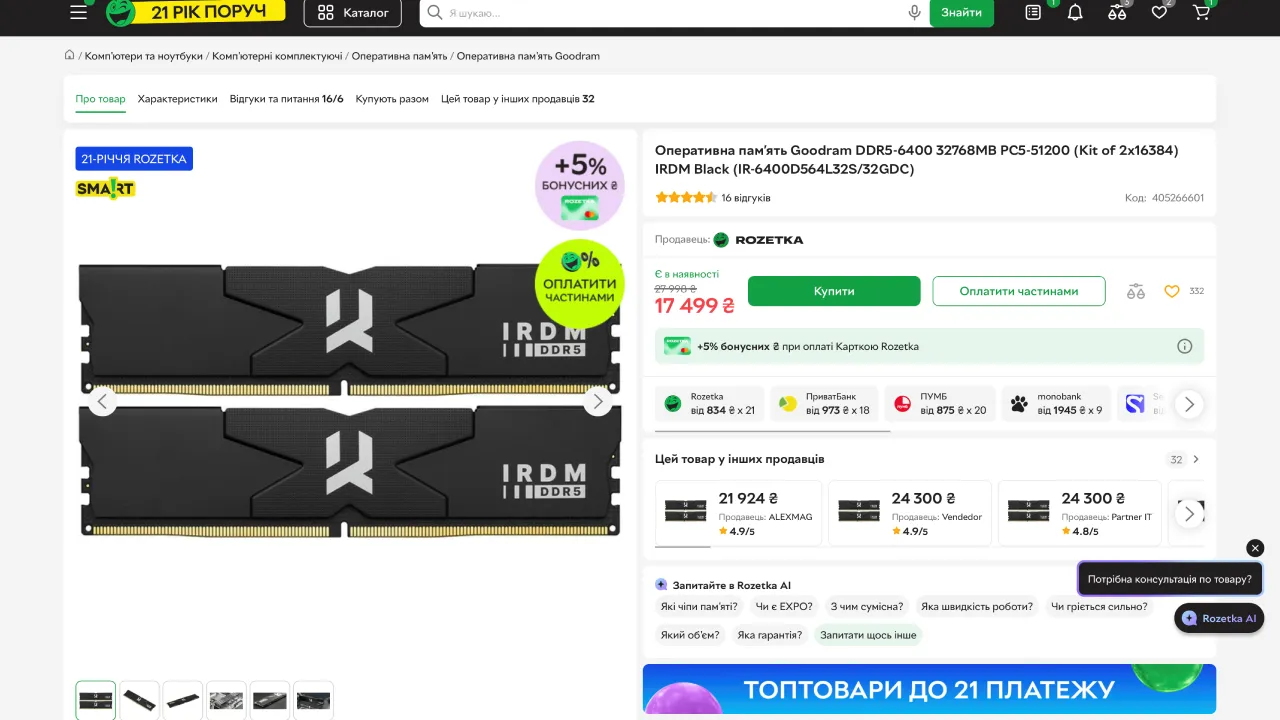
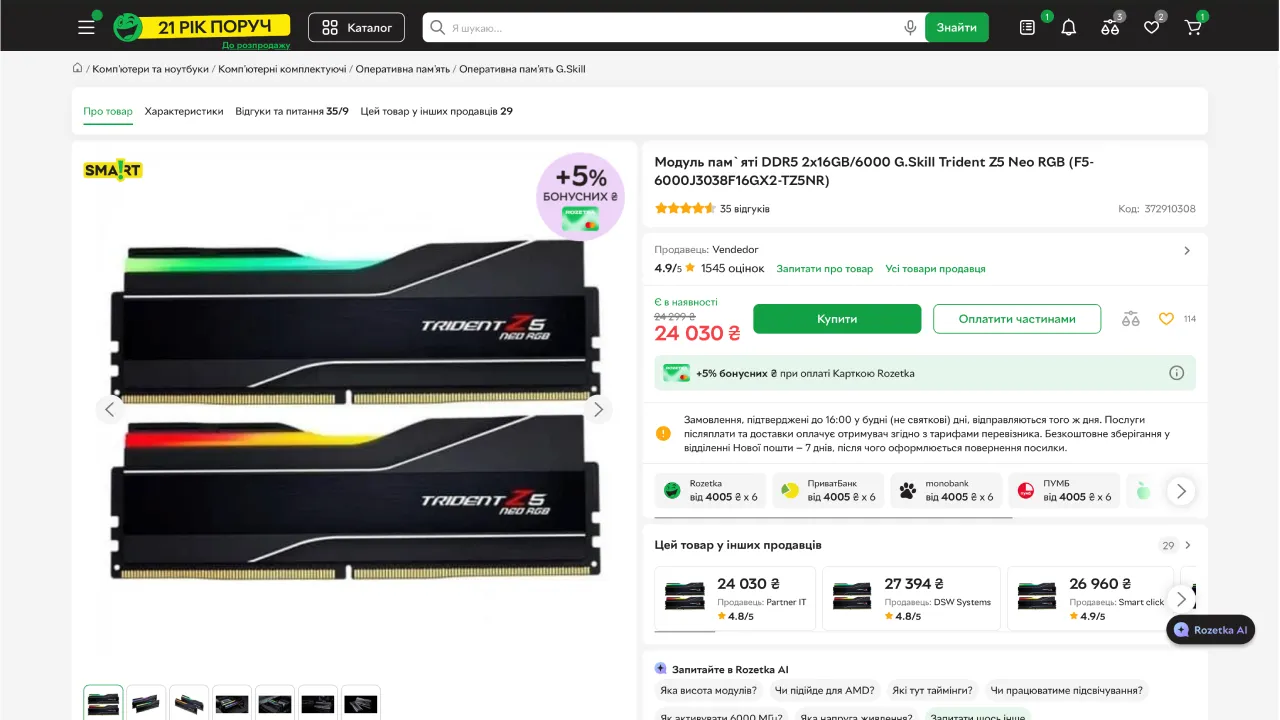
DDR4 is following the same trend. In some cases, even faster.
These changes are particularly painful for us. Budgets are already stretched thin between blackouts, exchange rates, and the war, and upgrading a computer or renewing the work equipment fleet has become a significant expense. Because of this, some buyers are turning to the secondary market and purchasing used memory to lock in the price now.
Don’t expect any quick relief here. Retail prices catch up to wholesale prices with a delay of eight to nine months. Occasional discounts on remaining stock from old batches should be viewed as a temporary phenomenon, not a reversal of the trend.
For now, the practical conclusion is simple. If you need DDR4 for your existing system, delaying the purchase is risky; it’s unlikely you’ll be able to buy it cheaper anytime soon. If you’re planning a new build, you should budget for significantly higher memory costs than a year ago. And businesses that rely on DDR4 infrastructure should do the math to see what’s more cost-effective.
The standard that everyone was rushing to bury has turned out to be surprisingly resilient. And the market is now paying the full price for that resilience.


