
Servers vs. People: Why There Are Protests Against Data Centers in the U.S.
05 August 2026 18:03Just a few years ago, data centers remained a nearly invisible part of the digital economy. People used search engines, social media, banking apps, and cloud storage without giving a second thought to where their photos, messages, and documents were physically stored.
However, the development of generative artificial intelligence has transformed server complexes into large-scale industrial facilities that require power plants, substations, water pipelines, and hundreds of hectares of land.
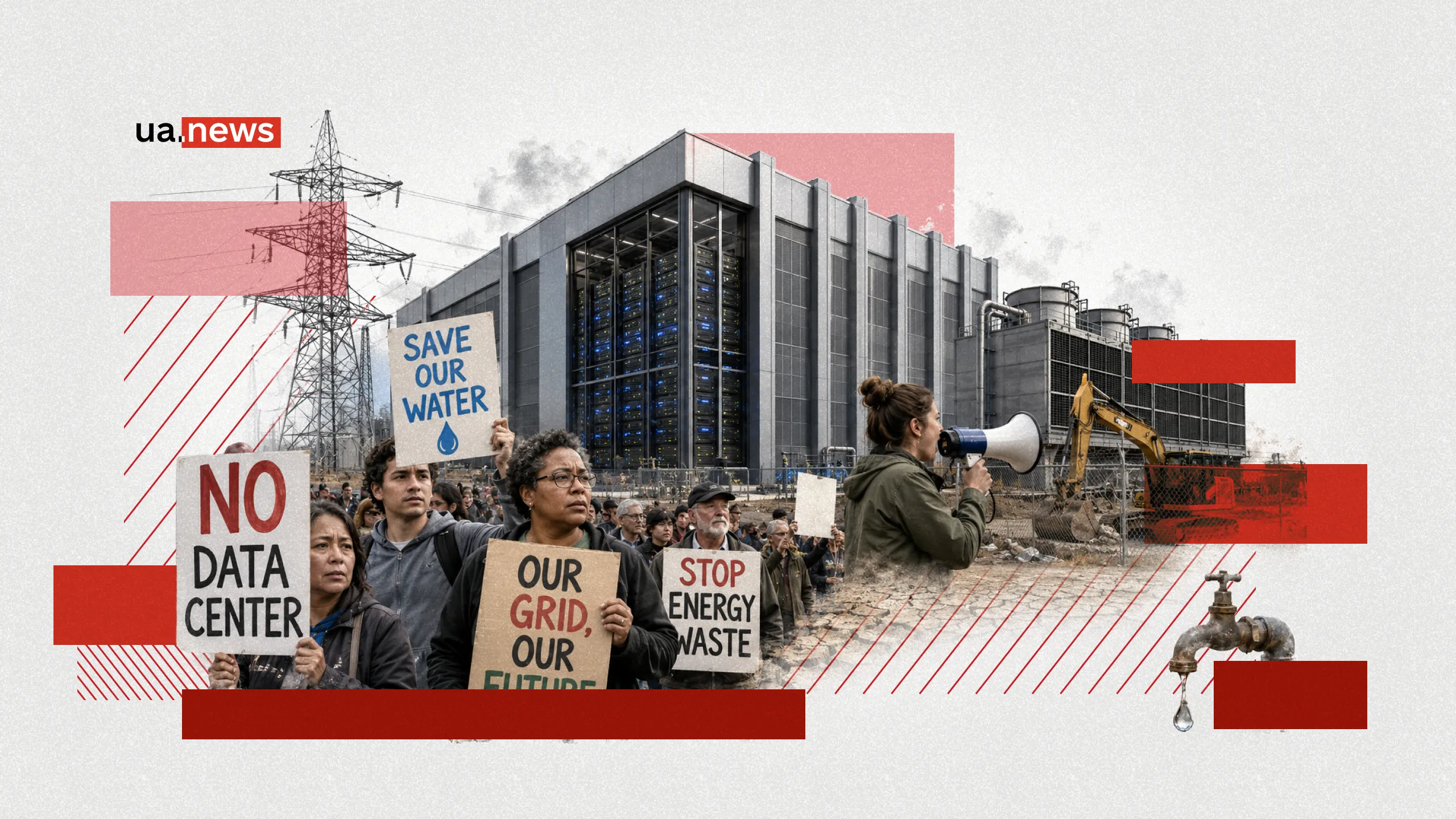
On July 18, 2026, opponents of the rapid construction of data centers held 142 protests across 42 U.S. states. According to Reuters, this was the first coordinated nationwide campaign against the expansion of artificial intelligence infrastructure. Protesters demanded transparency, protection of water resources, community participation in project approvals, and corporate accountability for unfulfilled promises.
According to a Reuters/Ipsos poll, only 14% of Americans are willing to support the construction of an AI data center in their community.
In less than three weeks, the issue reached the level of state policy. On August 4, Texas Governor Greg Abbott ordered a suspension of approvals for new data centers seeking to connect to the state’s power grid until they undergo a special audit. ERCOT, the operator of the Texas power grid, is reviewing applications for new customers with a total capacity of about 474 gigawatts.
Approximately 90% of this potential demand comes from data centers, and the declared capacity is more than five times the record peak load for the entire state of Texas.
UA.NEWS explains why data centers have become one of the major infrastructure conflicts in recent years, how much electricity and water they consume, and what local communities fear.
What Is a Data Center and Why the Digital World Can’t Function Without It
A data center is a specially equipped building or complex of buildings that houses servers, data storage systems, networking equipment, batteries, backup generators, and cooling systems.
Search engines, social networks, video services, cloud storage, online banking, government registries, and corporate systems all operate through data centers. When a user sends a message, watches a TV show, or asks a chatbot a question, the request is processed not in some abstract “cloud,” but on physical hardware.
According to the International Energy Agency, in a modern data center, servers consume an average of about 60% of the electricity. Data storage systems account for approximately 5%, and networking equipment accounts for up to another 5%. Cooling accounts for anywhere from about 7% in the most efficient hyperscale facilities to over 30% in older or less efficient corporate data centers.
The problem lies not in the existence of data centers themselves, but in how rapidly they are expanding. Millions of people in different countries can use digital services, while electricity, water, noise, and new power lines are concentrated in a single specific city or town.
Why Artificial Intelligence Has Dramatically Increased Demand for Electricity
Conventional internet services also require servers, but generative artificial intelligence has significantly increased the demand for computing power. Thousands of specialized graphics processing units (GPUs) are used to train and run large language models. They perform a massive number of operations, run almost continuously, and generate significantly more heat than traditional servers.
According to an updated forecast by the International Energy Agency, data centers worldwide will consume approximately 485 terawatt-hours of electricity in 2025. By 2030, this figure could nearly double—to 950 terawatt-hours, or about 3% of total global electricity demand. At the same time, consumption by data centers focused primarily on artificial intelligence could triple.
The energy efficiency of individual processors and algorithms is improving. However, these savings are offset by an increase in the number of users and the emergence of new energy-intensive services—such as video generators, voice assistants, big data analytics systems, and autonomous AI agents.
The MEA explicitly states that energy consumption per task is decreasing, but overall demand continues to grow due to the widespread adoption of the technology.
How Much Electricity Do Data Centers in the U.S. Consume?
In the United States, the scale of the problem is particularly noticeable. According to a report by the Lawrence Berkeley National Laboratory, released by the U.S. Department of Energy, in 2023, U.S. data centers consumed approximately 176 terawatt-hours of electricity—about 4.4% of the country’s total consumption.
By comparison, in 2014, this figure stood at 58 terawatt-hours. By 2028, consumption could rise to 325–580 terawatt-hours, or 6.7–12% of U.S. electricity. This wide range is due to uncertainty regarding the number of new AI accelerators, server utilization, and the speed at which new facilities are coming online.
A single large AI data center can consume as much electricity as approximately 100,000 households. The largest complexes currently under construction may require 20 times that amount, according to the International Energy Agency.
For the power grid, the problem lies not only in the total amount of electricity. Data centers operate around the clock and require a stable power supply. They also tend to cluster in the same regions where fiber-optic networks, substations, affordable land, or tax incentives already exist.
A data center itself can be built in two to three years, whereas the design and construction of power plants, transformers, and transmission lines take significantly longer. It is this very difference that creates waiting lists for grid connections and forces energy companies to urgently invest billions of dollars in expanding their networks.
How Much Water Do Data Centers Need?

Electricity is only one part of the resource footprint. Server equipment constantly generates heat that must be dissipated. To do this, data centers use air, liquid, or evaporative cooling.
In systems with cooling towers, water absorbs heat and then partially evaporates. This method may require less electricity than fully air-based cooling, but it creates a constant demand for water.
According to estimates by the Lawrence Berkeley National Laboratory, U.S. data centers directly consumed about 66 billion liters of water in 2023, or approximately 17.4 billion gallons. In 2014, direct consumption stood at 21.2 billion liters.
There is also an indirect water footprint. Water is needed by thermal and nuclear power plants that generate electricity for servers. According to Berkeley Lab’s estimates, in 2023, indirect water consumption associated with powering U.S. data centers approached 800 billion liters, or approximately 211 billion gallons.
These figures should not be confused. Direct consumption occurs on the data center’s premises and can place a strain on local water systems, wells, or reservoirs. Indirect consumption occurs at power plants and depends on the sources from which the data center obtains its electricity.
It is also important to distinguish between water withdrawal and water consumption. Withdrawn water is sometimes returned to the water body, although it may have a different temperature or quality. Water is considered consumed when it has evaporated or has not otherwise returned to the local water cycle.
Nationwide, data centers use less water than agriculture. But for a specific arid community, an additional few million liters per day can be critical. The situation is particularly challenging in the summer, when data centers require more cooling due to the heat, residents use air conditioning more frequently, and water supplies are simultaneously dwindling.
Why Americans Are Protesting the Construction of Data Centers
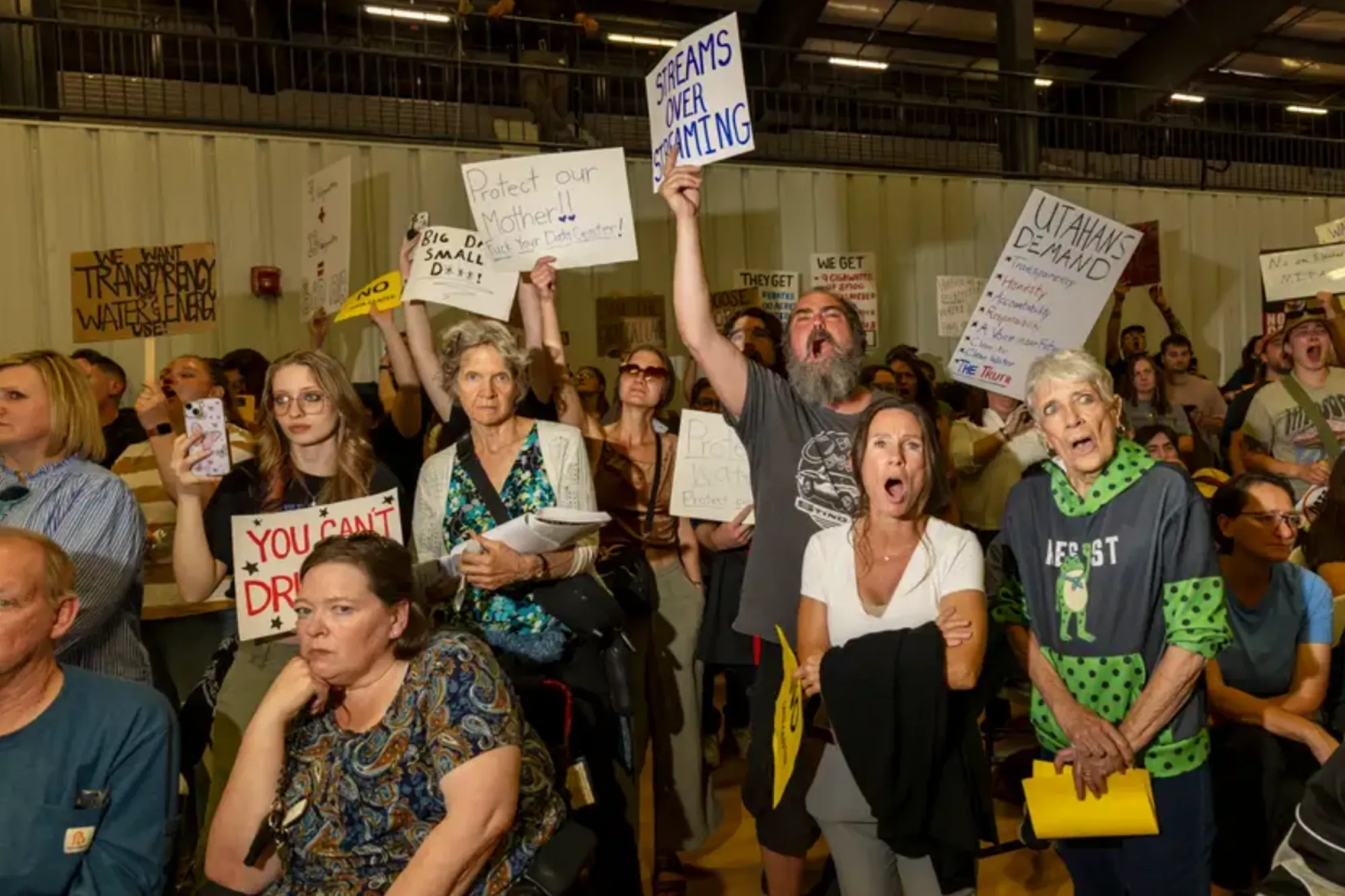
The main complaint of local residents is the lack of a clear answer to the question: What will the community receive in exchange for the land, water, and strain on the power grid?
Companies promise tax revenue, investments, construction contracts, and new jobs. At the same time, opponents of these projects fear higher utility rates, noise from fans and transformers, pollution from backup diesel generators, the loss of green spaces, and a decline in property values.
According to a study by Data Center Watch, over the course of two years, data center projects worth approximately $18 billion were blocked in the U.S. due to community pressure, and another $46 billion worth were delayed. The organization identified at least 142 activist groups across 24 states. Most often, they raise concerns about rates, water consumption, noise, the preservation of green spaces, and the impact on property values.
Public opinion is also becoming increasingly critical. According to a Pew Research Center survey, 39% of Americans view the environmental impact of data centers as mostly negative, 38% see it as negative for electricity costs, and 30% view it as negative for the quality of life of nearby residents.
At the same time, 25% of respondents view data centers as beneficial for the local job market, and 23% see them as beneficial for tax revenue. This shows that the public does not deny the potential economic benefits but is increasingly skeptical that they outweigh the infrastructure and environmental costs.
Why Opponents of Data Centers Have United the Left and the Right
Opposition to data centers does not fit into the usual divisions of American politics. Environmental organizations primarily focus on water, pollution, emissions, and climate change. Conservative activists criticize tax breaks for tech corporations, interference in the lives of rural communities, and the potential for forced land expropriation for power lines.
Money remains a common concern. Residents fear that tech companies will receive incentives and cheap land, while ordinary consumers will foot the bill for grid expansion through higher utility rates.
That is why the protest campaign on July 18 spanned both Republican and Democratic states. Most of the demonstrations took place in Texas, but protests also occurred in California, Georgia, Pennsylvania, Florida, and Indiana. Reuters calls opposition to data centers one of the few issues that currently unites Americans with different political views.
Why has this issue become particularly relevant in recent years?
Data centers have existed for decades, but in the past, the growth of digital services was partially offset by improvements in equipment efficiency. Companies replaced old servers, consolidated workloads, and built more efficient hyperscale facilities.
Artificial intelligence has shifted this balance. The demand for computing power has begun to grow faster than the energy efficiency of processors. At the same time, the U.S., China, Europe, and countries in the Middle East began to view computing power as a strategic resource on par with semiconductors and energy.
According to the International Energy Agency, capital expenditures by the five largest technology companies exceeded $400 billion in 2025. In 2026, they could grow by another 75%. A significant portion of this money is being directed toward servers, chips, data centers, and energy infrastructure.
The impact is particularly noticeable in countries where data centers are concentrated in a small area. For example, according to data from the Central Statistics Office of Ireland, in 2025, data centers consumed 23% of all the electricity recorded by the country’s meters. In 2015, their share was only 5%.
Conflicts over water are also arising outside the United States. In Chile, an environmental court ordered a review of the permit for a Google data center near Santiago due to its potential impact on the region’s aquifer, which has been suffering from drought for years. Google later decided to redesign the project and switch from water cooling to air cooling.
Is it possible to build data centers without harming communities?
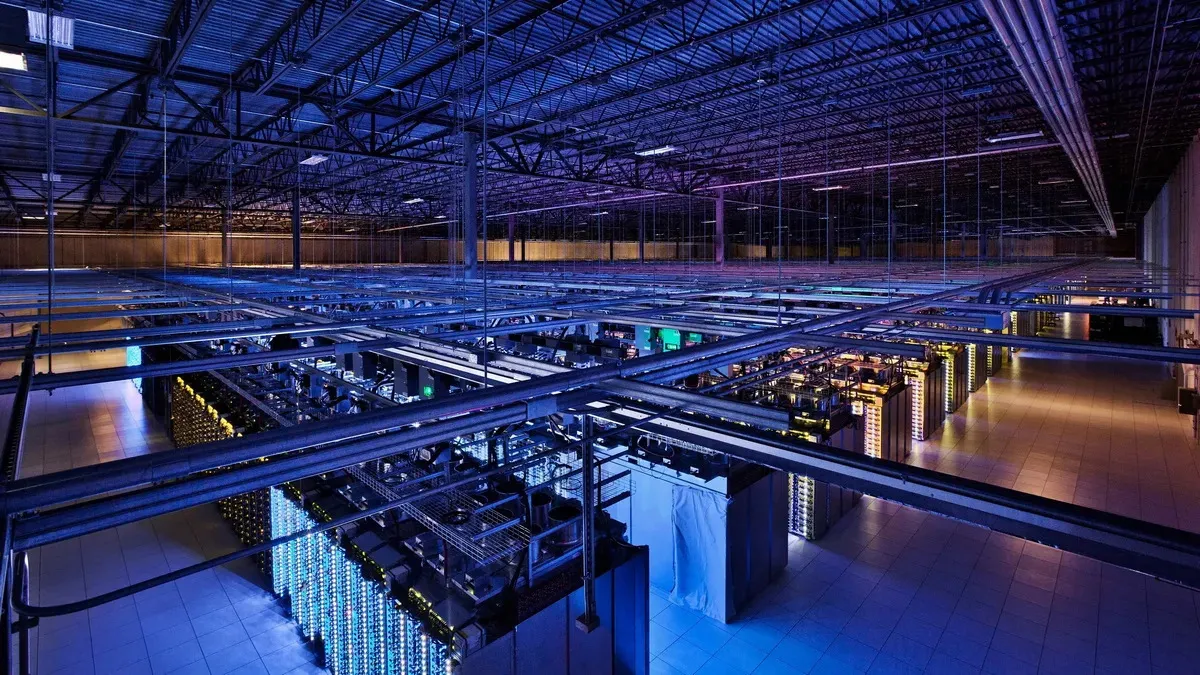
It is impossible to completely do away with data centers. They keep banks, hospitals, government agencies, communication systems, online services, and scientific platforms running. Artificial intelligence can also be used in medicine, energy, weather forecasting, and the development of new materials.
However, not all data centers have the same impact on the environment. Closed-loop cooling systems allow the same liquid to be reused multiple times. Treated wastewater can be used instead of drinking water. Data centers can be built in cooler regions, where the equipment is cooled by outside air for part of the year.
However, there is no one-size-fits-all solution. Air cooling saves water but may require more electricity in hot climates. Water cooling sometimes reduces energy consumption but increases the strain on local water resources.
Therefore, the entire balance must be evaluated: power sources, water consumption, local climate, emissions, noise, the need for new power lines, and the ability to temporarily reduce the load during peak hours.
Protests in the U.S. have shown that data centers are no longer just inconspicuous warehouses full of computers. They have become full-fledged, heavy-duty infrastructure—with enormous demand for electricity, water, land, and networks.
This does not mean that the development of artificial intelligence must be halted. But digital services are not intangible. Every chatbot, video generator, or cloud storage service has a physical cost that specific regions bear.
Therefore, the main question is no longer whether humanity needs data centers. The question is where to build them, who will pay for the necessary infrastructure, how many resources they will be able to use, and whether local residents will have the right to influence these decisions.




