
Roman Telescope Will Have a Much Wider Field of View Than Hubble and JWST
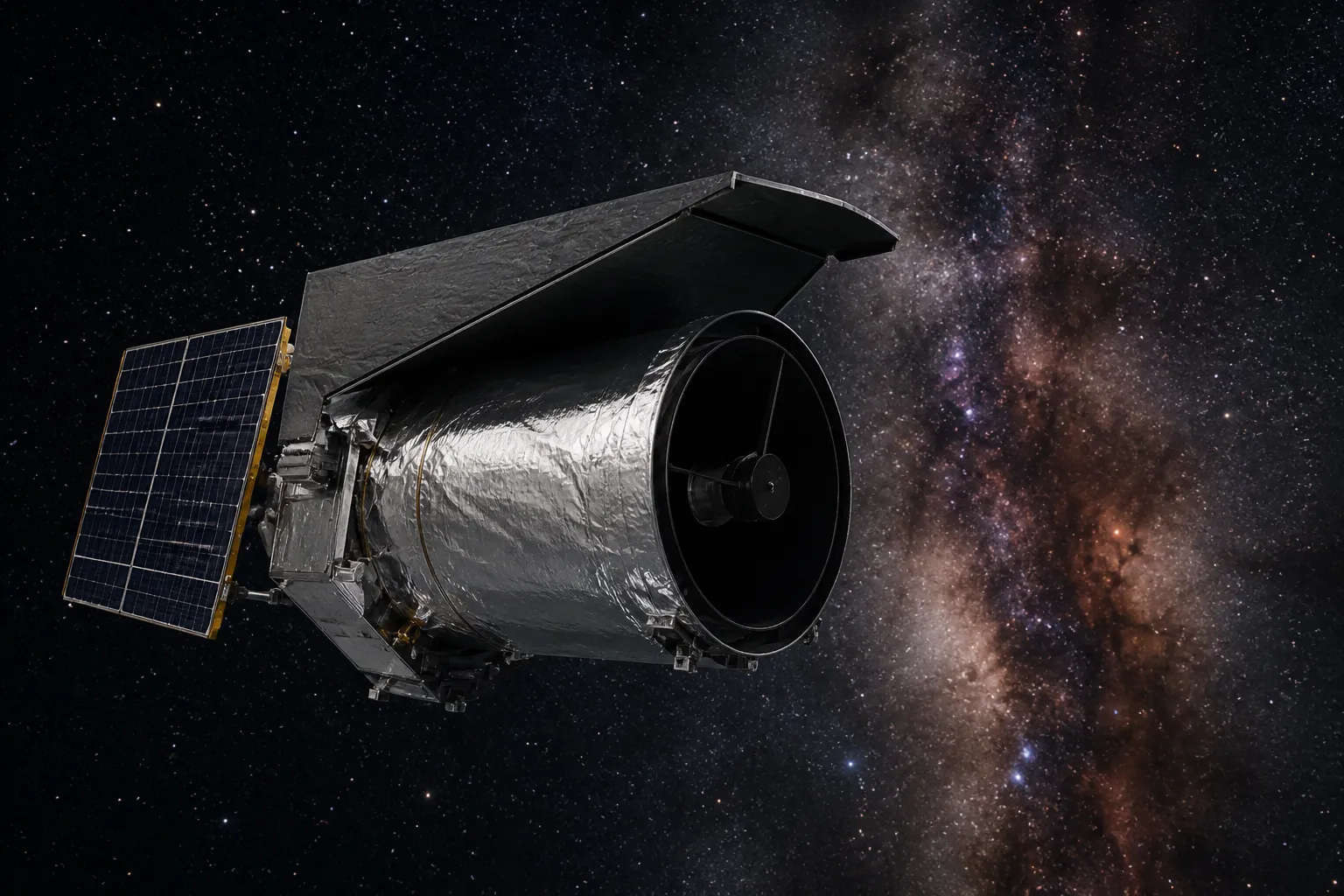
NASA's Nancy Grace Roman Space Telescope is planned to launch on August 30 aboard a SpaceX Falcon Heavy rocket from the Kennedy Space Center in Florida. The observatory is expected to use the Wide-Field Instrument and a coronagraph for large-scale surveys of space, the search for exoplanets, and research into dark matter and dark energy, Space.com reports.
Wide field of view
Roman's primary mirror has a diameter of 2.4 meters, the same as the Hubble telescope's. At the same time, the Wide-Field Instrument's field of view will be approximately 100 times larger than Hubble's infrared instrument and 50 times larger than that of the James Webb Space Telescope. This is expected to allow the spacecraft to cover significantly larger areas of the sky in a single observation.
According to NASA, during its operation Roman will be able to measure light from about one billion galaxies and billions of other cosmic phenomena. NASA Administrator Jared Isaacman said that the telescope's survey capabilities will be more than a thousand times faster than Hubble's, while a single image will be able to cover an area of the sky 200 times larger. Roman is expected to generate about 500 terabytes of data annually, whereas Hubble has collected approximately 400 terabytes over about 35 years of operation.
Complementing other telescopes
The Wide-Field Instrument specializes in infrared radiation. Such observations make it possible to study very distant objects whose light is shifted into the infrared part of the spectrum due to the expansion of the Universe, as well as objects hidden behind interstellar dust and gas.
More current news is available on the UA.News Telegram channel Telegram.
Roman will not have the same image depth as JWST, whose primary mirror has a diameter of 6.5 meters. Instead, its broad survey is expected to make it possible to detect more potentially important phenomena simultaneously, including supernovae, fast radio bursts, emissions from black holes, and candidates for gravitationally lensed galaxies. Other observatories will be able to conduct more detailed observations of the detected targets.
Coronagraph and exoplanets
Roman's coronagraph is intended to block the bright light of stars to help directly detect planets orbiting them. According to NASA's estimate, it will be able to detect planets that are 100 million times fainter than their stars. Its capabilities are expected to be 100–1000 times better than those of existing space coronagraphs.
Roman's baseline mission is designed for five years. If the spacecraft's operation is successful, its duration may increase to ten years.


