
CERN discovers how quarks disturb primordial plasma — ScienceDaily
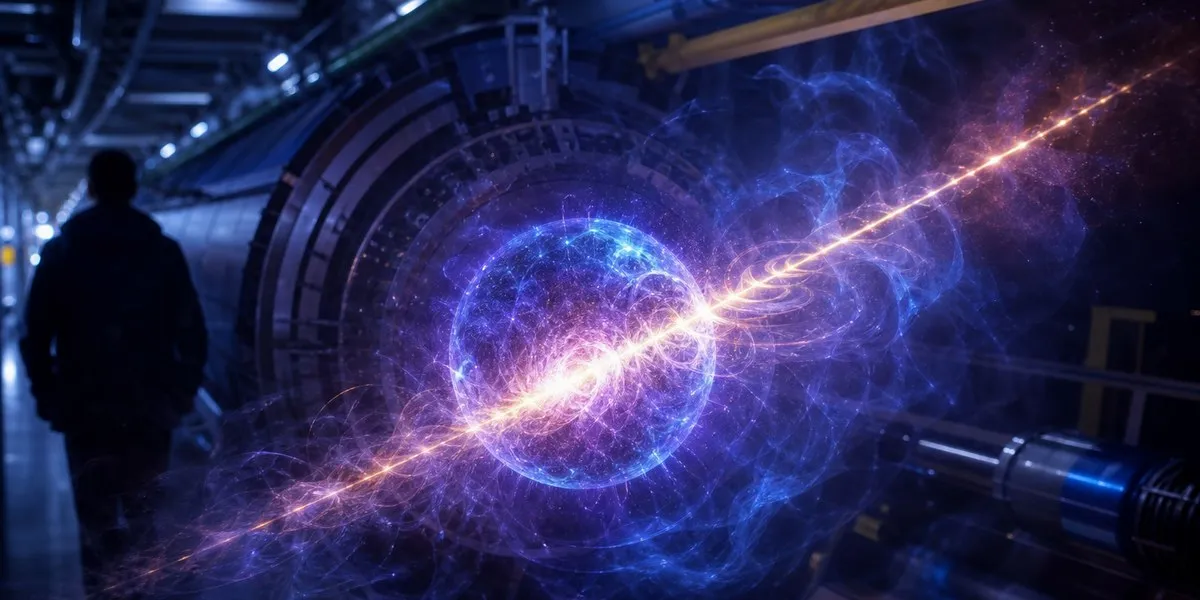
Researchers at CERN’s Large Hadron Collider in Switzerland have found signs of a wave-like wake that high-energy quarks leave in quark-gluon plasma. The observations indicate that this ultra-hot form of matter responds collectively to the motion of particles like a liquid, rather than being a collection of independently scattered particles, ScienceDaily reports.
How they searched for a quark’s wake
Quark-gluon plasma is a state of matter in which quarks and gluons existed during the first microseconds after the beginning of the Universe. At the collider, it is briefly recreated during collisions of heavy ions, including lead ions, accelerated to nearly the speed of light. The resulting droplets of such matter exist for less than a quadrillionth of a second, so their properties are determined from the distribution of particles produced after the collision.
Previous searches focused on quark-antiquark pairs, but their traces could overlap. The new method involved selecting events in which a quark moved almost in the opposite direction to a Z boson, a neutral elementary particle that interacts weakly with the plasma. This made it possible to use the Z boson as a reference point for determining the quark’s direction of motion.
More current news is available on the UA.News Telegram channel Telegram.
Analysis of billions of collisions
The team, which included members of the CMS collaboration, analyzed data from 13 billion heavy-ion collisions. In about 2,000 cases, physicists recorded the production of a Z boson. For these events, they studied the energy distribution in the plasma and found splash-like and vortex-like structures on the side opposite to the Z boson’s motion.
Because the Z boson interacts very little with the plasma, the researchers link the detected disturbances to the motion of an individual quark. The results are also consistent with a hybrid model under which an energetic jet of quarks should disturb the plasma and create a wave-like wake behind it. The authors plan to apply the method to additional data to measure the size, propagation speed, and duration of such disturbances. The study was published in the journal Physics Letters B.




