
Scientists have shown how high-speed drones and constant alarms have changed the rhythm of life in Kyiv

Russian jet-powered drones have changed not only the duration of air raid alerts in Kyiv but also the very nature of the threat to the capital. Individual UAVs or small groups of drones launched at specific time intervals can force the city to go on air raid alert again and again, sometimes even before normal operations have fully resumed following a previous threat.
The authors analyzed the frequency of air raid alerts in Kyiv and the number of reports of jet-powered drones.
Back in May–July, air raid alerts in the capital were mostly isolated incidents. Between them, Kyiv enjoyed several hours of relative calm.
The situation began to change noticeably in mid-August, when reports of jet-powered drones became regular.
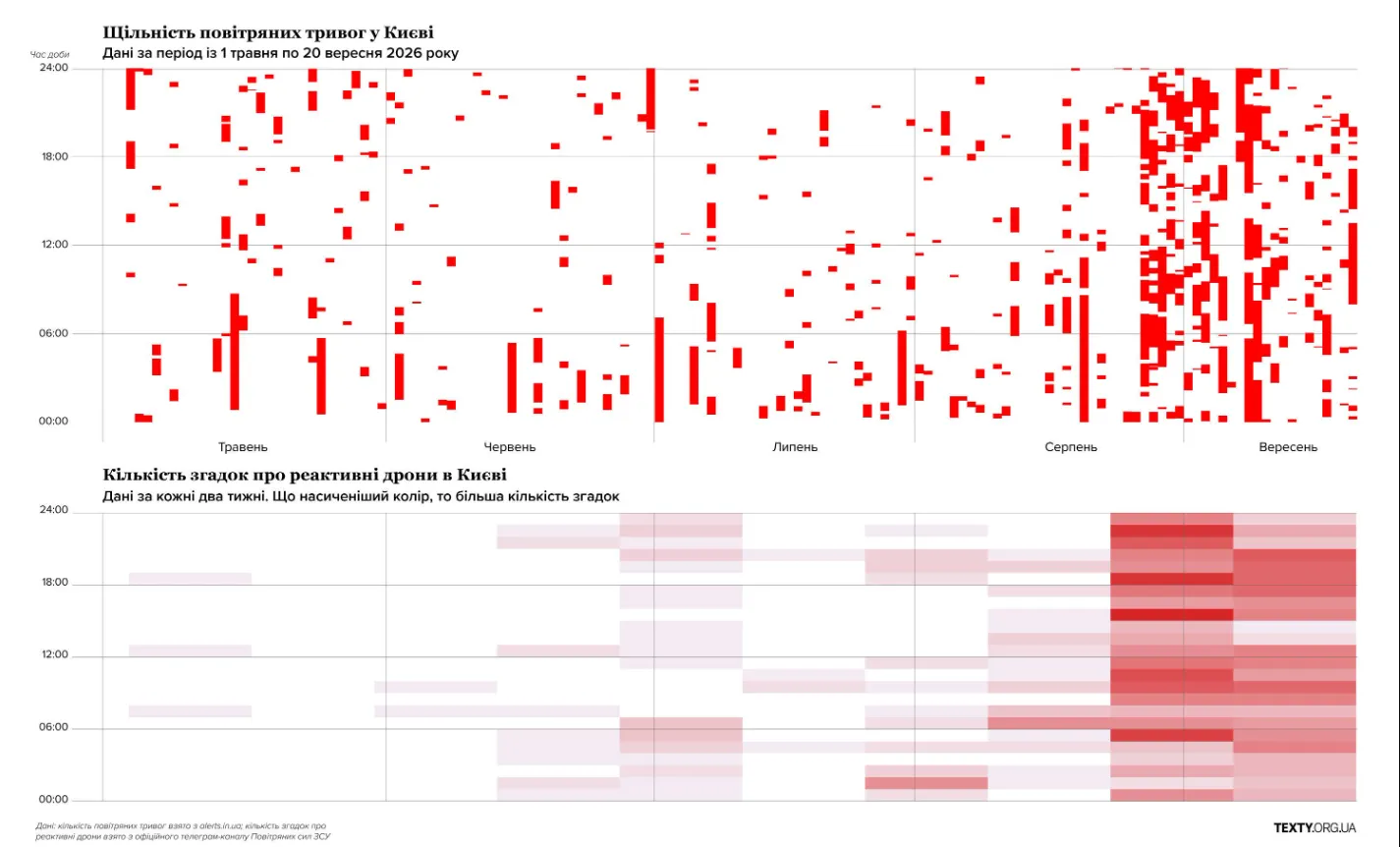
According to the researchers, air raid alerts are increasingly occurring at all times of the day—night, morning, afternoon, and evening. After the all-clear, the city may face a new threat within a short period of time.
Thus, jet-powered drones have allowed Russia to extend the threat far beyond the scope of traditional nighttime attacks.
Using August 28 as an example, the researchers demonstrated a mechanism whereby even a small number of drones can effectively divide the day into constant cycles: “alert—all clear—new alert.”
If drones approach Kyiv not simultaneously, but one at a time or in small groups at intervals, each new target can trigger a separate cycle of danger.
The problem lies not only in the duration of the air raid alert itself. After the all-clear, Kyiv needs time to return to its normal rhythm.
People need to leave their shelters, businesses need to restart their equipment, and institutions need to resume their operations. If a new alert begins shortly after the previous one, the city may simply not have enough time to fully resume normal operations.
Researchers also noted the peak intensity of the alerts on August 28. The highest number of alerts occurred between 5:00 p.m. and 7:00 p.m.—precisely when a significant number of Kyiv residents are returning home from work.
Under such conditions, there is additional strain on transportation links between the right and left banks of Kyiv.
Separately, the study’s authors analyzed the flight characteristics of jet-powered drones.
A typical strike drone typically moves in long, straight lines and changes course relatively infrequently. In contrast, the flight paths of jet-powered UAVs can be significantly more winding.
Such drones are capable of approaching Kyiv from various directions, changing course several times, and performing repeated turns.
Such maneuvers can prolong the duration of an air raid alert. As long as the drone remains near the capital and changes direction, its subsequent route is difficult to predict, and the danger to the city persists.
If a UAV initially moves away and then returns, this can extend an already declared alert or trigger a new one.
Another characteristic of jet-powered drones is their higher flight speed.

Researchers compared approximately 250 km/h for a conventional drone to about 600 km/h for a jet-powered one.
At an altitude of about 4,000 meters, such targets are more difficult to engage with conventional air defense systems.
The consequences of such tactics extend beyond the immediate military threat. Air raid alerts directly impact the capital’s economy.
Even a single hour of an air raid alert can disrupt the operations of businesses, stores, transportation, and public and private institutions.
For Kyiv, prolonged or nearly continuous air raid alerts could mean hundreds of millions of hryvnias in economic losses within a single day.
The study’s authors note that the jet drone has become not only a weapon but also a tool capable of effectively bringing a major city to a standstill.
Its high speed makes interception difficult; its evasive maneuvers can prolong the air raid alert; and launches spread out over time allow Kyiv to be kept in a cycle of constant threats for hours on end.
This is detailed in a study by Texty.org.ua.
In Kyiv, a massive attack by the Russian Federation has damaged the “Aunt Clara” pastry factory. Due to the damage, some items on the menu may be temporarily unavailable.
As a reminder, Russia struck a maternity hospital in Kyiv’s Podilskyi district.
In Kyiv’s Dniprovskyi district, a residential neighborhood was destroyed as a result of a Russian attack on September 24. According to preliminary information, there were no fatalities among residents.
Also, in Obolon, a drone crashed onto the grounds of a garage cooperative.
Russia launched a missile attack on Kyiv on the night of September 24, leaving two people dead and eight injured.




