
The war in the Middle East and rising global energy prices have increased pressure on the Ukrainian currency market. In recent days, the hryvnia has begun to weaken to record levels against the US dollar and the euro. Some experts even predict that in the near future the dollar could reach 47 hryvnias, while the euro could approach 60 hryvnias.
How realistic is such a scenario for the Ukrainian currency market? And what factors, besides the fighting in the Persian Gulf, are influencing the weakening of the hryvnia? UA.NEWS spoke with economic experts to explain the situation.
The war in the Middle East has played in favor of the dollar
Global markets. In the first days of the war in the Middle East, most major currencies fell relative to the US dollar. Doubts about its status as the world’s main reserve currency — which had emerged during the trade wars of Donald Trump’s presidency — temporarily faded into the background. Interest in the dollar was also fueled by a sharp rise in oil and liquefied gas prices.
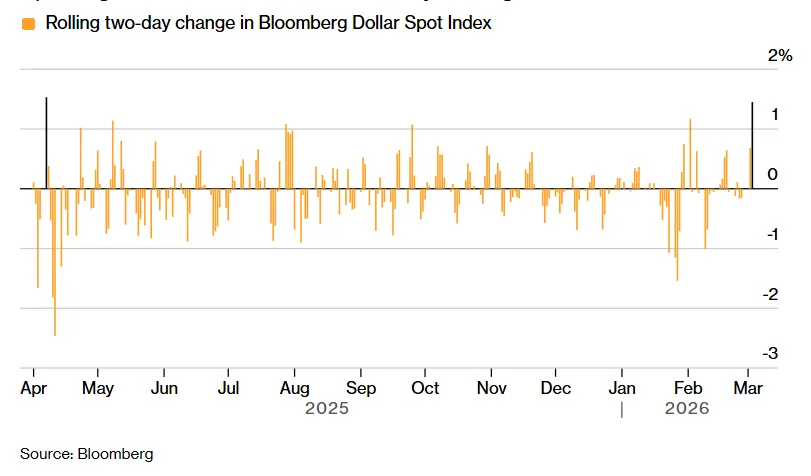
However, currency strategists believe the strengthening of the US dollar since the start of the war with Iran could be short-lived. This was shown by a survey of market participants conducted by Reuters. When asked how the positioning of the dollar would change by the end of March, about half of the respondents (21 out of 45) said they did not expect significant changes. Nineteen respondents predicted a reduction in short positions, while five forecast a shift toward net long positions.
“We still expect volatile trading between the euro and the dollar and various currency pairs this year. But does the dollar remain as safe as it once was? Probably not, because if that were the case, we would not have been having this debate over the past year,” explained Jane Foley, Head of FX Strategy at Rabobank.
As of March 5, the prolongation of the war in the Middle East and concerns about the monetary policy of the United States Federal Reserve limited the growth of the US dollar in global markets. Investors mostly chose protective assets such as gold and other precious metals.
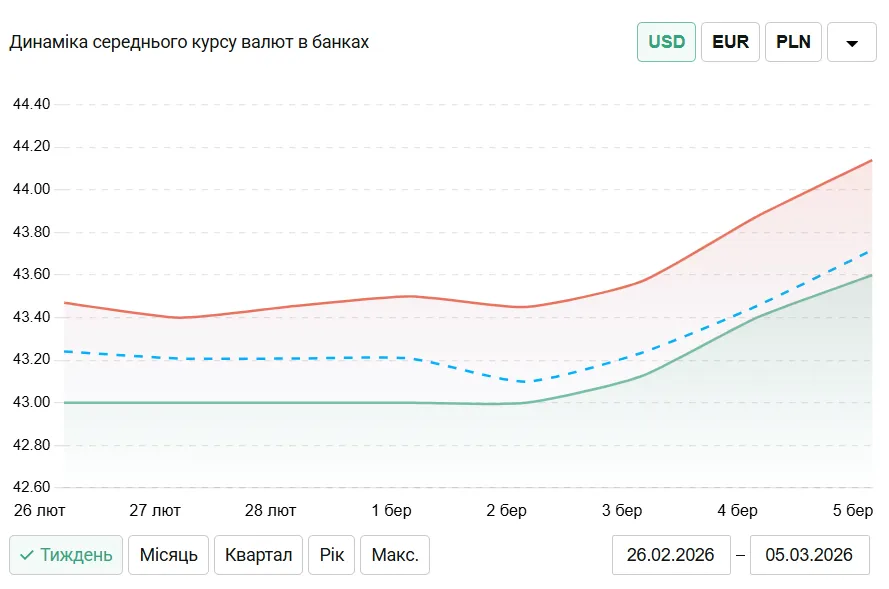
Ukrainian market. The wave of uncertainty caused by the prolonged military campaign against Iran has also reached the Ukrainian currency market. As of Friday, March 6, the official exchange rate of the dollar against the hryvnia reached a historic high for the third time in a row and rose to 43.80 hryvnias.
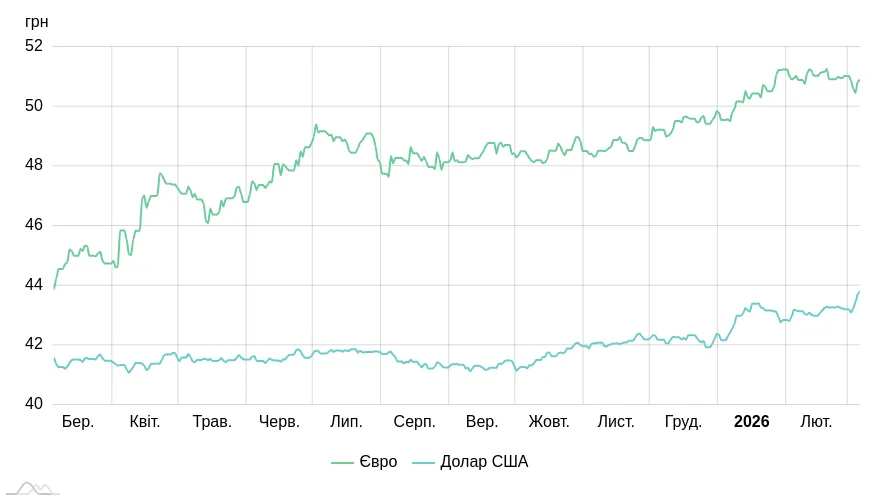
The day before, on March 5, in the cash market the dollar was on average bought and sold at 43.55–44.20 hryvnias, while the euro was traded within the range of 50.60–51.40 hryvnias. According to data from the Minfin portal, the dynamics of the dollar’s appreciation looked as follows.
Oleh Pendzyn: The National Bank will try to prevent the collapse of the hryvnia
Investors have now begun actively leaving the Persian Gulf countries, having little alternative other than the euro, the dollar, or gold, notes Oleh Pendzyn, an expert at the Economic Discussion Club.

“Gold has risen in price today, so it is no longer as attractive from an investment perspective. If we talk about the euro, the European economy is heavily dependent on imports of energy resources, including those from the Persian Gulf. We see that the price of liquefied gas in Europe has increased by 50 percent. Unlike the American market, which relies more on domestic oil production, Europe does not have such deposits. Therefore, we see that investors have moved into the dollar. Now we have a very interesting situation. If two weeks ago one euro was worth 1 dollar and 20 cents, now it is worth 1 dollar and 14 cents. That means the dollar has actually strengthened relative to the euro,” the expert emphasized.
According to Oleh Pendzyn, the National Bank of Ukraine had to respond to the global problems caused by the war in the Middle East. However, it should be taken into account that in Ukraine there is no real currency market as such. The main seller of foreign currency is the National Bank of Ukraine. Under such conditions, Pendzyn believes, there cannot be unexpected developments.
“Everything here is happening within the framework of the strategy planned by the National Bank of Ukraine. At the moment, the NBU has slightly weakened the hryvnia, allowing the dollar to strengthen. At the same time, it has significantly weakened the euro — today the euro is around 50 hryvnias. These steps fully correspond to how the NBU sees global currency processes,” the economist commented.
Oleh Pendzyn also does not expect that the National Bank will allow a significant deviation from the average annual exchange rate of 45.6 hryvnias per dollar, which was included in the State Budget for 2026.
“For the National Bank, the exchange rate is essentially a mechanism for controlling inflation. Lowering the hryvnia and strengthening the dollar means making import prices extremely high and provoking inflation. I assume that the National Bank will try to maintain roughly the same stable ratio that existed last year. Let me remind you that the 2025 budget included an average annual rate of 45 hryvnias per dollar. The actual rate we had was 42.5.
Approximately the same ratio may occur this year. That means the average annual rate will be 43.5–44 hryvnias, no more. But again, if the war in the Persian Gulf continues, no one knows how the world and the global economy will react,” Pendzyn concluded.
Borys Kushniruk: the key factor is uncertainty regarding the actions of the National Bank
The strengthening of the American currency will continue until the end of the hostilities in the Middle East, after which a reversal will most likely begin, believes economic expert Borys Kushniruk.

“The fundamental reasons that led to the weakening of the dollar relative to the euro still remain. In particular, the United States was also interested in this. But during hostilities, moving assets into dollars as a ‘safe haven’ is a classic story that has been going on for many years. Therefore, this was predictable,” he noted.
According to Kushniruk, the situation on the domestic currency market is both simpler and more complicated at the same time. He also points out that a currency market in Ukraine, in principle, does not exist. The key factor remains the uncertainty of the actions of the National Bank, which effectively manages the exchange rate.
“We have a huge foreign trade deficit. In simple terms, our exports are about half the size of our imports. Under market conditions, the hryvnia should have collapsed relative to the dollar — significantly. But this is not happening. Ukraine is managing thanks to external financial assistance. Therefore, the National Bank has currency reserves to cover the difference between the purchase and sale of foreign currency on the domestic market and the interbank market.
The issue is that under such conditions there should be a procedure by which the National Bank would publicly announce what exchange rate policy it is pursuing. This could ensure predictability. For example, it could inform how during the year the NBU will conduct the devaluation of the national currency, at least approximately,” Kushniruk emphasized.
Predictability of the National Bank’s actions would allow businesses and the population to better understand the situation with the exchange rate. For example, bank depositors could analyze interest rates: if they exceed the change in the exchange rate, then it is more profitable to keep money in deposits. Meanwhile, unpredictable management of the exchange rate creates certain risks.
“This provokes additional pressure on the exchange rate. Essentially, both businesses and the population are forced to buy foreign currency because of uncertainty about the actions of the National Bank. This also creates opportunities for abuse and corruption. Because no one knows what the National Bank will do: keep the rate stable or sharply devalue the hryvnia. Whoever has such information can earn very well from it. At the same time, this creates serious problems for the entire country, for businesses and for the population.”


