
A Russian spy ring that was planning terrorist attacks and the murder of volunteer Sternenko has been uncovered in Ukraine

Ukrainian law enforcement officials have uncovered a Russian intelligence and combat network whose members were planning terrorist attacks and contract killings in several regions of Ukraine. An armed hitman was also neutralized during the special operation.
This was reported by Ukraine’s Prosecutor General Ruslan Kravchenko and the Security Service of Ukraine.
According to Kravchenko, the network consisted of 10 individuals who were gathering intelligence on the Ukrainian Armed Forces, particularly in the Kramatorsk and Pokrovsk districts of Donetsk Oblast, as well as in Kharkiv Oblast.
“Law enforcement officers exposed a Russian intelligence and combat network whose members were gathering intelligence on the Ukrainian Armed Forces and planning terrorist attacks and contract killings on Ukrainian territory. The network consisted of 10 people. They gathered information on the locations, movements, weapons, equipment, and personnel of the Ukrainian Armed Forces in the Kramatorsk and Pokrovsk districts of Donetsk Oblast, as well as in the Kharkiv region,” he said.
One of the agents’ tasks was to prepare a terrorist attack in Kramatorsk—they were to identify a restaurant frequented by Ukrainian military personnel and plant explosives there. A device for this purpose was dropped from a drone at a predetermined location.
In addition, the perpetrators documented the effects of Russian shelling and relayed the information to their handlers.
“The network members were also planning contract killings of public figures and military personnel in various regions of Ukraine. Among the potential victims were an advisor to the Ukrainian Minister of Defense, volunteer Serhiy Sternenko, and a Russian citizen, RDK fighter Ilya Bogdanov, who has been fighting on Ukraine’s side since 2014,” the Prosecutor General noted.
According to the SBU, the eliminated hitman arrived from the temporarily occupied part of Donetsk Oblast, where he underwent training at a Russian GRU base. He was transported to territory controlled by Ukraine to carry out sabotage missions.
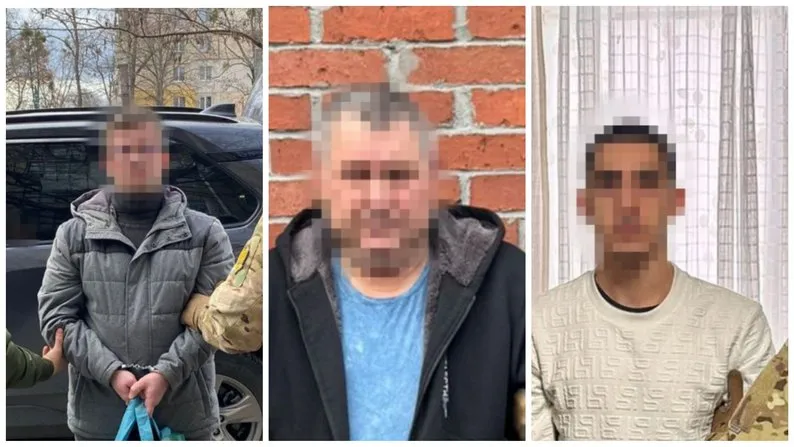
“It has been established that he was to manufacture homemade explosive devices and plant them under cars or near the homes of his victims. In the event of a ‘failed’ explosion, the hitman received instructions from his handler in Russia to shoot the victims at point-blank range,” the security service reported.
The network’s organizer turned out to be a forensic expert from Poltava recruited by Russia’s GRU, who coordinated the collection of intelligence and passed it on to the Russian side.
During searches of the suspects’ premises, weapons, ammunition, equipment, and other evidence of collaboration with the enemy were seized.
All detainees have been taken into custody without the right to bail. They are charged with treason, preparing terrorist attacks, and other serious crimes. The suspects face life imprisonment with confiscation of property.
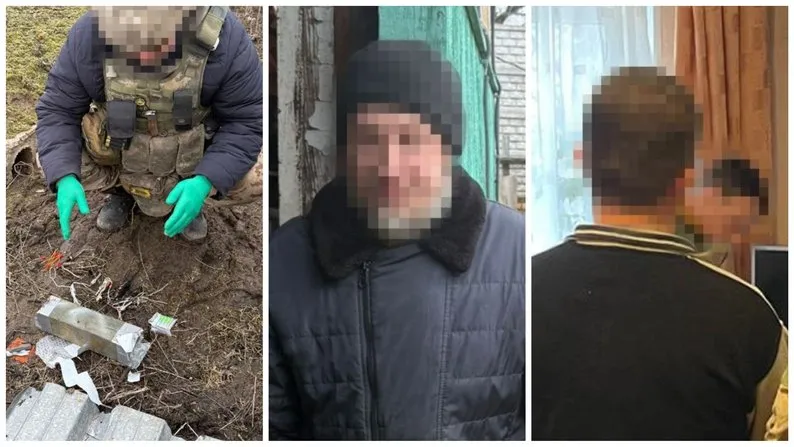
Additionally, the Counterintelligence Directorate of the Security Service of Ukraine detained another agent of the Russian GRU in Rivne. He turned out to be a former factory worker in Donetsk Oblast who had been recruited by the enemy and had traveled to western Ukraine to coordinate airstrikes.
In Rivne, the Russian agent was preparing a terrorist attack using a homemade bomb made from a pot.
Earlier, the Security Service of Ukraine detained a Russian agent in the Kharkiv region who was gathering data for missile and bomb strikes on Ukrainian military positions in the Kupiansk direction.
In addition, the Security Service of Ukraine (SBU) detained a Russian agent who, under the guise of fulfilling defense contracts, was coordinating airstrikes on Kyiv.
Prior to this, the Security Service of Ukraine detained an enemy agent in Zaporizhzhia who was attempting to infiltrate a strategic enterprise of the defense-industrial complex.
As a reminder, an SBU employee was detained while receiving a $68,000 bribe.
The SBU also exposed seven enemy agitators in five regions of Ukraine.


