
From “Seventh State Film Studio” to a Missile Strike: The Centennial History of the Legendary “Kyiv Rus” (PHOTOS)
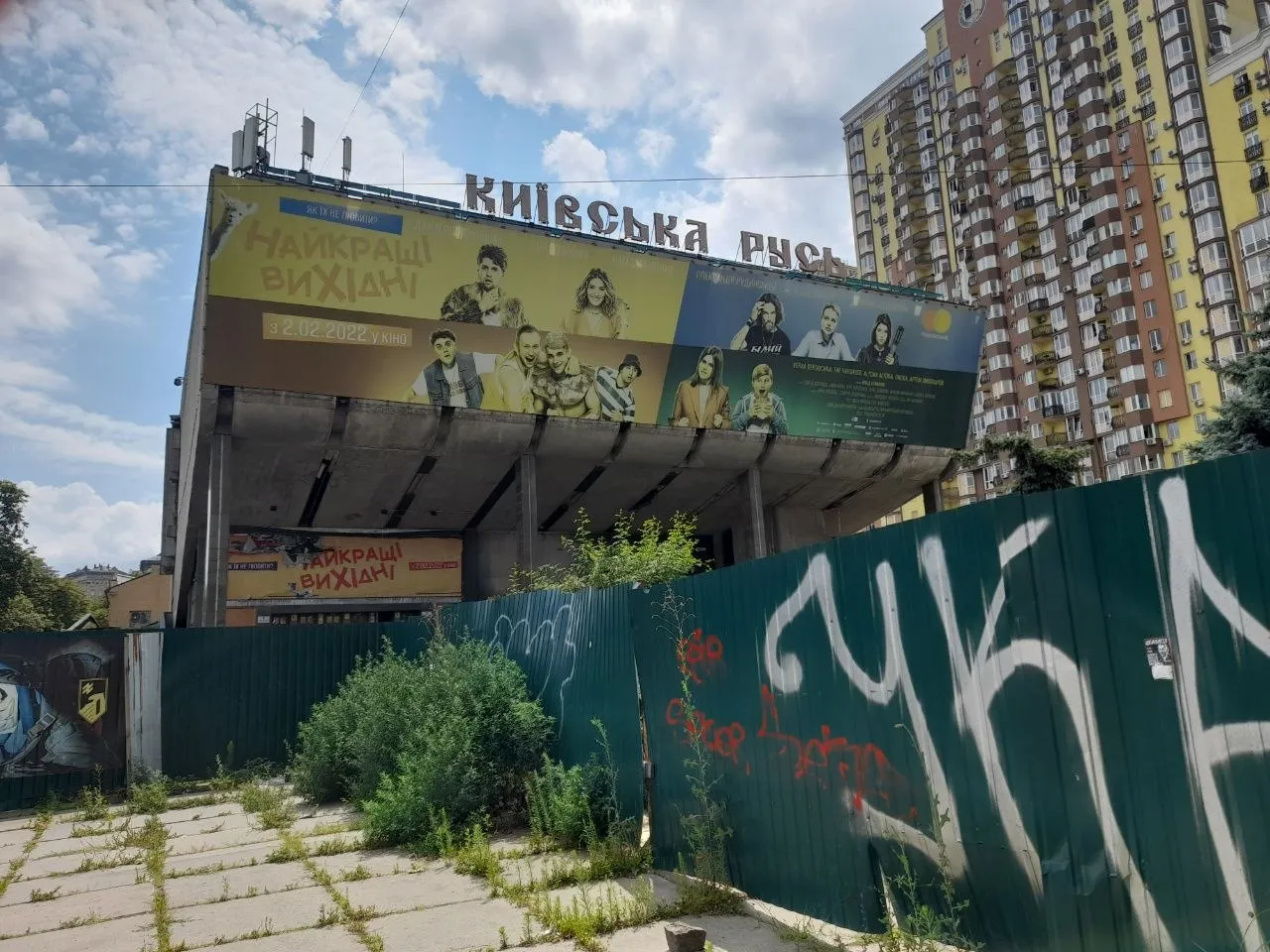
"Closed"—and plywood turns yellow in the empty windows. The "Kyivska Rus" movie theater building on Sichovykh Striltsiv Street is surrounded by a tall metal fence. There are no entrances or windows—the result of enemy shelling.

On the night of July 19, 2026, during yet another massive Russian missile attack on Kyiv, the blast wave damaged the cinema’s facade, shattered the windows, and caused further destruction. Along with the “Kyivska Rus,” the Lukyanivska metro station and the historic building of the former 1902 police station on Sichovykh Striltsiv Street—which had only recently been restored—were also damaged.

The cinema survived World War II, the demolition of its predecessor—the “Kommunar”—decades of prosperity, years of decline, closure, and an unfinished renovation due to the full-scale invasion. Now its history is laid out in shards of glass on the asphalt.

How long will the movie theater remain closed? “Closed permanently,” says Google.
“Ask the theater management,” replies a man from behind the fence, refusing to give his name or say what he’s doing here—he doesn’t want to.
In fact, the movie theater—which has the largest auditorium and screen in Kyiv—was closed for renovation in 2021. Renovation work began in February 2022, and the two-screen theater was scheduled to reopen in 2023, but those plans were derailed by the full-scale war that broke out at the same time as the building’s renovation.


“Seventh State Cinema”: How It All Began
The history of the Lukyanivskyi movie theater began nearly a century ago. The first movie theater on this site opened back in 1928. At that time, it was much smaller and was located in a two-story building called “Seventh State Cinema.” Back then, it was one of Kyiv’s chain of state-run movie theaters, which were actively opening in various parts of the city.
During World War II, the building sustained serious damage. After Kyiv’s liberation, it was decided not only to repair it but to completely rebuild it. In 1947, the movie theater was reborn under the new name “Kommunar.” This is how several generations of Kyiv residents remembered it.
A quarter of a century later, the building found itself back in the spotlight—but not because of movies. In 1972, preparations were underway for a visit by U.S. President Richard Nixon to the USSR. Kyiv authorities hurriedly spruced up the routes the distinguished guest would take. They decided not to renovate “Kommunar”—which hadn’t seen any repairs in years—but simply to repaint it a bright light green. And the old buildings nearby, which marred the overall view, were hidden behind tall green fences. The reasoning was simple: if the problem isn’t visible, then it doesn’t really exist.


However, this “cosmetic renovation” turned out to be in vain. Nixon’s route was changed, so he never actually drove past the “Kommunar.” And it soon became clear that the movie theater itself was living out its final years. It was closed that same year, 1972, and a decision was later made to demolish it.
Incidentally, the practice of hastily painting facades and hiding old buildings behind decorative fences before the arrival of distinguished guests was quite typical of the Soviet era. “Kommunar” became one of the most famous examples of such “cosmetic improvements.”
Another ten years later, it was decided to build a new movie theater on the site of the demolished “Kommunar.” That’s how “Kyivska Rus” appeared in Kyiv—a building that quickly became one of the capital’s most famous movie locations.

“Kyivska Rus”—A Gift for the Capital’s 1,500th Anniversary
The opening was specifically timed to coincide with this major celebration. On May 30, 1982, Kyiv officially celebrated its 1,500th anniversary, and it was on this very day that the new movie theater opened its doors to the public for the first time. Although historians still debate the city’s actual age, the Soviet authorities turned the anniversary into an all-Union event, and “Kyivska Rus” became one of its symbols.
The name of the movie theater was also chosen for a reason. It was meant to emphasize the connection to the capital’s history, and a large decorative panel depicting the founders of Kyiv—Kyiv, Shchek, Khoryv, and their sister Lybid—appeared on the facade. This composition remains one of the building’s most recognizable features to this day.

At the time of its opening, “Kyivska Rus” was the capital’s largest movie theater. The main auditorium seated nearly 1,200 viewers, which was truly impressive for the early 1980s. It was equipped with state-of-the-art technology for its time, and the wide screen allowed for the screening of films in 70 mm format—a technology that only a few movie theaters in Ukraine could afford.
That is why the most anticipated premieres were often brought here. For many Kyiv residents, a trip to “Kyivska Rus” was not just about watching a movie, but a real event. On weekends, tickets for popular films would sell out in advance, and long lines would often form at the box office—a phenomenon that’s hard to imagine today in the age of online booking.
The Capital’s Main Movie Theater and Festival Venue
After Ukraine gained independence, “Kyivska Rus” effectively became the country’s main festival cinema. It was here that the opening and closing ceremonies of the Molodist Film Festival took place for many years, as well as screenings of international festivals and premieres of Ukrainian films. For Kyiv movie lovers in the 1990s–2010s, the phrase “Let’s meet at ‘Kyivska Rus’” was just as common as “at the Golden Gate.”

The building’s sheer size helped transform the theater into the capital’s main festival venue, hosting premieres, artist talks, and international film screenings: the main auditorium seated about 1,600 people, and the small one—another 300. For Kyiv in the early 1980s, it was a true cinematic giant.
By the early 1990s, “Kyivska Rus” had become a destination for international stars. One of the most high-profile events was the British Film Festival, which took place in 1990. Director Lindsay Anderson—winner of the Palme d’Or at the Cannes Film Festival for the film *If...* — as well as British actor Malcolm McDowell, for whom this film marked his breakthrough in mainstream cinema. For Kyiv residents, it was a rare opportunity not only to see these iconic artists in person but also to talk with them.
Over the years, the “Kyiv Rus” stage has hosted dozens more renowned directors, actors, and producers. It was here that the opening and closing ceremonies of the “Molodist” International Film Festival were held for many years, as well as the Ukrainian premieres of films that had only recently been screened in Cannes, Berlin, or Venice. For several generations of Kyiv residents, “Kyivska Rus” was the place to see films that weren’t shown in other movie theaters.
Back then, going there meant much more than just watching a movie. It was an opportunity to find yourself at the very heart of the city’s cultural life, where in a single evening you could meet both young directors and world-famous movie stars.

The Legend of Princess Diana, Who Wasn’t There
By the way, according to some websites, even Princess Diana once visited “Kyivska Rus.” In reality, this is a beautiful urban legend. Princess Diana never came to Kyiv and, consequently, never visited the theater. Instead, in 1990, Princess Anne—the only daughter of Queen Elizabeth II and the younger sister of the current King Charles III—was a guest at the British Film Festival. It was she, together with British Prime Minister Margaret Thatcher, who launched a British cultural project in Kyiv. Later, in various publications, someone replaced Princess Anne’s name with that of the much more famous Diana, and this inaccuracy circulated on Ukrainian websites for years, gradually turning into a beautiful legend.
For nearly four decades, “Kyivska Rus” remained one of the capital’s main movie venues. People watched premieres here, attended festivals, and met with directors and actors. For many Kyiv residents, a visit here was almost a ritual.
But in 2021, the theater was closed due to the building’s dilapidated condition. And this is not surprising: since its opening in 1982, the building had never undergone a comprehensive renovation. During that time, the equipment was updated, but not the building itself.

From Dolby Surround to a Dilapidated Facade
The most extensive technical upgrade took place back in 1997. At that time, the “Kyivska Rus” was equipped with a Dolby Surround sound system—state-of-the-art for its time—and the screen and seats were replaced. For audiences, this meant a whole new level of viewing quality, but the facade, floors, and structural elements remained virtually unchanged.
Problems had been building up for years. The facade began to crumble, and on one occasion, a piece of cladding fell onto a car parked near the building. After that, it became clear that cosmetic repairs would no longer suffice.

The Renovation Halted by the Great War
In early 2022, a large-scale renovation project was prepared for “Kyivska Rus,” and by mid-February, construction equipment had already appeared near the building.
But they weren’t even able to complete the preparatory work. On February 24, 2022, Russia launched a full-scale invasion, and all plans had to be put on hold.
That said, the renovation project itself hasn’t gone anywhere. It involves not just repairs, but effectively giving the movie theater a new lease on life. The plans include adding another screening room, creating an open-air terrace, and establishing a modern art space. The seats, screens, and sound equipment will be completely replaced, as will all the building’s utility systems—from electrical and ventilation to heating and air conditioning.
At the same time, the architects promise to preserve what matters most—the recognizable silhouette of “Kyivska Rus,” which has become an integral part of Lukyanivka over the past forty years.

It would seem like the end of the story: wait for victory, restore the movie theater, and enjoy movie premieres. But recently, the war has once again changed the fate of this place. And someday, the lights here will go out again before a movie begins—not before a nighttime attack. We’ll wait and see.


