

The war has left thousands of Ukrainian families without a home of their own. For some, a dormitory or shelter has become their new home, while others are crammed into a rented room or living with strangers, having lost hope that they will ever walk through the doors of their own home again.
Maksym Lavrynenko, founder of the “Trukha Ukraine” media group, has been using the profits from his business for several years to buy apartments for families who lost their homes due to the war. During this time, displaced persons from the Kharkiv, Donetsk, and Luhansk regions have received housing.
Back in early 2026, Maksym had already told us about the project: at that time, some of the deals were still in the negotiation phase. And recently, he attended the housewarming party for yet another family that received housing from “Trukha.” We revisited the conversation to learn about the project’s progress.
— Maksym, welcome back. For those who haven’t read the previous interview, could you please remind us how your “Trukha Gives Housing” project began?
Back in 2024, we purchased apartments for Kharkiv families with children who had lost their homes due to Russian shelling at the start of the full-scale war. After the first key handover, it became clear that the need was urgent and that our help was truly making a difference in these people’s lives, so we want to continue.
I remember very well how the fate of one of those families changed. Because they now had a home of their own, a mother with two children was able to return to her husband from abroad. That’s how a family was reunited—a family that might still have remained separated across countries because they had nowhere to live. How could we stop after that?
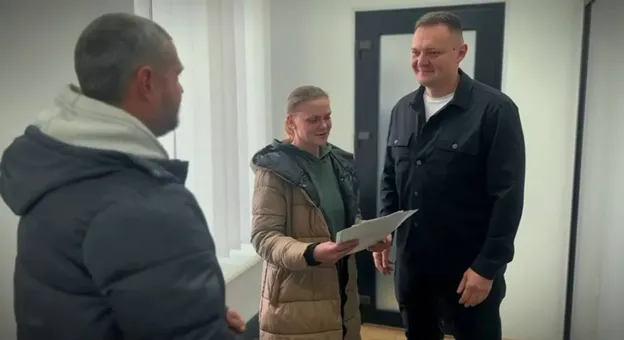
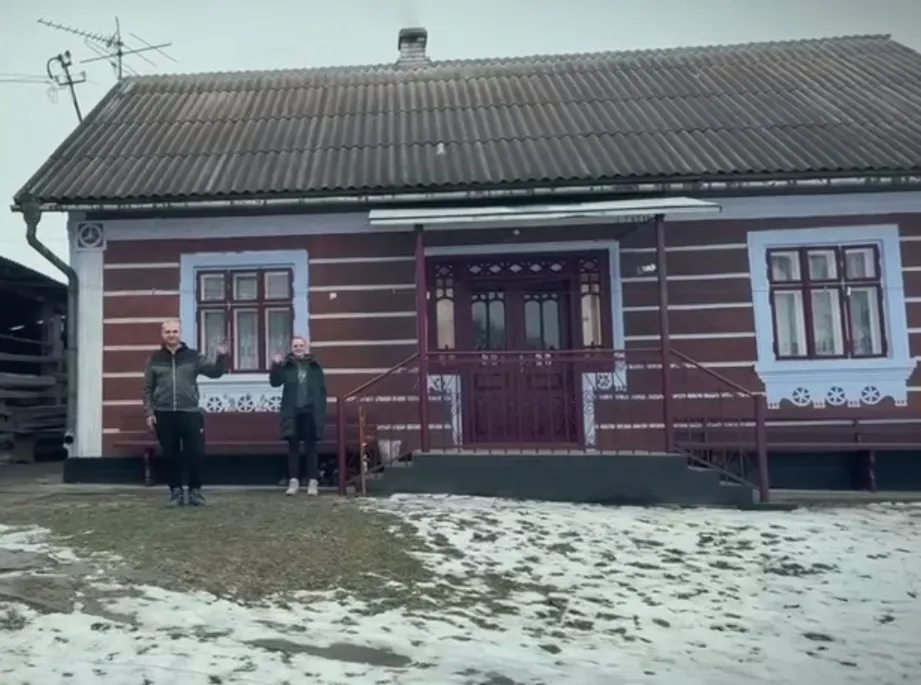
Last year, most of the project’s activities took place in the winter, around Christmas. Our team even called it a Christmas miracle, because that’s exactly how the people who received housing described our help. First, we bought an apartment for a large family of displaced people from the Kharkiv region who had survived the occupation. For months, they had been searching for shelter all over the country with a tiny child, their grandmothers, and their pets. Now they have a home with a garden. When I attended their housewarming, the father of the family confessed that he dreams of planting fruit trees there. I sincerely hope they’ll have a good life there.
— Why did you decide to buy a home with your own money instead of organizing a fundraiser?
I get asked this question all the time. People in Ukraine are used to fundraising to help others. It’s great that they raise money—whatever they can manage to collect. We at “Truha” often support other fundraising campaigns and are grateful for the trust people place in us—including the military. But in our case, many people found—and still find—it strange that a network of Telegram channels led by me is buying apartments without asking anyone to contribute.
In reality, there’s no mystery here. It’s not because we want to be different. We have the ability to help using our own funds from our profits for a specific purpose, so that’s what we do.
Moreover, it’s a matter of principle for me to take responsibility for providing this assistance. I’ve repeatedly shared on my social media and in my Stories how we process applications and what the process looks like at every step. Everything is clear and transparent.
— How does the process work, from the initial application to signing the agreement?
People fill out a Google Form, describe their situation, and attach documents. The team reviews each application, verifies the information, and clarifies any details. I make sure to read every application myself. It’s a huge and challenging task, but that’s the only way to do it.
We try to delve into the details, understand how the family lived before the war, what happened during the invasion, and why they’re reaching out to us now. We give priority to large families, single parents, people with disabilities, and families of defenders who were killed or are missing in action. But there’s no strict algorithm. Sometimes, a single application brings together so many circumstances at once that we simply can’t ignore it.
A difficult and sensitive issue for me is realizing that no one can help everyone. From the very beginning, I really didn’t want this selection process to turn into a competition based on criteria. We review every case individually and very carefully. We help those who are in the worst situations.
Once a family is selected, a long process begins. We communicate with real estate agents, review options, assess the condition of the housing, verify documents, and negotiate with sellers. The family always has the final say in choosing an apartment. It’s important that it be decent housing, not just four walls and a roof.
— What often goes unseen behind the scenes?
The process is never just “came, saw, bought.” At every stage, something can go off track. That’s why we have to be flexible and mentally prepared for various scenarios. There have been times when we found an apartment, reached an agreement, and at the last moment the seller says, “I’ve changed my mind; I’m not selling it anymore.” And we’ve already come a long way. Well, then we start all over again.
There’s also the legal side of things: verifying the owner, checking the apartment’s documents, and finalizing the deal. Our subscribers see the video where we hand over the keys, but behind the scenes, there’s a lot of work going on—a whole team is involved, along with lawyers and notaries, and it takes weeks of correspondence, meetings, and negotiations.
— Tell us about the family you recently handed over an apartment to. When we met in the winter, it was still just a plan. What stood out about their application?
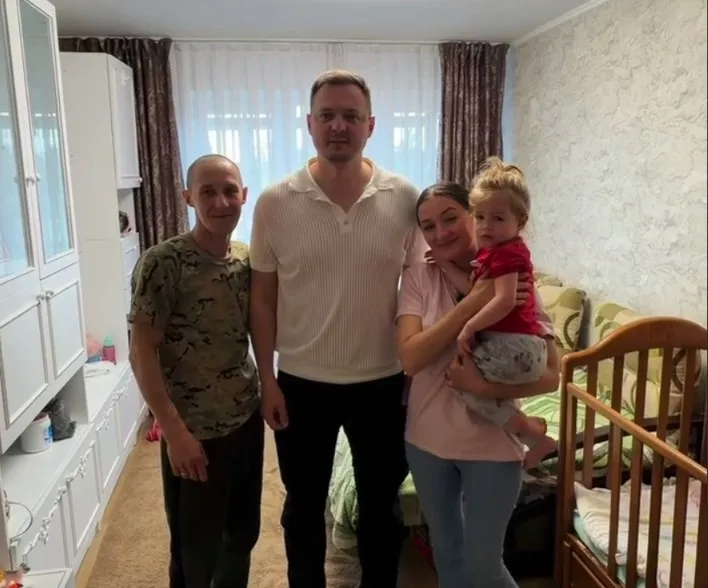
Olga and Yevgeny are from Lysychansk. Their apartment remained in the occupied city. Olga has had a second-degree disability since childhood due to a severe form of diabetes; her ongoing treatment consumes almost the entire family budget. Yevgen is a veteran who has seen combat twice and suffered a concussion. Together, they are raising their teenage son Bohdan and their little daughter Eva, who was born during the full-scale war. Before moving, the family of four lived in a 12-meter room in a former monastery in the Lviv region.
In her application, Olga wrote: “We lost more than just our home. We lost our reason for living. Not a single photo remains.” They saw a rocket strike their home, but what pained them most was not the loss of their possessions, but the fear for their children’s future—they would have nowhere to live.
After reading those lines, it’s hard to calm down and just move on with life. I reread them several times. We got in touch with the family. This past summer, they had a housewarming party; I was invited, and it was a wonderful, warm gathering. Do you know what stuck with me? Yevgeny told me how Olga bakes treats in the oven in the evenings. For four years, they didn’t even have an oven. And now they have their own home with everything they need. I left there feeling truly happy for this family and their children.
— You also bought an apartment for a grandmother and her grandson, right? Please remind us of their story. What stood out to you about that application?
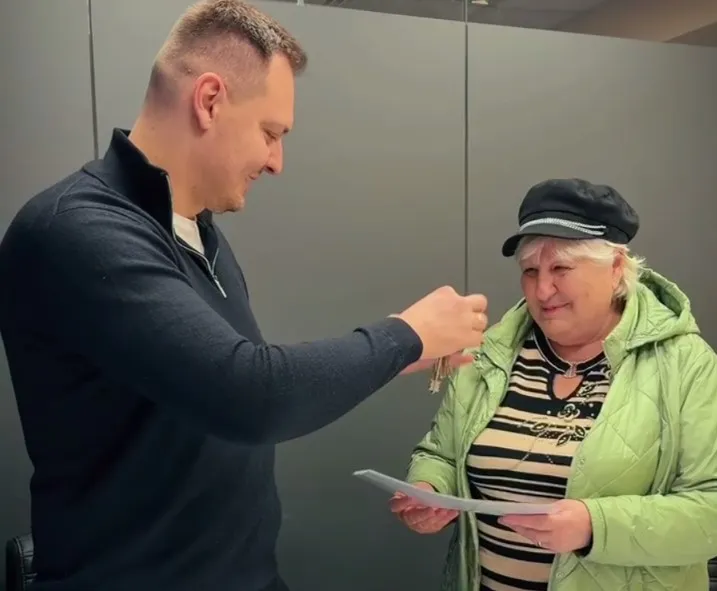
Zoya Dmytrivna is a retiree. She evacuated from the Bakhmut district at the start of the full-scale invasion along with her child. Their home in Donetsk Oblast was completely destroyed. In Kyiv, the elderly woman was renting an apartment with her 12-year-old grandson, Matviy, who has poor eyesight. Almost everything they received from the government went toward rent. Matviy is growing up without a mother or father; Zoya Dmytrivna is raising him on her own. He’s a wonderful, cheerful boy, and it was a real pleasure to talk with him and his grandmother.
In her application, she wrote that she and her grandson dream of having at least a small place of their own. When we handed them the keys to the apartment, Zoya Dmytrivna said she now feels at ease about her grandson’s future. The people we help worry most not about themselves, but about their children and grandchildren who are growing up during the war.
— How have the years of participating in this project changed you personally?
I’ve started to look differently at things that used to seem self-evident. We leave work or return from a business trip, or we’re coming back from seeing friends or an important meeting. Where do we go? Home. We take out our keys, unlock the door, and then each of us goes our own familiar way through the rooms. Your home is in order, but for a huge number of people in Ukraine, that’s no longer the case at all. There’s no address, no door, no familiar path from the hallway to the kitchen or bedroom. Many have no keys left, and for some, the ones they have are just a memento. It’s always a loss—not just of a home, but of the entire past and the foundation for the future.
When I read the applications, I think about this—I picture the real people who’ve reached out to us. I imagine their losses, their hopes, their expectations, and their fears. I suppose I’ve become much more empathetic. And I’ve also realized that the hardest decisions aren’t the ones where you have to do a lot, but the ones where you have to choose between people who all need help equally.
— When you hand over the keys, is that the end for you, or, on the contrary, the beginning?
To some extent, it’s both. The purely technical process leading up to this moment is already behind us: we found an apartment, processed the paperwork, and finalized the deal. But after handing over the keys, of course, nothing is over.
We stay in touch. People call, write, and invite us to see how they’ve settled in. Some show off their first home improvements; others share photos of how they’ve decorated the kids’ room, how thrilled they are with the kitchen, or what trees they’ve planted near the house. It’s nice to see that life is gradually settling into its usual rhythm.
You know, everyone experiences a lot of emotions while working on the project. The team gets excited, prepares, rejoices, or feels sad when something doesn’t go as planned. The people we help sometimes even cry when we hand over the keys.
I cherish every one of these touching moments. And yet, what I look forward to most is the housewarming—when I come not as the head of “Truha” or a participant in a housing project, but simply as a guest.
Read also: Ua.News
Exclusive: From Local News to Life-Changing Aid: Maksym Lavrynenko, “Trukha Ukraine” Media Group




