
Putin Is Still Not Interested in Negotiations – Foreign Affairs
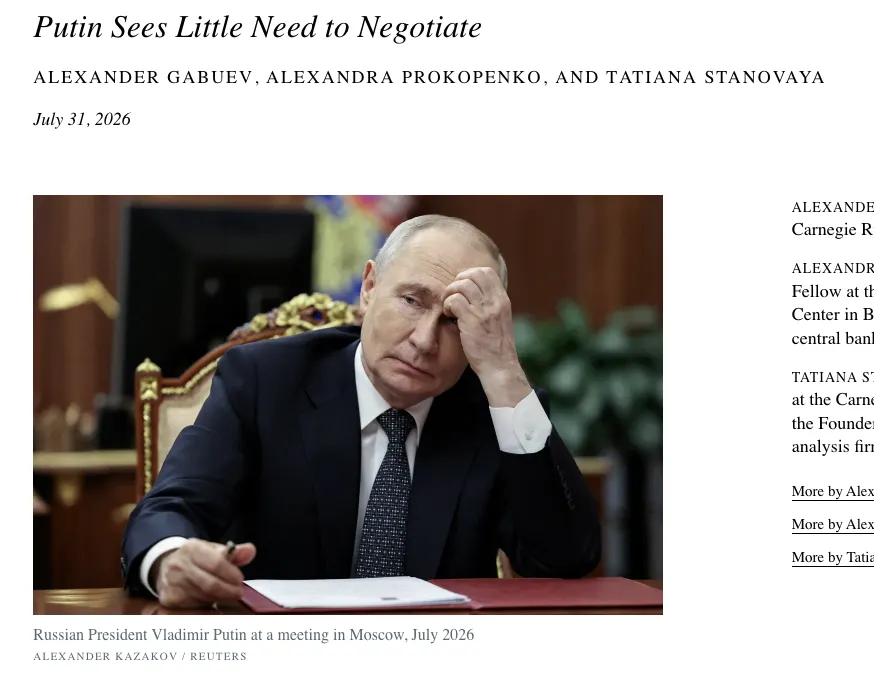
Analysts at *Foreign Affairs* believe that Vladimir Putin currently sees no point in negotiating an end to the war against Ukraine. In late June, the Russian leader declared his intention to continue military operations, despite the problems caused for Russia by Ukrainian strikes on military targets and critical infrastructure in the rear.
Twenty months ago, Putin’s confidence would have been justified. At that time, newly elected U.S. President Donald Trump was praising Moscow and criticizing Kyiv, while Russian troops were advancing slowly but steadily on the front lines. The authors note that back in March 2025, in an article for Foreign Affairs, they outlined three possible strategies for the Kremlin.
Plan A envisaged that the Kremlin would reach an agreement with the White House and force Kyiv to accept a deal drafted in Moscow. Plan B was that Putin would simply wait it out until Trump stopped supporting Ukraine, and the Russian army would win on its own. If that didn’t work, there was always Plan C—to continue combat operations and ultimately achieve victory on the battlefield.
Today, Russia’s position has deteriorated. Plan A has failed—in his latest interview, Putin didn’t even mention Trump. Plan B didn’t work either: although the White House has cut back on some aid, the U.S. continues to share intelligence with Kyiv and maintain sanctions against Russia, and Ukraine has made up for the lost support through its European partners. In fact, Ukraine is now in a better military position than it was a year ago, so Plan C—under which Russia was supposed to win simply by wearing Ukraine down—has also failed to materialize.
It would seem that after the failure of all three scenarios, Western governments might expect Putin to agree to a constructive settlement. But, as the authors write, there is little reason to believe this: in all his recent statements, the Russian president has made it clear that his military objectives have not changed. And, unfortunately, he still has the resources to back up these words with action—the Russian economy is struggling, but it is not on the brink of collapse.
The Kremlin can continue to finance the war by shifting the costs associated with drone attacks onto the businesses themselves—rather than investing in anti-drone systems or compensating affected companies. Similarly, regions can be forced to cover rising defense expenditures by cutting other budget items, while households can be made to bear the burden of military spending through higher inflation. Currently, Russia spends 8% of its GDP on defense—a significant amount, but considerably less than what the Soviet Union and the United States spent during World War II, or than what Ukraine itself is spending now—nearly 40%.
Such measures would make Russians poorer and more resentful, but the regime is protected by an extensive apparatus of repression—laws on total censorship, AI-based surveillance tools, and an ever-growing ranks of security forces capable of suppressing any signs of dissent.
Dissatisfaction with the economy may also be offset by the “rally-around-the-flag” effect: the more Ukrainian strikes affect ordinary Russians, the easier it is for them to believe Putin’s claim that the war against Kyiv is a war for national survival. According to a poll by the independent Levada Center, more than 65% of the country’s population supports the Russian military’s actions, while less than 25% opposes them. In regions bordering Ukraine—which began feeling the impact of retaliatory strikes earlier than others—support for the war is even higher.
Moscow also maintains its advantages on the battlefield: it is ramping up production of guided aerial bombs that threaten Ukrainian positions and terrorize frontline cities, and has doubled its production of ballistic missiles compared to pre-war levels—just as Ukraine is running out of high-quality interceptor missiles. If the bombing campaign alone proves insufficient to force Kyiv to accept Putin’s terms, the Kremlin may intensify the pressure with a new mobilization.
The authors suggest that this will almost certainly trigger a new wave of discontent, but the process will be far less public than in 2022, when Putin announced the mobilization on national television—and will therefore attract less attention. The Kremlin will likely ensure that mobilization efforts largely bypass Moscow and other major cities, focusing instead on poorer regions. It is also possible that pressure on Europe will intensify through hybrid attacks or operations in the “gray zone.”
The authors note that not all members of the Russian establishment want the war to continue, let alone escalate—there are voices among the elite calling for genuine negotiations. However, Putin himself is not interested in this option at the moment. He calmly accepts cautious calls for peace and occasionally sends signals of interest in a settlement, but his actions indicate that the Russian president is not ready to climb out of the hole he has found himself in— — on the contrary, it seems he wants to dig deeper.
“We know that the West continues to seek Russia’s strategic defeat,” Putin said in an interview on June 28, commenting on calls from the Americans and Europeans for negotiations or a ceasefire, which he perceives as an attempt to buy time for Ukraine.
As long as Putin remains convinced that he holds the upper hand over Ukraine thanks to the destructive power of his ballistic missiles, and that Kyiv is vulnerable due to a lack of interceptors, he will most likely continue to try to wear Ukraine down—regardless of the damage to his own country. Kyiv and its allies, the authors conclude, should prepare for a long and arduous road ahead: Ukraine may be in its best position since late 2022, but the Kremlin is counting on breaking the will of both Ukraine and its partners this winter. Russia may be facing serious problems, but Putin has not yet exhausted all his options and wants to keep fighting for as long as possible.
Source: Foreign Affairs
On July 29, Ukrainian President Volodymyr Zelenskyy announced new results from strikes on Russian facilities used to support and prolong the war against Ukraine.
SBU drones struck the Lukoil oil refinery in Perm, more than 1,500 km from Ukraine.
As a reminder, on the night of July 29, the Ukrainian Armed Forces carried out strikes on a number of military and infrastructure targets on the territory of Russia and in the temporarily occupied Crimea. Among the targets struck were the Ryazan oil refinery, a base for Russian Black Sea Fleet vessels, a radar station, and military logistics facilities.


