
Defense forces destroyed nearly 24,000 Russian drones in August
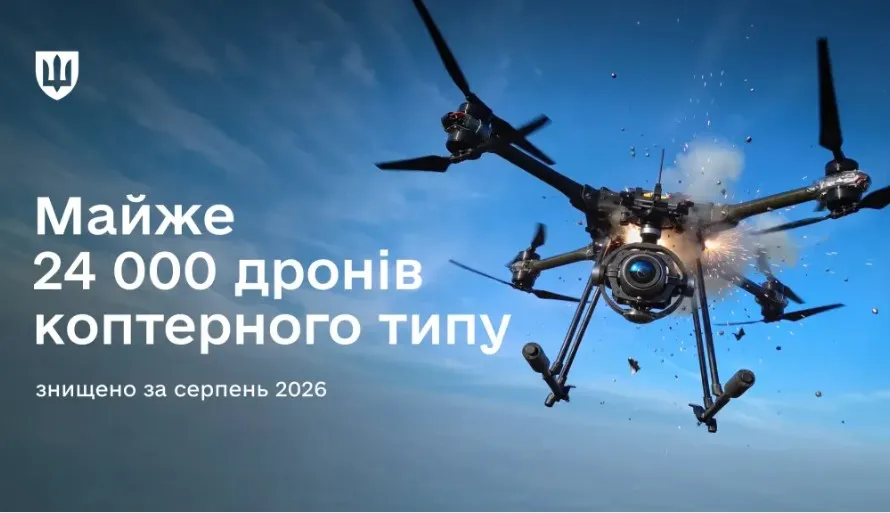
In August 2026, the Ukrainian Defense Forces destroyed nearly 24,000 Russian helicopter-type drones. This is the highest figure since the “eBaly” program began. Over the course of the month, they also took down more than 35,000 aircraft-type UAVs and carried out strikes against Russian targets in the Black Sea.
According to the Ukrainian Ministry of Defense, August set a record for the number of Russian helicopter-type UAVs destroyed—nearly 24,000 drones. The Ministry of Defense notes that this is the highest figure since the “eBaly” program began.
In addition to copter-type drones, the Ukrainian military destroyed more than 35,000 aircraft-type UAVs. The Ministry of Defense emphasizes that these results were verified within the framework of the program. Each result is recorded on video in the DELTA combat system, after which the data is verified by the Innovation Development Fund of the Ministry of Digital Transformation of Ukraine.
In August, Russian aircraft and a helicopter were struck
The Ukrainian military did not target only drones. Among the key targets struck in August was a Russian Su-30 fighter jet. An L-39 “Albatros” training and combat aircraft and a Ka-52 “Alligator” attack helicopter were also destroyed.
These are among the most expensive and difficult types of Russian military equipment to replace. The Ministry of Defense specifically highlighted the results of Ukrainian strikes at sea.
Ukrainian strikes have shifted to the Black Sea
Another significant development in August was a shift in the geography of naval strikes. Previously, a significant portion of targets were located in the Sea of Azov. Now, Ukrainian forces are operating more actively in the Black Sea.
Specifically, this refers to the areas around Novorossiysk and Sochi. These are strategically important regions for Russia, where military and logistical facilities are located. Thus, Ukrainian unmanned systems are gradually expanding the area in which they can strike Russian targets.
Over 30,000 occupiers were struck in August
According to the “eBaly” program, the elimination or wounding of 30,246 Russian soldiers was also confirmed in August. These results are also undergoing verification. The Ministry of Defense notes that confirmation is based on video recordings from the DELTA combat system and following verification by the Ministry of Digital Transformation’s Innovation Development Fund.
The program allows for the systematization of data on the destruction of Russian targets and the verification of the results achieved by Ukrainian units.
Ukrainian drones are reaching targets in the rear
Ukrainian unmanned aerial systems continue to operate not only directly near the front lines. The Ministry of Defense reports that the Defense Forces are systematically striking Russian targets more than 20 kilometers from the front line. It is there that important routes run, along which Russian troops transport personnel, equipment, and ammunition.
Due to Ukrainian strikes, the Russians are forced to alter their usual logistics. They are compelled to move some of their forces and equipment farther from the front lines to reduce the risk of being hit. A separate challenge for Russian forces is finding ways to counter Ukrainian drones that use Starlink satellite communications.
Russia Is Forced to Restructure Its Logistics
The increasing number of Ukrainian strikes against Russian drones and other targets is placing additional strain on the Russian supply system. The farther depots, equipment, and personnel have to be moved from the front lines, the more complicated logistics become. Russian troops are having to find new locations and change their routes.
According to the Ministry of Defense, August’s results reveal another trend: Ukrainian drones are being actively used to strike various types of targets. These include not only enemy drones but also aircraft, warehouses, logistics facilities, and targets at sea. At the same time, the Ministry of Defense does not disclose all the details of the operations carried out. Some information regarding specific units, methods of engagement, and the circumstances of the attacks may remain classified for security reasons. This was reported by the Ministry of Defense of Ukraine.
On the evening of September 8, Russian troops struck Mykolaiv. The attack damaged the “Metro” hypermarket—windows were shattered and the roof was damaged.
In the Darnytskyi district of Kyiv, a Russian strike drone hit a 16-story residential building. Information regarding possible casualties is currently being verified.
Since the evening of September 8, Russian troops have shelled four districts in the Dnipropetrovsk region more than 20 times. The occupiers used drones in the attacks, and three people were injured as a result of the strikes.
As a reminder, fires broke out at industrial facilities in the Kyiv region due to an attack by the Russian Federation.
Russia also launched a massive attack on Kyiv, killing and wounding civilians.
Later, rescue workers showed the aftermath of the strikes on Kyiv.
Alona Shevtsova, CEO of Sends, will moderate a panel discussion at the executive level at the 17th Middle East Banking Innovation Summit (MEBIS 2026), which will take place on September 16–17 at the Jumeirah Emirates Towers in Dubai.


