
HRW has called on the U.S. not to transfer old cluster munitions from Turkey to Ukraine
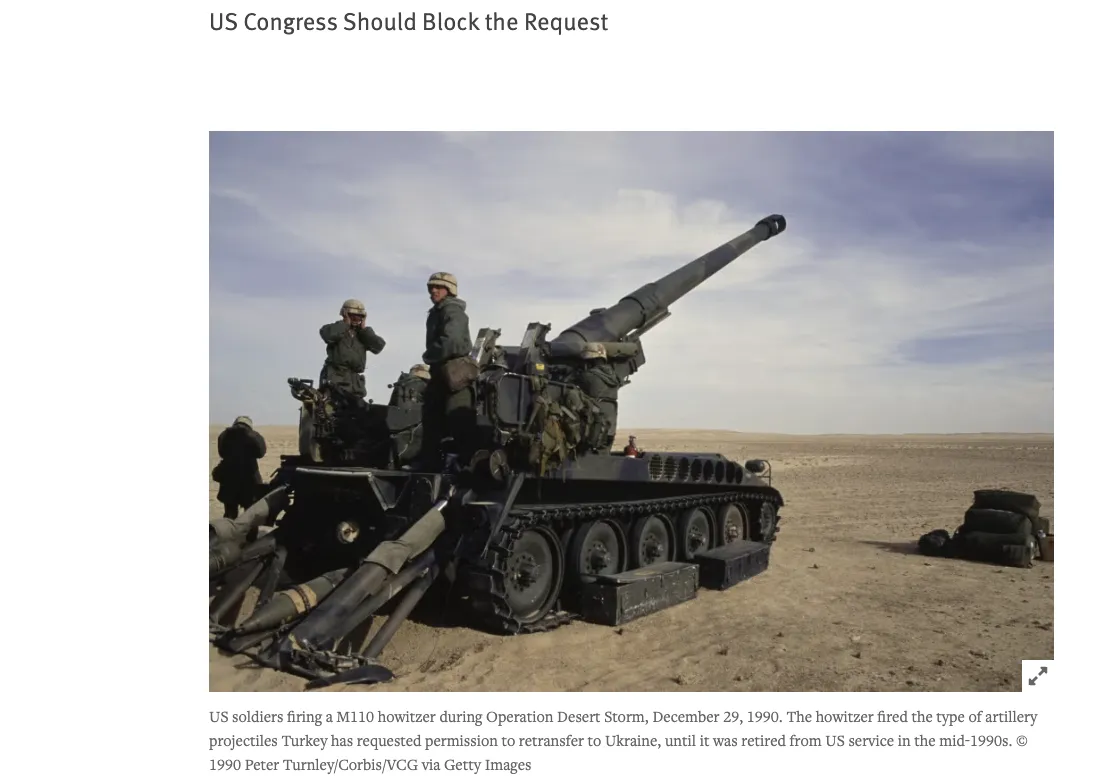
On August 12, the human rights organization Human Rights Watch called on Washington to reject Turkey’s request to transfer tens of thousands of cluster munitions—which have been stored in Turkish military depots for years—to Ukraine. HRW spoke out against such a transfer.
“Dropping obsolete cluster munitions into a conflict zone creates a humanitarian liability for the civilian population that is tragically predictable… The impact on civilians of these imprecise and unreliable munitions, which are more than 30 years old, has prompted 112 countries to ban these weapons by joining the international Convention on Cluster Munitions,” said Nicole Widdersheim, deputy director of Human Rights Watch in Washington.
It is noted that these munitions were partially manufactured by Turkey under U.S. licenses granted in 1987.
In addition to selling its entire inventory of 12 M270 multiple-launch rocket systems, the $256 million deal proposed by Turkey includes the transfer of three types of cluster munitions: 70 M39 ATACMS ballistic missiles, each containing 950 M74 anti-personnel/anti-materiel submunitions, for a total of 66,500 individual submunitions; 2,524 M26 missiles, each containing 644 M77 dual-purpose submunitions with improved conventional warheads (DPICM), for a total of 1,625,456 individual submunitions; 47,000 M509A1 203-mm artillery shells, each containing 180 M42 DPICM submunitions, for a total of 8.46 million individual submunitions.
“These types of cluster munitions are known for failing to hit their targets and causing harm to the civilian population. They should never be used. Congress can still take action to stop this short-sighted and dangerous transfer,” said Widdersheim.
In a letter submitted to Congress on August 6, 2026, notifying it of this agreement, an unnamed senior State Department official notes that the U.S. government is prepared to authorize this transfer and that Turkey “seeks to reduce its stockpiles of older defense items in order to focus its financial resources on modernizing and maintaining existing systems.”
“Ukraine seeks to acquire these systems to strengthen its offensive and defensive fire support capabilities as it confronts the Russian invasion. Ukraine already possesses munitions of the same or essentially similar type,” he noted.
HRW notes that cluster munitions are inherently indiscriminate and have a history of posing a deadly threat to civilians whenever they are used, making it difficult to reconcile their use with the prohibition on indiscriminate attacks against civilians, which may constitute a war crime.
Although the U.S. has not acceded to the treaty, an export moratorium has been included in the Department of Defense’s annual budget since 2009. However, former U.S. President Joseph Biden circumvented the moratorium between July 2023 and October 2024 and arranged at least seven transfers of cluster munitions to Ukraine, without disclosing the quantities provided.
As detailed in the “2025 Cluster Munitions Monitoring Report,” the U.S. Foreign Assistance Act facilitates this circumvention by allowing the president to determine that this type of security assistance is “vital to the security interests of the United States.”
It is not publicly known whether the administration of current U.S. President Donald Trump has made a similar decision in this case to circumvent the export moratorium.
Source: Human Rights Watch
Ukraine previously purchased 70 ATACMS ballistic missiles from Turkey.
Turkey has begun restricting the movement of some commercial vessels heading toward the Black Sea due to an increase in attacks in the region. Some vessels bound for Novorossiysk, Russia, or Ukrainian ports are facing delays in obtaining permits to pass through the Dardanelles.
On August 7, Saudi Arabia, Pakistan, and Turkey signed a mutual defense agreement in Mecca. The agreement stipulates that an armed attack on any one of the three states will be considered an attack on all three countries.


