
How cats help make sense of the connection between mechanics and free will
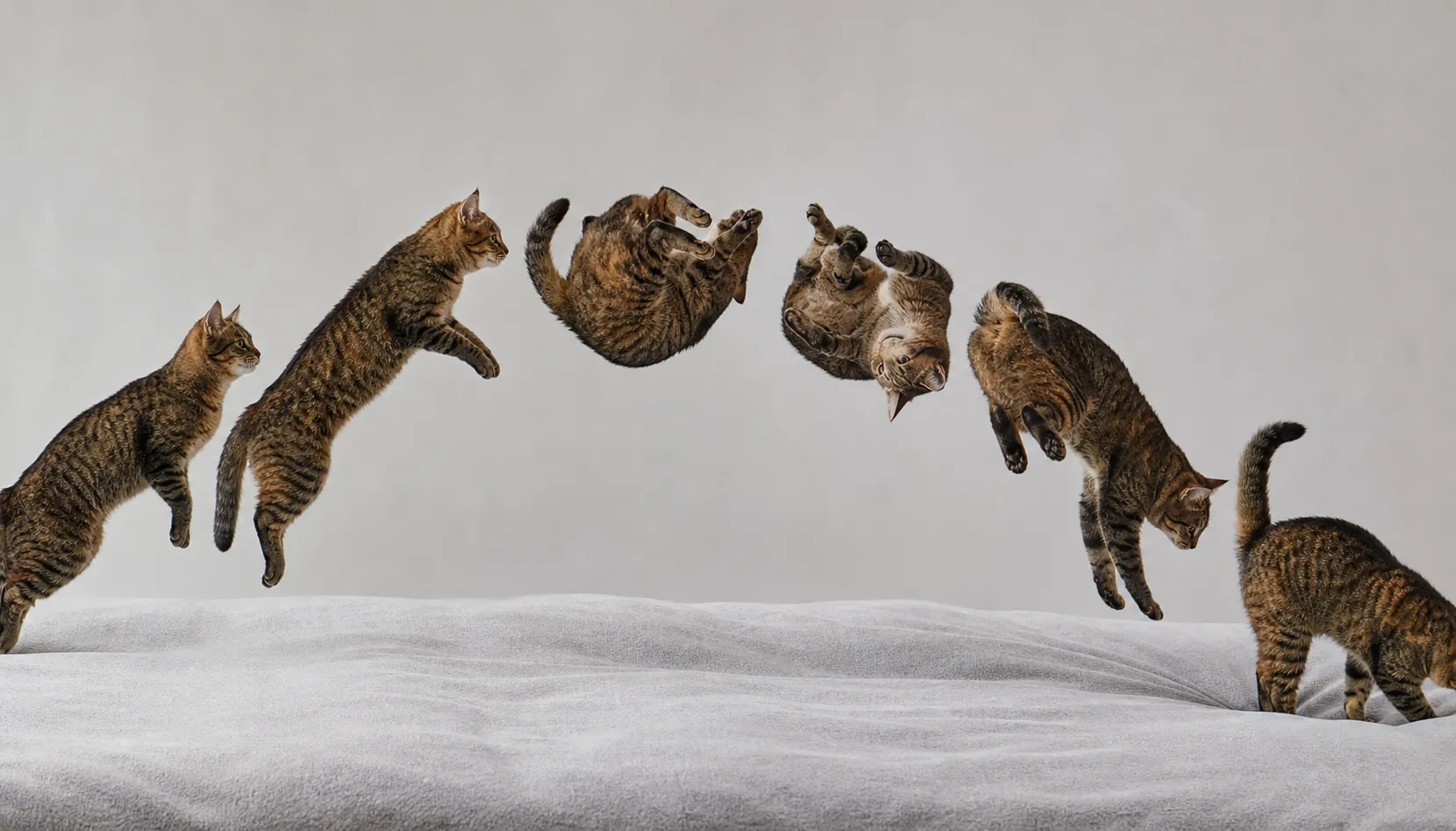
Cats’ ability to turn over in midair and land on their feet has prompted reflections on the connection between mechanics, control and free will. As the South China Morning Post reports, the phenomenon was studied as early as the 1850s by mathematical physicists George Gabriel Stokes and James Clerk Maxwell.
From experiments to models of motion
Maxwell mentioned a Trinity College tradition according to which he supposedly tried to find a way to throw a cat so that it would not land on its feet. He explained that the purpose of the experiment was to measure the speed at which the animal turns in the air, and that the cat was to be dropped onto a table or bed from a height of about two inches.
The subsequent development of high-speed photography made it possible to examine the sequence of movements in greater detail. Étienne-Jules Marey created a chronophotographic camera that recorded 12 frames per second, and in 1894 he published a series of images showing how cats change their body position while falling. In 1969, a classical dynamic model of this process appeared. In a 2026 study, researchers began replacing idealized joints and cylinders with measured parameters of a real feline spine.
Motion without a new force
The author explains that a cat does not violate the laws of physics or create a new force. By changing the shape of its body and redistributing mass with the help of muscles, it follows a closed path in the space of possible shapes and changes its orientation. For a rigid body with zero angular momentum and no external torque, such a turn would be impossible.
More current news is available on the UA.News Telegram channel Telegram.
The author proposes calling this approach “mechanics filled with mind” — a combination of mechanics with the concepts of will, control and purposeful behavior. Its technical components are being developed in biomechanics, control theory and robotics. Similar principles are also used in the design of autonomous cars, where sensors provide perception, computers implement a control policy, and actuators translate it into physical forces.
Determinism and choice
The article notes that determinism in physics describes the evolution of the complete state of a closed system, but a person does not possess such a complete description. The practical question for an agent is not only what will happen, but also what will happen under different actions. Memory, reasoning and ideas about consequences are part of the causal chain of choice.
According to this logic, quantum theory does not abolish the deterministic evolution of the quantum state of a closed system, but limits an observer’s ability to measure that entire state without changing it. The author contrasts Schrödinger’s cat, which illustrates the gap between a formal description and an uncertain experienced outcome, with a falling cat. Its motion, according to the concept presented in the article, shows the difference between a trajectory described from the outside and a future that a creature directs from within.


