
Drone incident in Romania exposes NATO vulnerability — Bloomberg
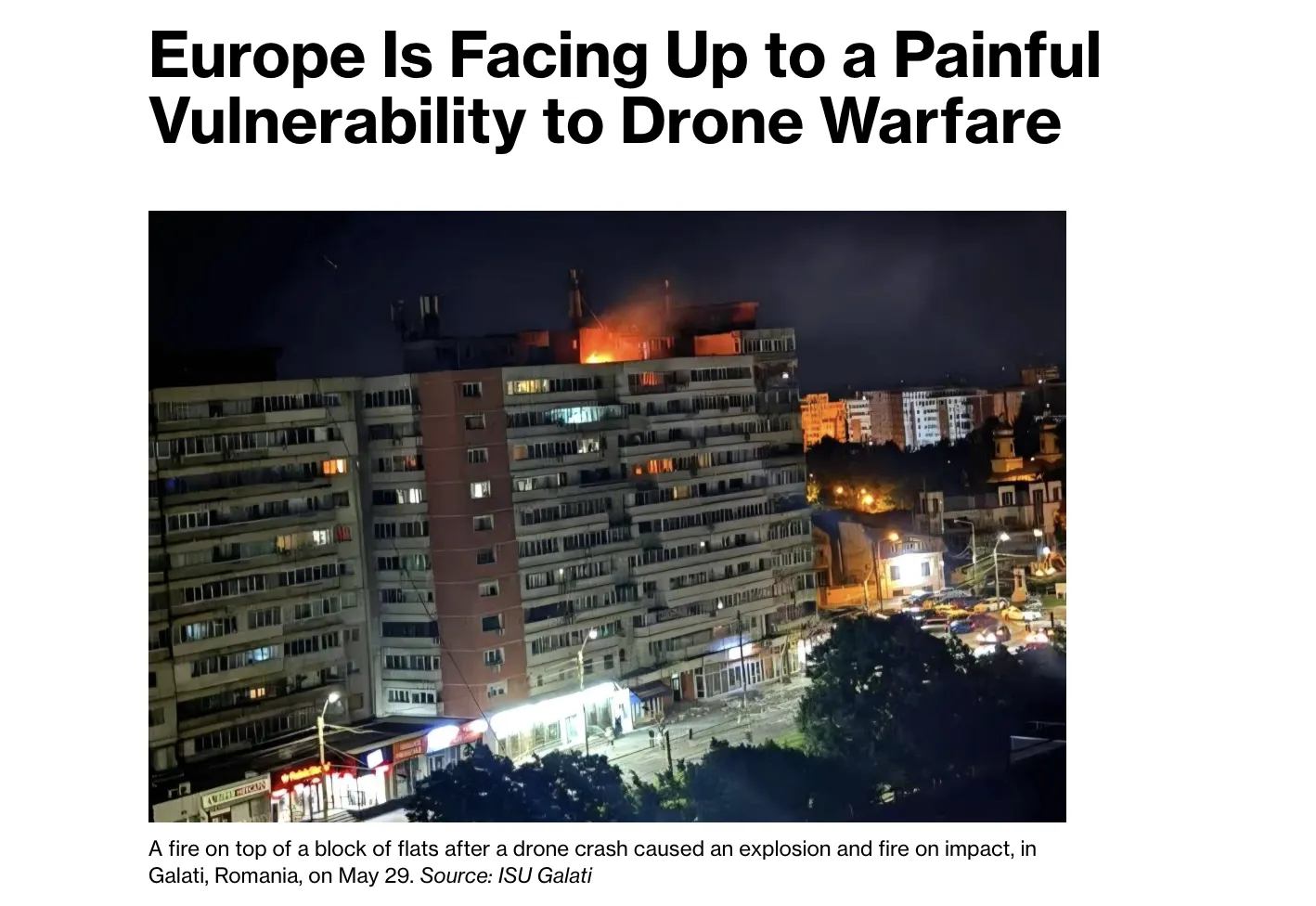
The crash of a Russian attack drone into a residential building in Romania has served as yet another warning of Europe’s vulnerability to drone warfare. This comes despite years of combat experience near the borders of the EU and NATO.
Bloomberg reports on this.
As a result of the incident in the port city of Galați, located about 20 kilometers from the Ukrainian border, a woman and her 14-year-old child were injured. Romanian authorities called the incident a “serious and irresponsible escalation” by Moscow.
However, in recent years, drone incursions into the airspace of EU and NATO countries have become a regular occurrence. Since the start of the full-scale war, Romania has recorded 47 such cases. Similar incidents have also occurred in Poland, Finland, Latvia, Lithuania, and Estonia.
Former NATO Deputy Secretary General Mircea Joane stated that the situation highlights serious gaps in the defense of the Alliance’s eastern flank:
“Delays in learning lessons over the past four years and a lack of military and technological equipment create a vulnerability that must be addressed immediately.”
One of the main problems is that modern strike drones fly at low altitudes and often remain undetected by traditional radars.
The Romanian military reported that the drone that crashed in Galați was detected by radar, after which F-16 fighter jets were scrambled. However, the drone flew so low that it effectively evaded interception.
Romania’s interim Prime Minister Ilie Bolojan acknowledged that the country’s capabilities remain limited. He stated: “Romania’s defensive response was limited by the level of equipment.”
Experts warn that the problem extends far beyond military technology. It undermines citizens’ confidence in NATO’s security guarantees.
Yulia Joya, director of the Black Sea Program at the Washington-based Institute for the Middle East, believes that the regular incursions by Russian drones pose an awkward question for the Alliance.
“If Russian drones can repeatedly enter Romanian airspace, reach populated areas, and still evade interception, citizens will inevitably ask whether NATO’s security guarantees work in practice,” she noted.
Countries on the eastern flank have already begun to rapidly modernize their defenses. Poland is creating a large-scale integrated anti-drone system. Latvia plans to deploy special anti-drone units along the border. Lithuania and Estonia are amending legislation so that operators of critical infrastructure can independently shoot down or jam drones.
European Commission President Ursula von der Leyen stated after the incident that this was “yet another red line” that had been crossed, while Chancellor Friedrich Merz emphasized the need to strengthen NATO’s eastern flank.
Experts warn that the war in Ukraine has become a testing ground for the rapid development of drone technology. Russia and Ukraine are constantly improving their drones, while traditional air defense systems are increasingly proving too expensive or ineffective against cheap drones.
Earlier, Romania explained why it did not intercept a Russian drone that struck a house
Video: A Russiandrone crashed into a residential building in Romania.
During the Russian strike on the Odesa region on April 25, Russian drones were moving along the border with Romania. British aircraft patrolling Romanian airspace tracked their routes. Later, drone debris was found in border areas of Romania.
The Romanian Ministry of Foreign Affairs summoned the Russian ambassador over the incident involving a drone crash near the city of Galați.


