
Despite the European Union extending temporary protection for Ukrainian refugees until 2027 and guaranteeing them access to housing, employment, education, and healthcare, the situation is already changing in many ways.
Cuts in financial assistance and growing negative sentiment toward refugees are effectively triggering new migration movements within the European Union. Whether refugees who lose EU temporary protection in 2027 will return to Ukraine has been examined in previous reports. For now, a more prominent trend is that Ukrainians are looking for better regions and opportunities for life in Europe.
However, for many, relocating to a new place has become a more complex issue than simply considering the amount of benefits or other social support. The ability to adapt and future life prospects has become a significant factor. In some even relatively wealthy countries, societal radicalization against migrants is increasing. Depending on political will, states may not only reduce social payments but also impose additional barriers and restrictions on newcomers.
Refugee flows from Ukraine continue
In 2025, a new wave of war migrants from Ukraine began. According to Eurostat, September saw a record high, with EU countries approving 79,205 new temporary protection applications from Ukrainians — the highest figure in two years.
The main reasons for this migration surge were the permission for men aged 18 to 22 to travel abroad and the intensification of attacks on cities, particularly in frontline regions.
In the following months, the number of applications decreased slightly, but the flow of refugees did not stop. EU official statistics show that from October 30 to November 30, 2025, 30,615 Ukrainians were granted temporary protection (+0.7%).
During this period, an increase in arrivals from Ukraine was recorded in 21 out of 26 EU countries. The largest absolute growth was observed in Germany (+11,040; +0.9%), Poland (+3,745; +0.4%), and Spain (+2,810). Among the five EU countries where numbers decreased were France (-870; -1.6%) and Lithuania (-575; -1.1%).
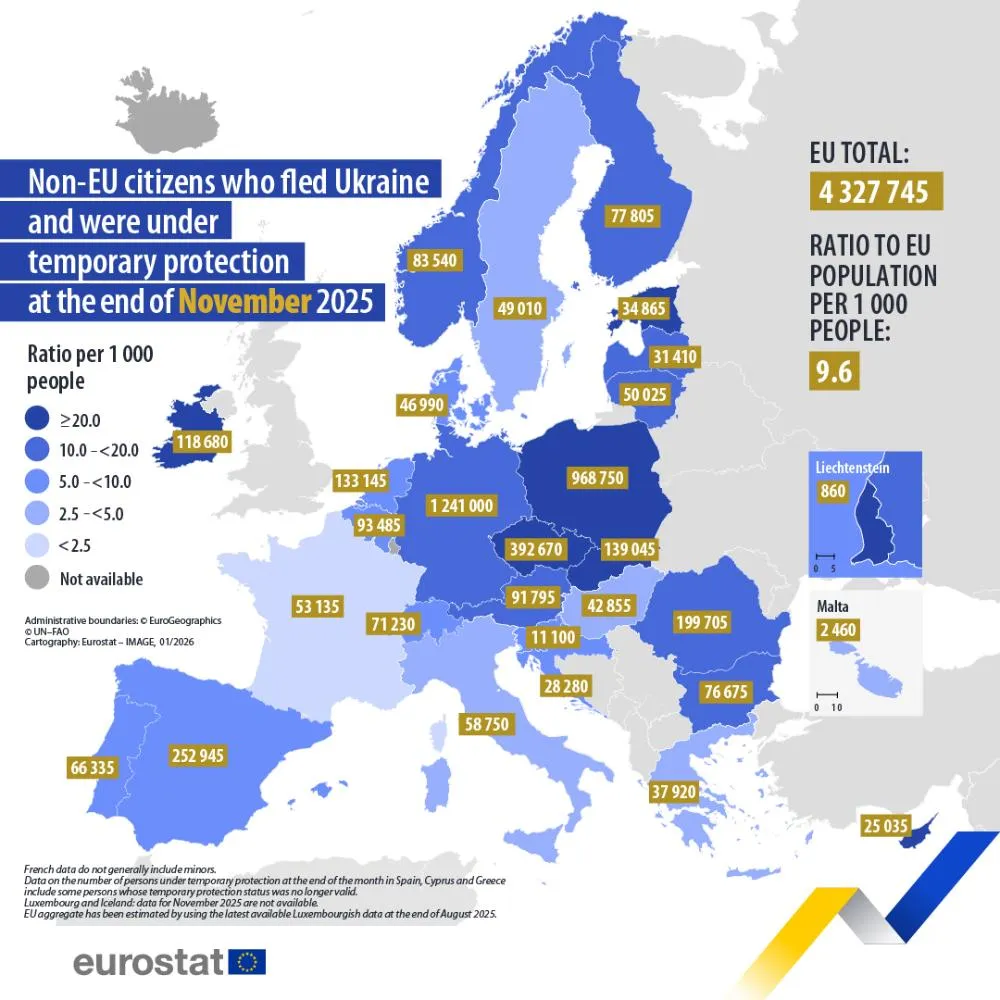
By the end of 2025, over 4.33 million Ukrainians with temporary protection status were living in European countries. Ukrainians most often settled in:
- Germany — about 1.24 million (almost 29% of all those under temporary protection in the EU)
- Poland — about 969,000 (22%)
- Czechia — approximately 393,000 (9%)
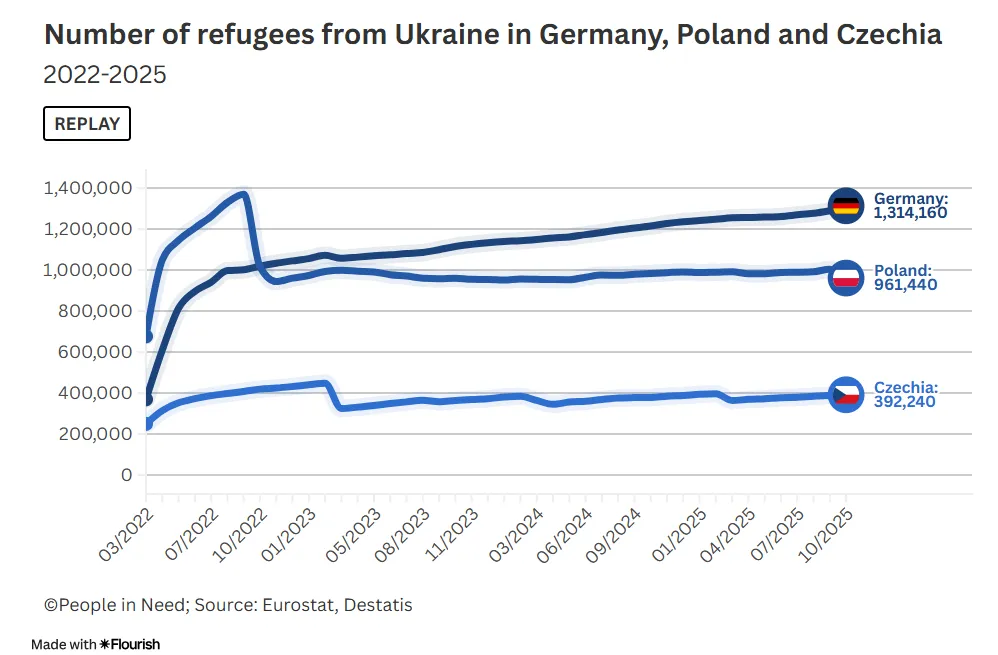
Looking at the number of refugees per capita, Czechia ranks first in the EU, where Ukrainians under temporary protection constitute nearly 4% of the population (almost 400,000 Ukrainians in November 2025). The only European country with a higher relative share of refugees is Moldova, which is not part of the European Union.
Choosing a new country: benefits and other factors
When choosing a new country to live in, Ukrainians mainly consider free access to healthcare, education, and the possibility of legal employment. For many, having acquaintances or connections within the Ukrainian diaspora in the new country helps with adaptation. Other important factors include the level of social benefits, geographic proximity to Ukraine, and a low language barrier.
Although financial support remains a key factor in relocation, Ukrainians also take into account the approaching economic slowdown in Europe. In 2026, refugee benefits will no longer be as generous as before. Most countries are beginning to restrict funding or tighten eligibility requirements.
- Germany: The German government planned significant changes in benefits for Ukrainians: arrivals after April 1, 2025, will receive lower support of about €441 instead of the Bürgergeld (€563). For refugees who arrived earlier, stricter employment requirements apply. In 2026, Ukrainians entitled to Bürgergeld will receive monthly payments of:
- Children 0–5 years — €357
- Children 6–13 years — €390
- Teenagers 14–17 years — €471
- Adults unable to work — €451
- Spouses (per partner) — €509
- Single adults — €563
- Belgium: Refugees may receive around €1,100 per month, the highest level of payments in the EU. In 2026, payments depend on family status:
- Single adult — €1,139.97 per month
- Couple — €758.64 each
- Child allowance — €150–220 per month
- Maximum per family — up to €1,537.90 per month
- Ireland: Financial programs exist for hosts providing accommodation to refugees, paying about €800 per month. New Ukrainian arrivals in 2026 will be given free housing for 30 days instead of 90. Refugees also receive weekly social payments: adults — €38.8; children — €29.8.
- Netherlands: Refugees with jobs and living in shelters must pay utilities, calculated based on income. Additional support includes clothing — €62.66, personal expenses — €77.16 per refugee. Food assistance ranges from €252 to €189 per person depending on family status, with separate child food support from €210 to €157.
It should be noted that financial benefits are not decisive for all categories of Ukrainian refugees. Decisions on relocation often depend on education, skills, financial status, and business contacts. Wealthier Ukrainians have mostly chosen Austria or Germany in recent years due to high safety and comfortable living conditions. Less wealthy or lower-educated individuals usually remain in neighboring countries, mainly Poland and Moldova.
Best countries to live in: conditions are changing
The list of popular countries for Ukrainians is gradually changing, mainly due to shifts in state policy and growing societal radicalization against migrants. Alternative research sources indicate that as of October 2025, only 600–700 thousand Ukrainians actually lived in Poland, instead of the officially reported nearly 1 million. This discrepancy is explained by Ukrainians moving from Poland to other countries.
Recent data on migration trends in Germany show that as of January 31, 2026, over 471,000 refugees fleeing the war in Ukraine had left the country. The statistics were reported by the German Federal Ministry of the Interior.
According to updated data, Germany now hosts 1.157 million Ukrainian refugees, including about 484,000 men and 672,000 women, of whom around 305,000 are minors.
Changes in migration flows are primarily linked to cuts in social benefits and stricter employment requirements. At the same time, the German Ministry of the Interior does not expect the number of refugees arriving in the EU and Germany to significantly decrease in the near future due to the ongoing war, constant shelling, and the economic situation in Ukraine.


