
Floating weeds threaten fishing and agriculture in Malawi — Mongabay
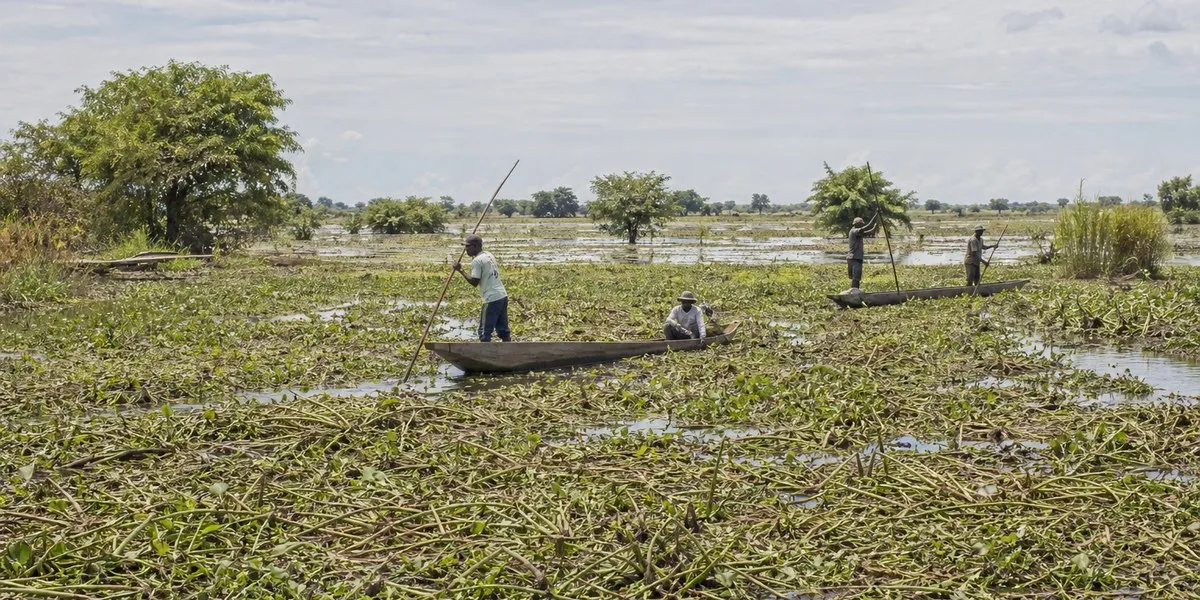
In Chia Lagoon, the largest in Malawi, a mass of floating weeds and debris has blocked waterways and made it difficult for farmers to access their fields and fishers to reach fishing grounds. Due to flooding that continues seven months after the end of the rainy season, local residents are unable to fully grow maize and rice on irrigated plots, Mongabay reports.
Fields remain flooded
The lagoon is located on the western shore of Lake Malawi and is connected to it by a narrow channel. Local communities said that weeds and debris began accumulating near the lagoon’s outlet in February. This prevents water from flowing out into the lake, causing it to return to the lagoon and flood agricultural land.
Ali Maulidi, who heads an association of more than 1,000 fishers in the Nkhotakota district, said local residents had not encountered a similar situation before. According to him, mature cassava has rotted in some fields because of waterlogged soil. Fishers also reported that they cannot reach fishing areas by boat because overgrowth has blocked the routes.
More current news is available on the UA.News Telegram channel Telegram.
Scientists study possible causes
Chia Lagoon covers 1,700 hectares. It directly provides livelihoods for more than 7,800 households engaged in growing rice, cassava and maize, fishing, and bird hunting. The wider river network supports more than 55,000 agricultural producers. In December 2025, the lagoon was recognized as a key biodiversity area due to its diversity of birds, fish, plants, reptiles and amphibians.
Environmental scientist Tiwonge Mzumara-Gawa of the Malawi University of Science and Technology noted that the exact causes of the current vegetation buildup have not yet been established. Her research group also had difficulty accessing parts of the lagoon earlier this year while studying land use in the catchment.
In the scientist’s view, deforestation, the expansion of arable land, growing settlements and cultivation of plots along the lagoon’s edges may have intensified siltation. She also suggested that two waves of flooding in December 2025 and January 2026 may have moved more quickly through the degraded catchment and forcefully uprooted plants into the lagoon.




