
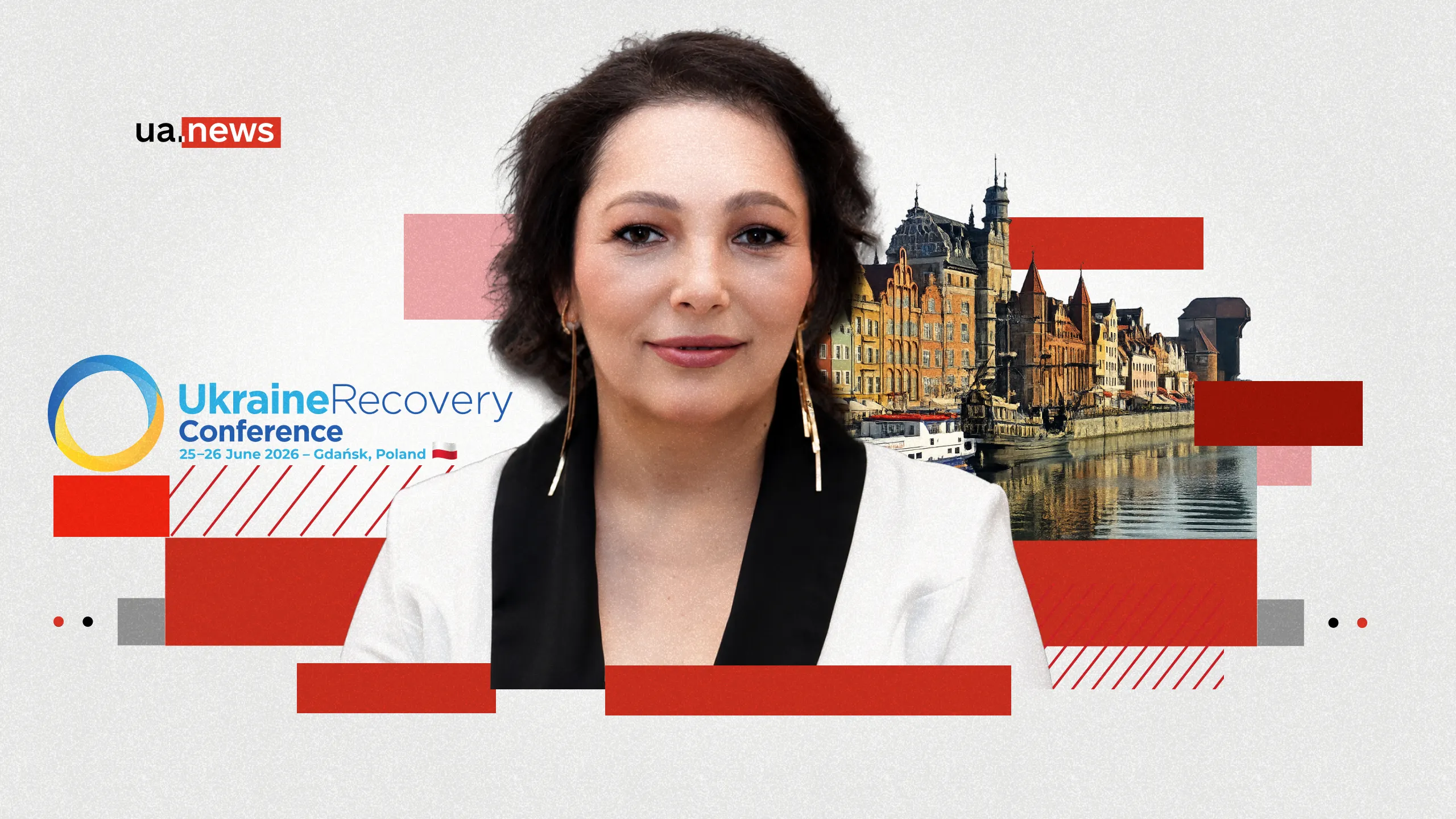
The large-scale Ukraine Recovery Conference (URC 2026) took place on June 25–26 in Gdańsk, Poland, and became one of this year’s key foreign policy events. Although President Zelenskyy did not attend the event, approximately 160 agreements worth over €10 billion were signed.
Galina Heylo, president of the International Payment Association (IPA), vice president of the Association of Ukrainian Banks, and chair of the Finance Committee, spoke about this and other topics in an exclusive interview with UA.News. Read more in our article.
On the conference in Gdańsk, Ukraine’s recovery, and key insights from the forum
I came away with mixed impressions from the conference. On the one hand, the very existence of an international platform for discussing Ukraine’s recovery is undoubtedly positive. Such events are essential for fostering international dialogue and coordinating partners’ efforts.
At the same time, questions arise regarding the practical effectiveness of such forums. If a conference becomes merely a discussion platform without a willingness to openly address complex issues, its value is significantly diminished.
During one of the panel discussions, the Deputy Minister of Economy was asked about the fight against corruption in Ukraine. However, no substantive answer was given—the question was effectively left unanswered. In my opinion, following the “Mindi-gate” scandal, the issue of corruption in Ukraine has come to the forefront for our partners and demands a response.
For European partners, the issue of corruption remains one of the key factors in the context of continued support for Ukraine. If the Ukrainian authorities are convinced that the scale of this problem is exaggerated in Europe, then international forums are precisely the best place for an open, reasoned discussion.
Sweeping such topics under the rug only creates additional doubts. At the same time, a significant number of important agreements were signed in Gdańsk, which was one of the main practical outcomes of the conference.
About the Agreements Signed
Numerous agreements were reached at the conference regarding funding for Ukrainian cities, infrastructure projects, and other areas of reconstruction. This is undoubtedly a positive outcome.
In my opinion, such conferences are needed first and foremost to develop diplomatic contacts, strengthen cooperation with the governments of other countries, and build long-term partnerships. It is particularly important today to maintain a dialogue with Poland, given the sensitive issues of historical memory and historical justice, which periodically affect bilateral relations, as is currently the case.
That is precisely why the absence of Ukrainian President Volodymyr Zelenskyy at the conference, in my view, was a very serious mistake. It was a good opportunity to personally thank Poland and other international partners for their support of Ukraine, as well as to hold a series of important bilateral meetings.
The forum’s program included separate events involving heads of state and other leaders—yet the Ukrainian president did not participate in them. This was a huge mistake, in my opinion.
The organizational discipline of the Ukrainian delegation also left a negative impression. During the energy panel, Poland’s Minister of Energy and European Commissioner Dombrowski, who is responsible for energy, were waiting for Ukrainian Prime Minister Denys Shmyhal, who was simply… late. At international events of this caliber, such situations look, to put it mildly, unprofessional.
On the specific outcomes of the conference
A large number of major agreements were signed in Gdańsk—in particular, with the participation of the European Bank for Reconstruction and Development and other international financial institutions.
For me personally, the thematic side events were even more interesting than the main program. One of them was dedicated to the development of Ukraine’s banking and insurance sectors and their integration into the European financial space.
The event was opened by Andriy Pyshnyy, Governor of the National Bank of Ukraine, who answered questions from Jacek Piechota, President of the Polish-Ukrainian Chamber of Commerce—a former Polish Minister of Economy who, in his time, participated in the country’s accession process to the European Union and effectively “led” Poland by the hand into the EU.
During the discussion, representatives of the financial sector spoke about reforms that have already been implemented and the challenges that still need to be overcome. Andriy Pyshnyy emphasized that Europe has already provided Ukraine with hundreds of billions of euros in aid—specifically, about 180. I liked his phrasing that this is not just aid, but also, to a certain extent, payment for Europe’s security, which Ukraine is ensuring today.
He also provided data on the insurance market. According to him, the main phase of transformation has already been completed. While there used to be 216 insurance companies operating in Ukraine, today there are only 58 left.
At the same time, the sector’s financial stability has improved significantly: previously, about 40% of companies had illiquid assets and were operating at a loss, whereas now, despite a significant reduction in the number of market participants, the insurance sector’s profitability has increased.
However, the insurance market’s share of Ukraine’s GDP stands at only 0.87%, whereas in most European countries this figure ranges from 5% to 7%.
Overall, it can be stated that both Ukraine’s banking and insurance sectors are already largely adapted to the requirements of European legislation. The next step should be to expand their role in the economy and increase their contribution to the country’s GDP.


