
Trump is stepping up pressure on Cuba, but faces obstacles — Politico
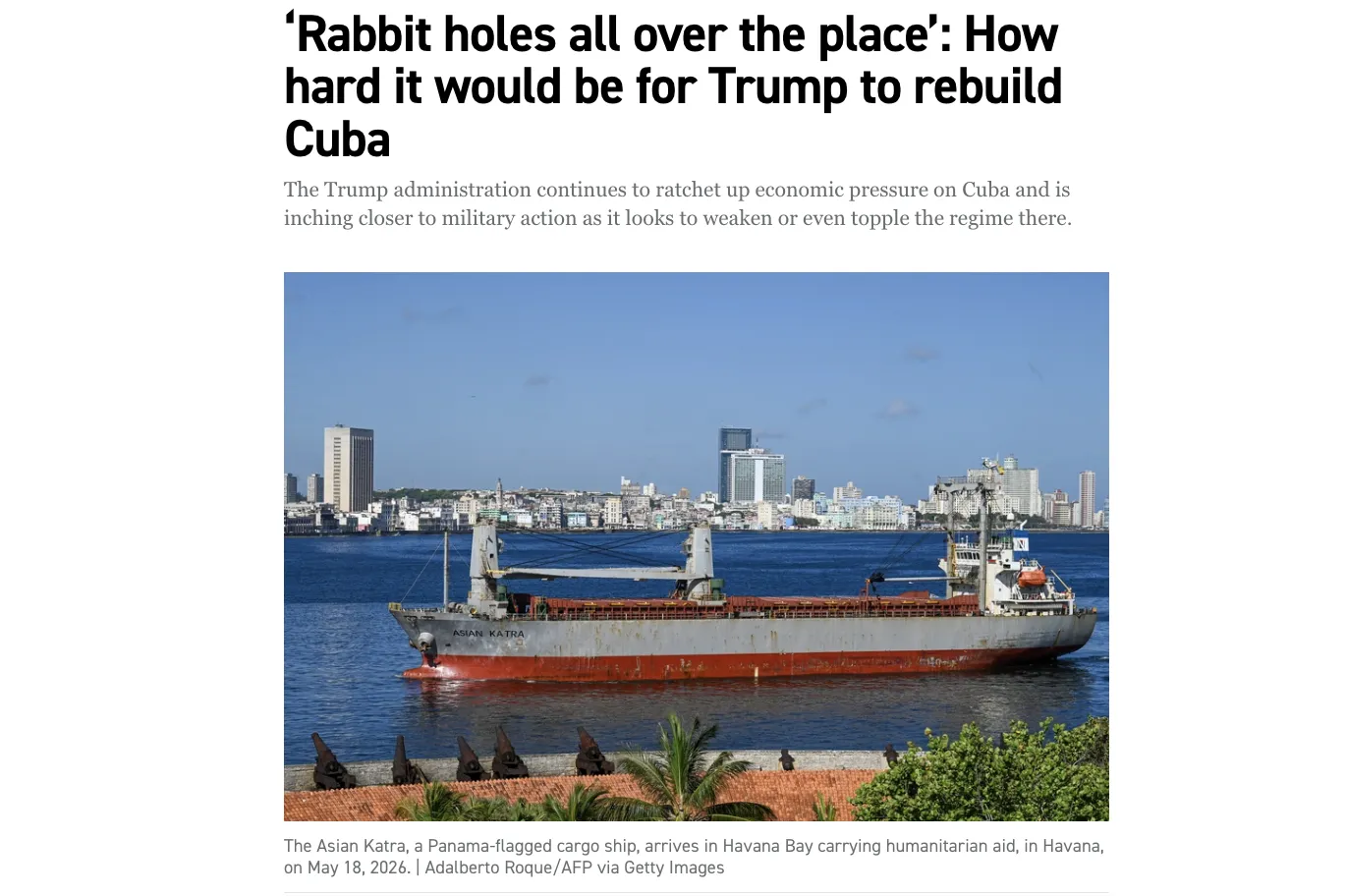
The Donald Trump administration is stepping up economic pressure on Cuba. According to Politico, Washington is attempting to influence the regime of Miguel Díaz-Canel, but the implementation of this policy faces a number of political and economic challenges.
Using sanctions and an energy blockade, Washington is gradually moving toward the possibility of military action to weaken or overthrow the communist regime. Secretary of State Marco Rubio, in a video address to the Cuban people, promised assistance in building a better future. However, implementing these plans will require massive investment by the U.S. private sector on an island with a population of about 10 million, while American companies are exercising serious caution.
The main difference between Cuba and Venezuela lies in the structure of their economies. In Venezuela, the oil sector is the key driver, whereas in Cuba there is no single dominant industry that Trump could leverage, despite past interest from American tourism and agricultural companies. Furthermore, decades of communist rule have led to the atrophy of the private sector and the decline of public services.
Business leaders emphasize that the country is in ruins and requires a complete overhaul from scratch. The island lacks basic infrastructure for water and electricity, and there is no functioning banking system. Modernizing networks neglected for decades and improving internet access will cost billions of dollars. Any attempts to open up Cuba are burdened by a heavy historical legacy: from emigrants’ efforts to reclaim confiscated property to the need to lift layers of U.S. sanctions through the U.S. Congress.
A major risk for American investors is a 1996 U.S. law. It allows individuals and companies whose property was seized after the Cuban Revolution to sue any business that profits from the use of those assets. Recently, American Airlines and a Spanish hotel chain have already settled similar lawsuits filed by Cuban-Americans who inherited the confiscated property.
The situation escalated after the U.S. Supreme Court ruled that an American port has the right to sue four cruise lines that used docks confiscated by the Cuban government between 2016 and 2019. The court is currently considering another case in which the energy company Exxon Mobil is seeking compensation for confiscated oil and gas. Under these circumstances, the U.S. Chamber of Commerce notes that involving businesses could lead to a flood of lawsuits against American companies.
In parallel with the economic blockade, Washington is intensifying political pressure. The U.S. Department of Justice has charged former Cuban President Raúl Castro in connection with the 1996 murders of four people who were participating in civilian rescue flights. Donald Trump himself openly calls Cuba a “failed state” where there is no electricity or money, but promises to help by engaging the Cuban-American community as a key asset for reconstruction and capital return.
However, the island’s most pressing need amid recurring power outages is food. According to the U.S. Agriculture Coalition for Cuba, a massive food crisis is unfolding in the country due to a critical decline in pig and poultry populations. American companies currently supplying the island with chicken, rice, and beef are ready to increase exports. If the embargo were lifted, the U.S. could also purchase Cuban agricultural products, including coffee, charcoal, tropical fruits, winter vegetables, and cigars.
For now, American companies’ interest in Cuba remains purely theoretical. Businesses are wary of openly discussing potential investments, as the uncertain economic situation and the risk of broken promises could draw sharp criticism from Trump. Companies that already have permission to do business with Cuba do not speak about it publicly, while potential investors are simply gathering information and monitoring developments, awaiting the establishment of clear democracy and the rule of law.
Read also:
Cuba is buying drones in preparation for war against the U.S. — Axios
The US and Cuba have returned to the negotiating table
Cuba Responds to Trump’s Declaration of a State of Emergency


