
Remains of royal chamberlain’s tomb discovered in Saqqara, Egypt
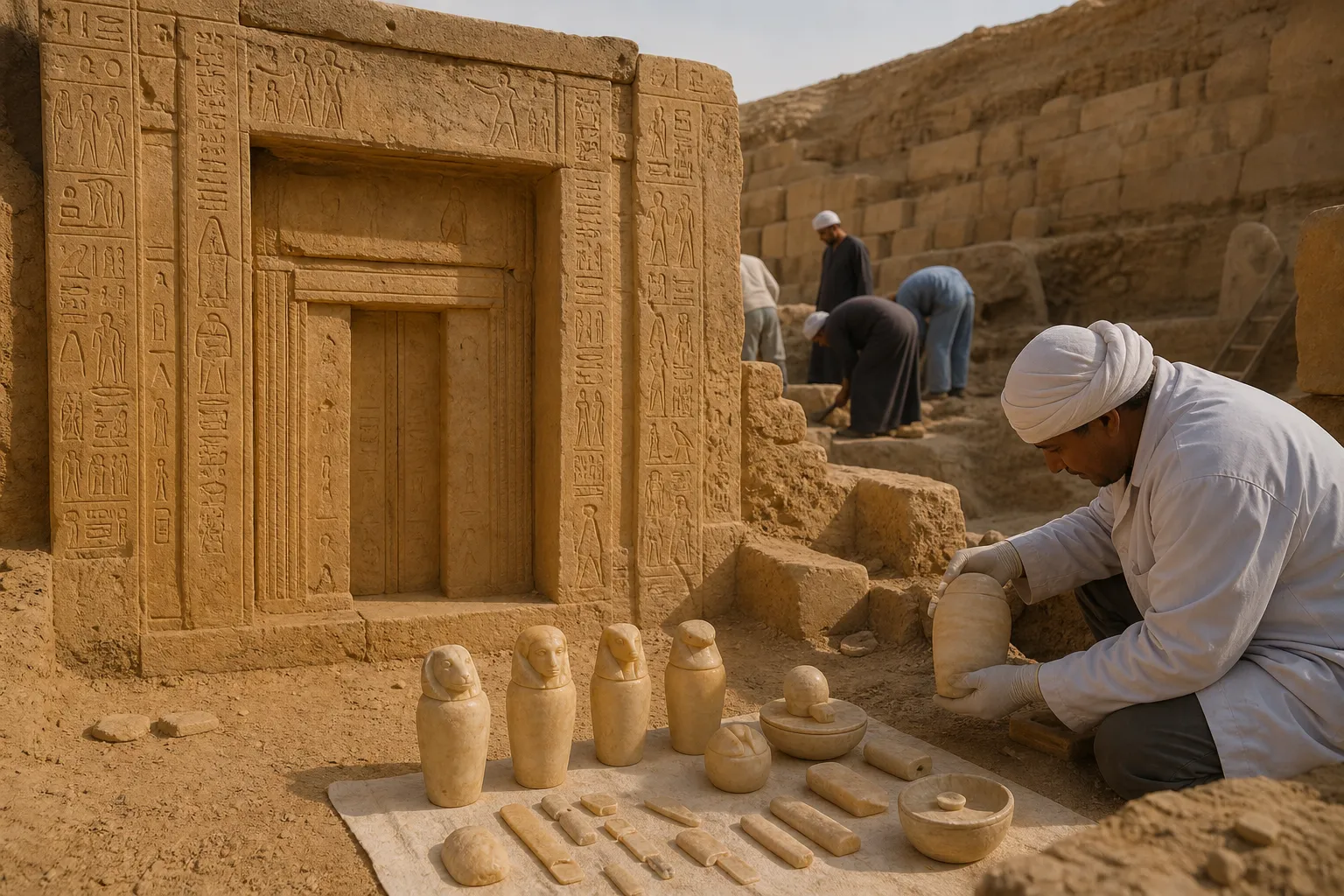
Archaeologists in Egypt’s Saqqara have discovered the remains of the tomb of royal chamberlain Sekhentiu-Ptah, including a burial chapel and a false door preserved in their original location. The discovery was made in Sector A of the Bubasteum necropolis during the first excavation season, the Jerusalem Post reported, citing Egypt’s Ministry of Tourism and Antiquities.
The Bubasteum necropolis is located on the edge of the desert in Saqqara and is part of a temple complex from the Ptolemaic and Roman periods dedicated to the goddess Bastet, the goddess of cats in ancient Egyptian religion.
Inscriptions identified the owner of the burial
Hieroglyphic inscriptions bearing the name Sekhentiu-Ptah and the titles of the burial’s owner have been preserved on the false door and several discovered objects. These include royal chamberlain, overseer of all the king’s works, overseer of royal documents, keeper of the secrets of royal decrees, priest of the goddess Maat, and overseer of scribes.
More current news is available on the UA.News Telegram channel Telegram.
In ancient Egyptian beliefs, false doors were considered a boundary between life and death through which a deity or the spirit of the deceased could pass in both directions. They were usually carved or painted on the western wall of a burial chapel.
Funerary equipment and sarcophagi
In front of the false door, researchers found a complete set of alabaster funerary equipment: an offering table and a disc, a purification basin, a jug, and another basin. Mohamed Abdel-Badi, head of the Egyptian Antiquities Sector, called the discovery of the set in its original position important for studying the funerary rites and practices of the Old Kingdom period.
The archaeological mission also discovered an interconnected system of burial shafts containing several human burials, a large quantity of colored funerary cartonnage, and three sealed stone sarcophagi. Other finds include more than 100 faience ushabti figurines, a wooden falcon statuette, and ceramic vessels. Mission head Amr El-Tayebi noted that some of the shafts had been looted in antiquity, as evidenced by passages between burial chambers.


