
In China, vacuum fluctuations raised NbSe2’s critical temperature by 5.4% — ScienceDaily
In China, researchers led by specialists from the University of Science and Technology of China demonstrated that quantum vacuum fluctuations can enhance superconductivity. The critical temperature of a six-layer niobium diselenide (NbSe2) device increased by up to 5.4%, ScienceDaily reports.
A superconductor in a terahertz cavity
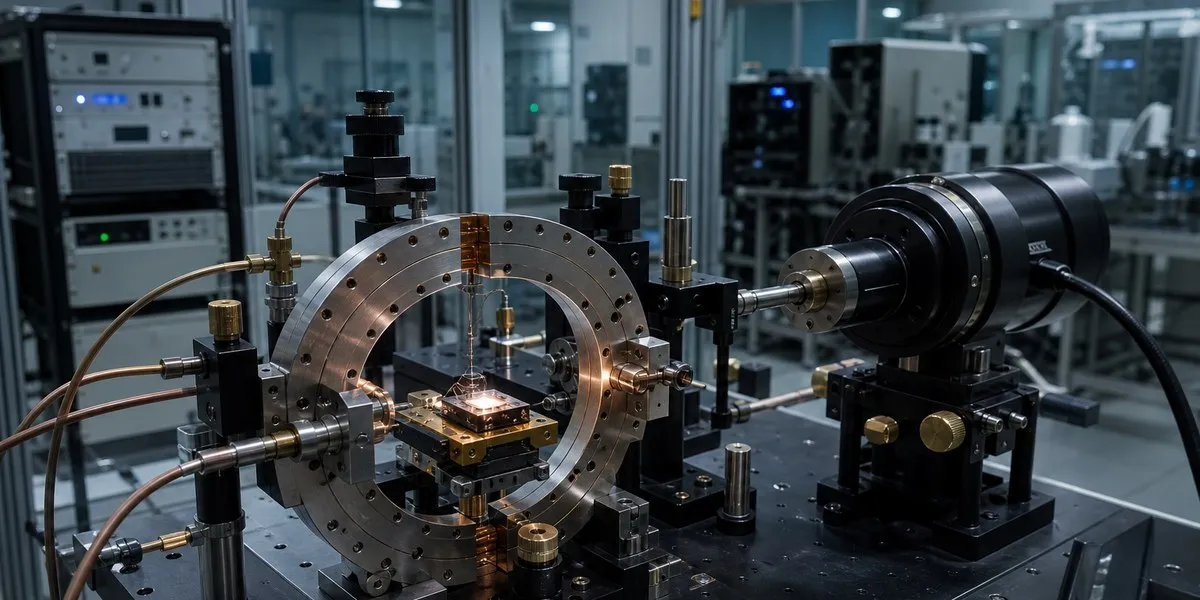
The team placed NbSe2 in a terahertz “dark” cavity with a split-ring resonator. Such a system changes the electromagnetic environment around the material and, according to the authors, can significantly enhance vacuum fluctuations, which in free space are usually too weak to have a noticeable effect on macroscopic condensed-matter systems.
The scientists compared the superconducting properties of NbSe2 inside and outside the cavity. They recorded an increase in the critical temperature — the temperature below which the material transitions into a superconducting state. Near this transition, the critical current and critical magnetic field also increased substantially.
More current news is available on the UA.News Telegram channel Telegram.
Control experiments and a model
The authors varied the geometry and characteristic frequency of the cavity, the thickness of the materials, dielectric components, and metal strips. According to their conclusions, the effect cannot be explained by material strain, degradation, inhomogeneity, or metallic screening.
The enhancement of superconductivity was resonant in nature and peaked at a certain cavity frequency. A theoretical model developed by Qing-Dong Jiang’s group with the participation of Frank Wilczek suggests that the superconducting state interacts with the cavity’s virtual photons. Under this interpretation, such an interaction lowers the energy of the superconducting state and makes it more stable.
Contactless influence on quantum states
The researchers describe this approach as a contactless way to control quantum states of matter: the material does not need to be directly excited by an external energy source; instead, its vacuum electromagnetic environment is changed. Further optimization of resonators and materials may strengthen and expand the method’s application to other quantum systems.




