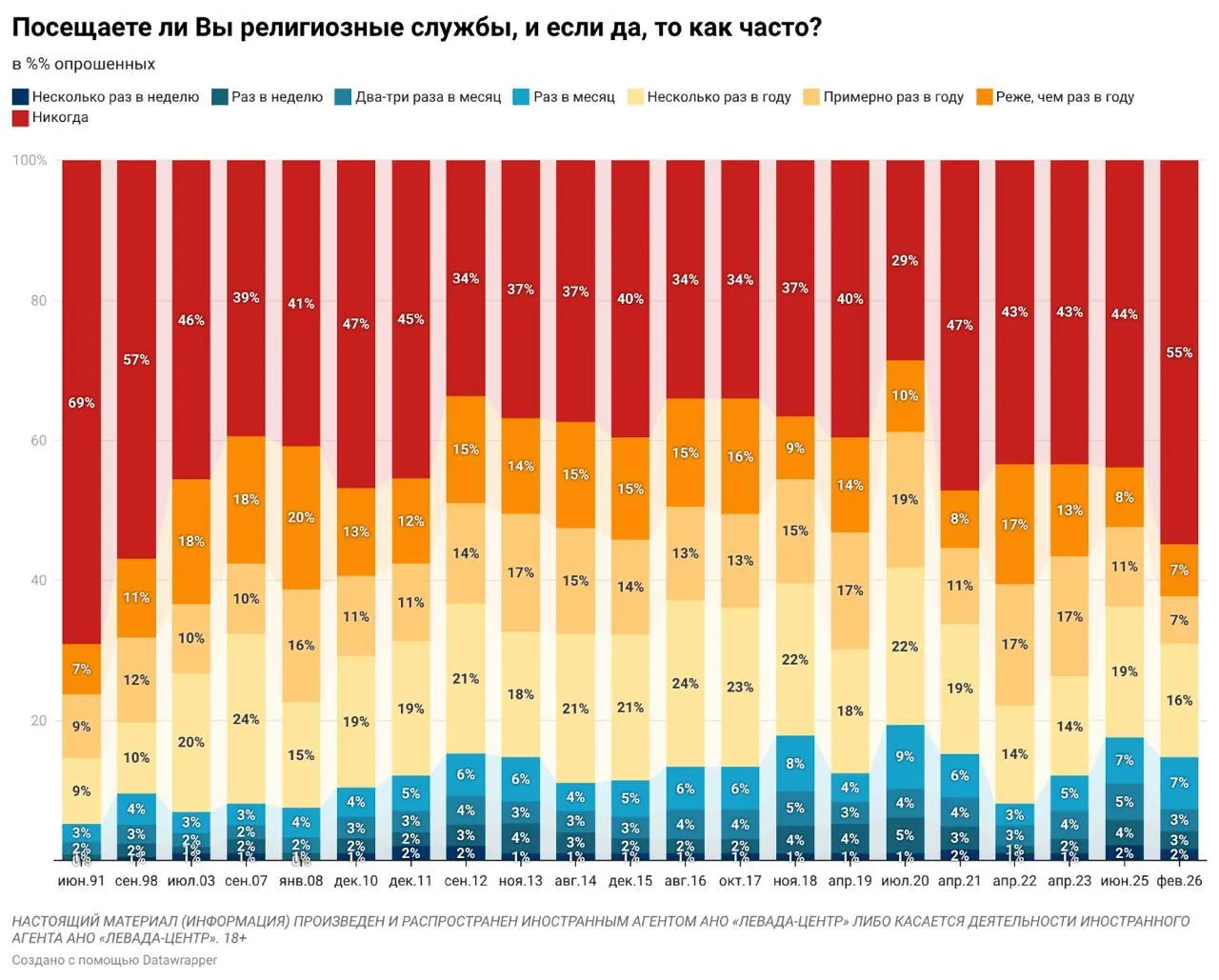
More than half of Russian citizens (55%) said they never attend religious services. This is the highest figure recorded to date and the first time since 1997 that the proportion of those who do not attend church has exceeded the number of worship service attendees.
This is evidenced by data from a Levada Center survey.
Compared to June of last year, the number of such respondents increased by 11 percentage points, and compared to 2020—by 26 points.
According to the survey results, only 16% of Russians attend services at least once a month, and another 16% attend several times a year. About 7% do so once a year or even less frequently.
The Levada Center notes that the increase in the proportion of those who do not attend church services is linked to a decline in the Orthodox Church’s authority. In particular, researchers point to its militaristic rhetoric, conservative stance, and interference in social processes, which is alienating some of its supporters.
The survey was conducted from February 18 to 25 without breaking down responses by denomination.
At the same time, according to a previous study, the majority of Russian citizens (73%) identify as Orthodox, another 6% as Muslims, 1% as Buddhists, 5% as atheists, and 13% do not identify with any religion.
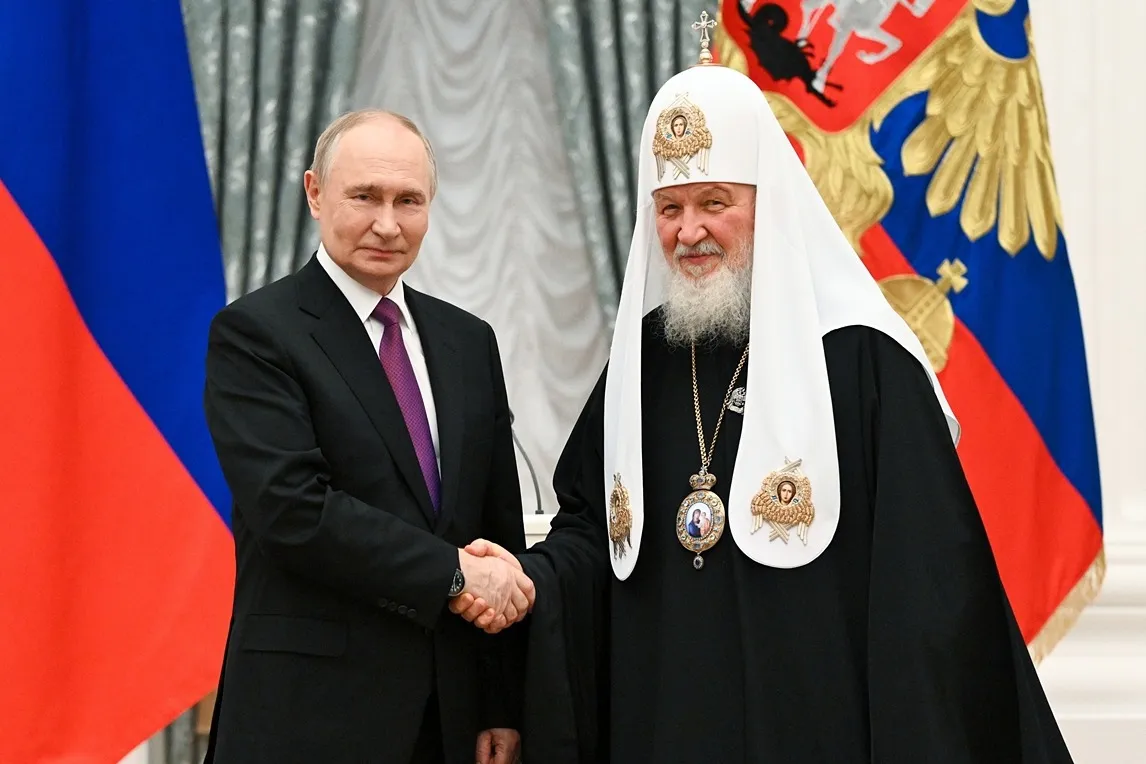
The head of the Russian Orthodox Church, Patriarch Kirill, who is under sanctions, stated that in 1943, “an entirely new era of Orthodoxy” began. He called Soviet dictator Joseph Stalin and his successor Vladimir Putin “a miracle of God.”
The head of the Russian Orthodox Church, Patriarch Kirill, stated that modern Russia is living in “very prosperous times” thanks to Vladimir Putin, whom he called “the first Orthodox president since tsarist times.”