
Rubio to Visit Gulf Countries for the First Time Since the Start of the War with Iran – Reuters
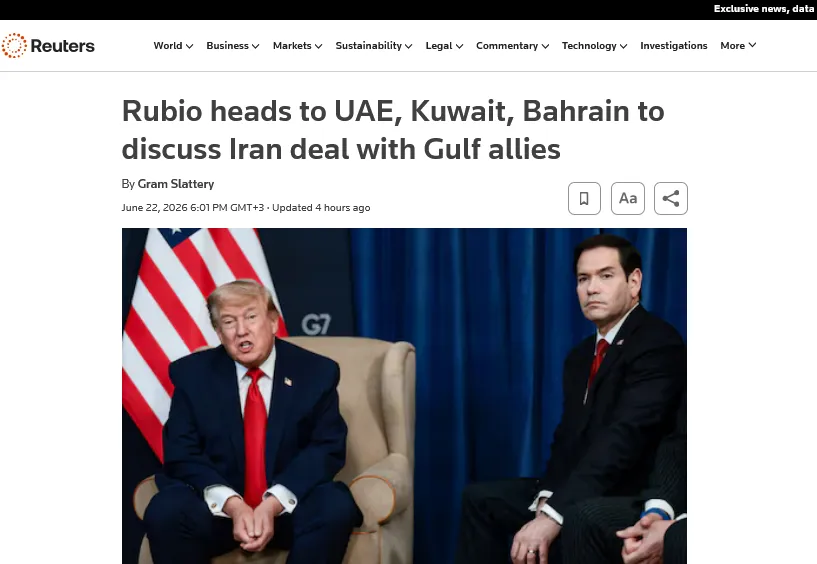
U.S. Secretary of State Marco Rubio, who also serves as the White House National Security Advisor, will embark on an official tour of the Middle East from June 23 to 25.
The head of U.S. diplomacy will visit the United Arab Emirates, Kuwait, and Bahrain. This visit will mark Washington’s first high-level engagement since the start of the U.S.-Israeli military campaign against Iran in late February.
The exact dates of the Secretary of State’s stay in each country and the detailed schedule of his meetings with local monarchs and government officials are not being disclosed at this time for security reasons. However, the State Department has confirmed that during his final stop in Bahrain, Rubio will hold an expanded meeting with representatives of the Gulf Cooperation Council (GCC), which also includes Saudi Arabia, Qatar, and Oman. The main goal of the talks will be to discuss regional stability and ensure free and safe navigation through the strategically important Strait of Hormuz.
The central theme of the diplomatic mission will be resolving disputes surrounding the 14-point Memorandum of Understanding between the U.S. and Iran, which President Donald Trump unexpectedly signed last week to launch a 60-day negotiation process. Despite general support for the ceasefire, the Sunni monarchies of the Persian Gulf are extremely concerned about certain financial and security provisions in the document.
The greatest concern among regional elites is the U.S. intention, in collaboration with its partners, to establish a fund for Iran’s reconstruction and economic development amounting to at least $300 billion. Washington’s allies fear that Tehran will use these resources to rebuild its own military-industrial complex and continue to finance proxy groups. Furthermore, the memorandum makes no mention whatsoever of restrictions on Iran’s ballistic missile program, whose strikes have severely affected territories in the Persian Gulf region in recent months. The situation is critical for Arab capitals, as key U.S. military bases are deployed on their territory and are now the primary targets for potential Iranian attacks.
This was reported by Reuters.
Participants in the four-party talks in Switzerland agreed on a roadmap intended to lead the United States and Iran to a final agreement within 60 days.
Talks between the U.S. and Iran on the nuclear program and the security situation in the Middle East have begun in Switzerland. The U.S. side has already announced the first positive results of the meeting.
U.S. President Donald Trump reacted harshly to statements by Iranian President Masoud Pezeshkian regarding the continuation of uranium enrichment and threatened Tehran with serious consequences.


