
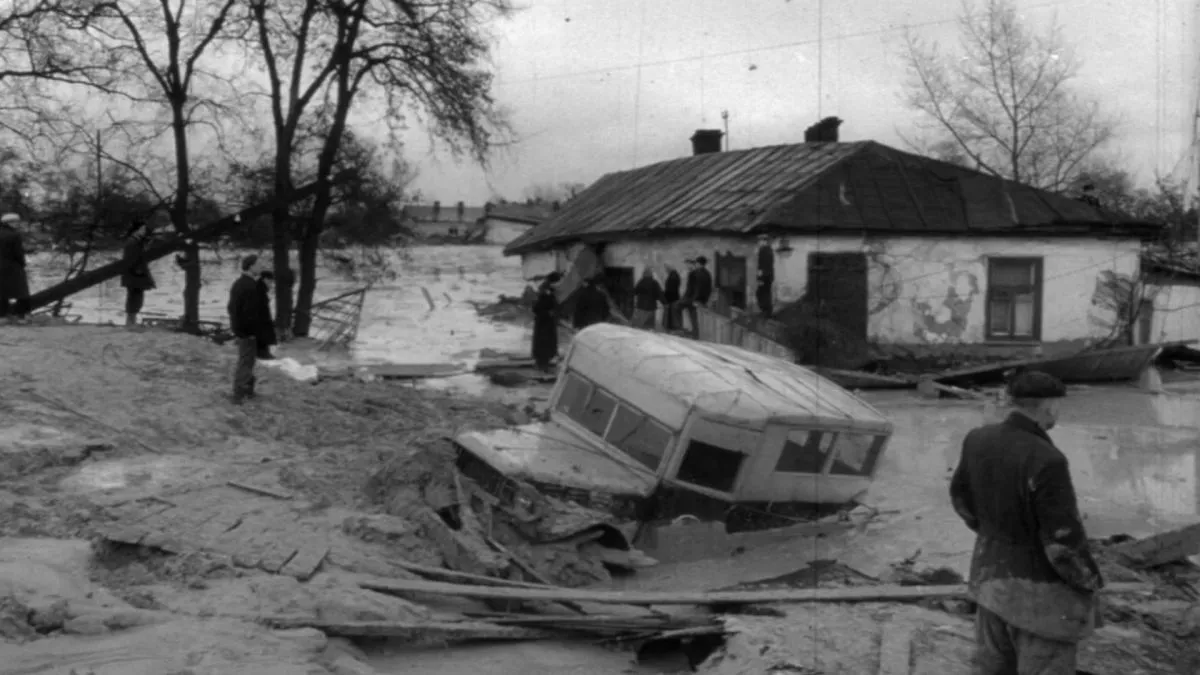
March 13 marks the anniversary of the Kurenivka tragedy. Today is exactly sixty-five years since one of the largest man-made disasters in the world occurred in the very center of Kyiv.
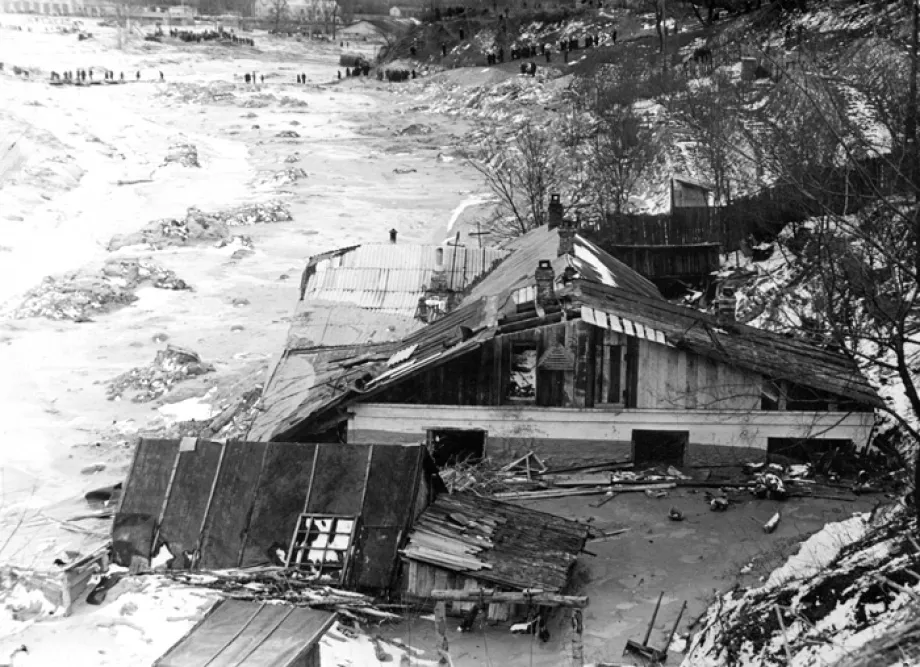
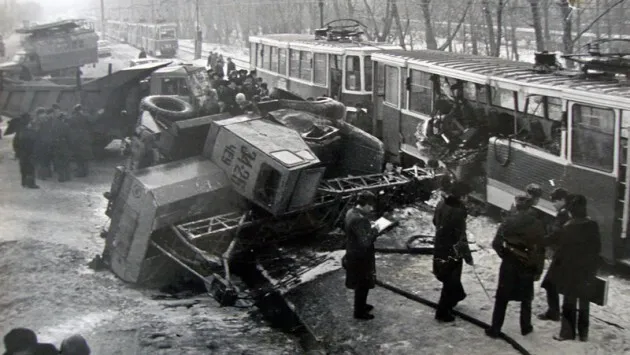
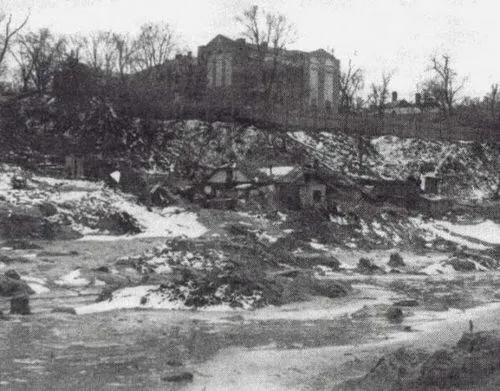
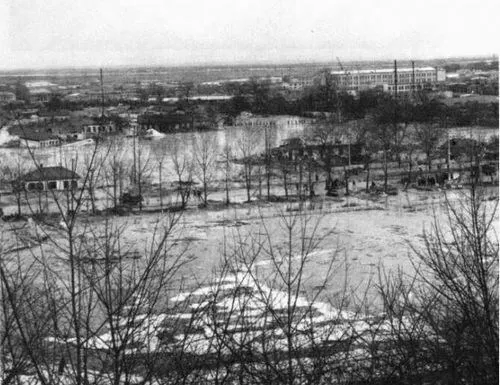
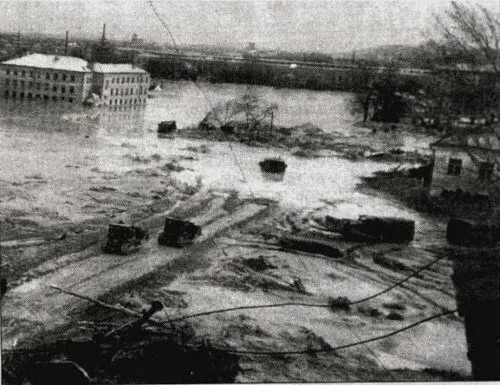
In 1961, a massive wave of pulp from Babyn Yar broke through a dam and within minutes engulfed the residential neighborhood of Kurenivka. In just half an hour, the pulp covered more than thirty hectares. It swept away everything in its path, from multi-ton trams to brick houses.
At the time, the First Secretary of the Central Committee of the Communist Party of Ukraine, Petro Shelest, wrote in his diary:
“The scene is horrific. Everything is flooded with water, mud, and sand up to three meters. People are escaping onto rooftops and trees.”
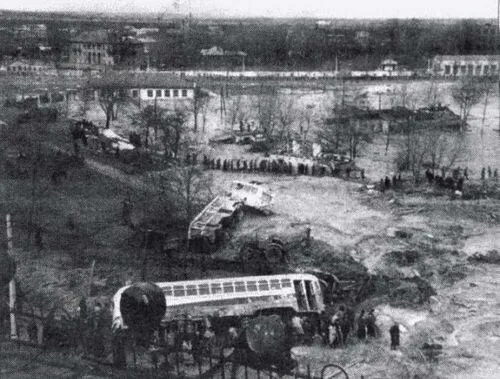
Eyewitnesses recalled that at the site of the tram depot and factory workshops there was a terrible plain of mud. People were buried alive under this mass. Some tried to escape on their own, others were pulled out by neighbors, but the majority could not be saved — cries and moans from beneath the sludge continued for a long time.
At that time, the Soviet authorities did everything to hide the true scale of the tragedy and the number of victims.
Today, as we live daily in the reality of new destructions, this story takes on new meanings. It shows how negligence, corruption, and ideology led to the death of hundreds of Kyiv residents.
How the Kurenivka Tragedy Was Built
The Kurenivka tragedy was the result of a series of decisions, where one violation led to another. Researchers note that at the heart of the man-made disaster was a political plan to conceal the consequences of the war crimes at Babyn Yar.
In March 1945, the authorities of the Ukrainian SSR planned to erect a monument at Babyn Yar for the victims of Nazi terror. However, construction was canceled due to the anti-Semitic “campaign against cosmopolitans” launched by the Kremlin in 1948. Since most of the victims were Jews, references to them were erased, and the territory (50 meters deep and 2.5 kilometers long) was leveled and intended to be turned into a district park with a swimming pool, stadium, and dance areas.
On March 11, 1950, a technical decision was made in Kyiv that would become fatal. At a meeting with deputy ministers of the construction materials industry, it was decided where to dispose of the pulp waste from the Petrovsky Brick Factories No. 1 and 2. The factories had new equipment to increase brick production for the reconstruction of Khreshchatyk (blown up by Soviet saboteurs in 1941) and the first residential districts in Chokolivka and Syrets.
With increased production, waste volumes also grew. Instead of transporting it away, the authorities decided to drain it directly into Babyn Yar. This allowed them to dispose of the waste and simultaneously bury the site of mass executions for the future park.
Technical Gamble. The plan was to transport waste from the quarries via pipelines to the Dnipro floodplain. The organization “Ukrpromproekt” had already prepared all the blueprints. But the authorities had another plan: to erase Babyn Yar entirely, even its name from the city map. At a technical meeting in the ministry, the project to send the pulp to the Dnipro was rejected. The official reason: there were not enough pipes for 3.5 kilometers, and installation would take too long. Participants unanimously voted to drain the pulp into the nearby Babyn Yar, requiring only 1.5 kilometers of pipe. Officials justified this as saving money. In reality, under the thick layer of mud, they wanted to bury forever the memory of the mass executions. Two weeks later, the Kyiv City Executive Committee legalized the plan (Decision No. 582 of March 28). Eleven years remained until the catastrophe.
Construction Sabotage. An even greater problem was ignoring even the minimal technical requirements. Instead of two metal pipes in the water intake wells, only one smaller-diameter pipe was installed. Records of these works were not created. Perhaps they were rushing for the next Soviet holiday, or maybe “extra” pipes were simply stolen, since once the Yar was flooded, it would be impossible to verify.
Standard of Violations
Flooding of Babyn Yar began in 1951. The foundation for the future catastrophe was laid: there was no technical oversight, and regulations were ignored in favor of speed.
According to the project, pulp should have been supplied only eight hours a day, from April to December. The rest of the time, water was to settle and be pumped out. In reality, the Yar was flooded year-round, sixteen hours a day, and during winter — round-the-clock. Anatoliy Kuznetsov recalled that the Yar became a giant lake of rotting green mud that swallowed everything, from garbage to human bones. The dam was constantly reinforced until it reached the height of a six-story building.
Authorities knew about the danger. As early as 1957, the Podil District inspection officially warned factory directors: “The Babyn Yar ditch is in emergency condition, water is overflowing the banks.” But brick production could not be reduced — the party demanded housing construction. Production targets were more important than safety.
By late 1960, the Yar was filled to a critical level. The pulp was supposed to be redirected elsewhere, but the new site was not ready. Leadership ordered the continuation of the Babyn Yar dumping. The section competed for the title of “Communist Labor Collective.” Stopping factories meant “losing one’s party card.”
In March 1961, a few days before the tragedy, the water pumps were completely turned off so the equipment would not be damaged by mud. The water intake wells were clogged and nonfunctional. The massive body of water and clay was held only by the honest word of the dam, while the country reported its next successes on the road to communism.
An Hour and a Half of Hell
Even in February 1961, Kurenivka residents complained that water was flowing from the Yar into basements. They did not realize that disaster was inevitable. On March 13, at 6:45 a.m., a worker noticed a washout in the dam. Attempts to fill the one-meter breach with sand were futile. The water could no longer be stopped, and the heavy pulp followed.
At 8:30 a.m., an eight-meter wave of clay and sand mixture broke through the last defense and swept into the city. The speed and weight of this mass were colossal. It swept away residential buildings, dormitories, the tram depot, factory workshops, and the Spartak stadium. Thirty hectares of territory — from Podil descent to Kurenivka Park — were buried under four meters of mud in minutes. The hell lasted an hour and a half.
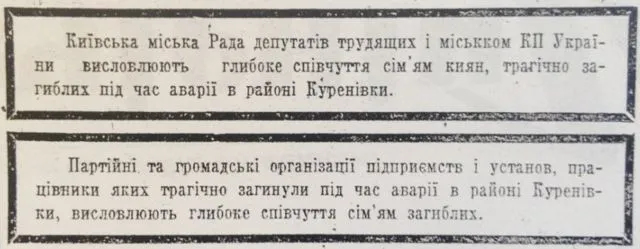
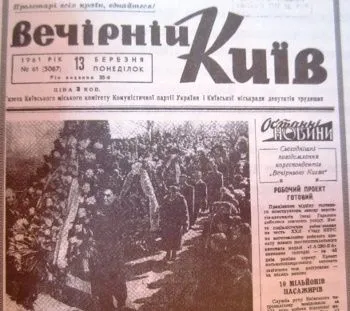
The Soviet authorities only cautiously reported 53 deaths three days later, on March 16, later “rounded” to 145. This was the number of bodies immediately recovered. True excavations began only in late spring and continued for two years. Kuznetsov wrote that hundreds of people died in the first minutes, never realizing what had happened. It was impossible to escape the viscous sludge. Rumors in Kyiv spoke of up to five thousand victims.
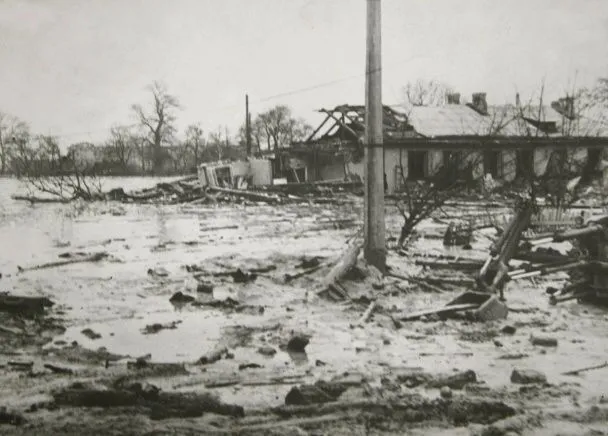
Soldiers worked day and night. Initially digging manually with shovels, soon machines arrived. Excavator buckets and bulldozer blades tore bodies apart. Witnesses said they sometimes heard the final screams of the still-living trapped beneath the mud. Soldiers were not rotated for two days due to secrecy. Thousands of Kyiv residents came to the Pavlivska psychiatric hospital, where bodies were arranged in rows in the club hall, according to historian Oleksandr Anisimov.
The Price of Silence
Kyiv historian Oleksandr Anisimov, who has studied the topic for years, notes that official reports at the time were created not to establish truth but to hide it. Documents marked “for official use” detailed property losses but ignored people.
“According to the papers, the city lost sixty-eight residential and thirteen administrative buildings. Three hundred fifty-three families — over twelve hundred people — were left without roofs. But you will find no figures for the dead or injured. Initially, the authorities reported 150 deaths. Determining the exact number of victims is almost impossible. By my calculations, it is about fifteen hundred,” the historian emphasizes.
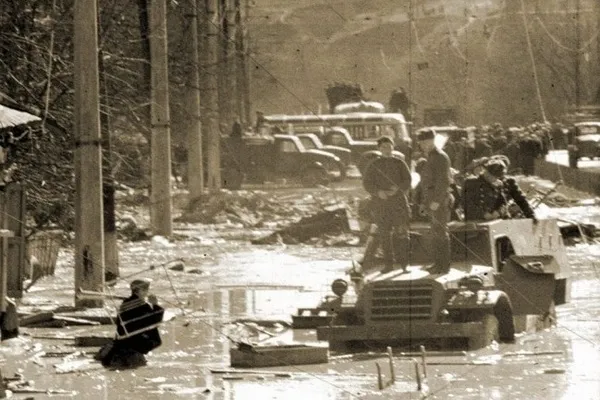
The operation to conceal the truth was as extensive as the disaster itself. On the day of the accident, Kyiv was cut off from the world: intercity and international communication was turned off. The first official report was made only three days later.
“This was strict censorship. The authorities did everything to disperse memory. The dead were buried in different cemeteries of Kyiv and the region, often with fake dates and false diagnoses in documents. Even on graves, writing the truth was forbidden. The army was deployed not only to remove the mud but to ensure no one saw what was being recovered from under four meters of pulp,” adds Anisimov.
Part of the soil was removed, the rest — over three hundred thousand cubic meters — was excavated with machinery. The Soviet system did not count the “missing”; it simply leveled the land along with those buried in it. Even sixty-five years later, the exact number of victims is unknown, as for the system, they were only obstacles on the path to “communist construction.”
Sixty-Five Years Later
March 13 is always mentioned in the news in reference to the 1961 Kurenivka tragedy, how pulp from Babyn Yar turned a district into a mass grave in minutes.
The history from sixty-five years ago seems distant and almost sterile. Black-and-white archival photos do not provoke the tightening in the chest felt daily while scrolling modern news. The 1961 mudslide has long been overshadowed by fresh, daily, unimaginable tragedies.
We live in a different dimension of ruins. In 1961, people were silent about death. Today, tragedy arrives almost live: apartment buildings gutted, parents sitting for hours on concrete waiting for rescuers to recover their child. They know the truth before the body appears. They pray because it is all they can do — waiting and praying — but in their hearts, they already know. Survival chances under tons of concrete are as small as for those trapped in pulp in 1961.
The cause of the Kurenivka tragedy was the negligence and cynicism of the Soviet authorities, and today’s tragedies are attempts to revive the Soviet Union by copying its worst trait: the willingness to bury thousands of lives in concrete for imperial ambitions. Nothing has changed.
We Have Not Forgotten
We remember the Kurenivka tragedy not to mourn again, but to remember: every “it will be fine,” every signature on a dubious document, every attempt to bury a problem instead of solving it eventually explodes. The cost is paid not by officials in high offices, but by ordinary people in trams or their apartments.
We have no time for “historical memory,” because all our memory is occupied by yesterday’s missile strikes, today’s alarms, and tomorrow’s funerals. Kurenivka is a frozen scar on the body of a city that receives new wounds every day. We have not forgotten; we are just too busy not to become the next scar on the body of the country.


