
UNESCO has added the Allied landing beaches in Normandy and Mount Olympus to the World Heritage List — AP
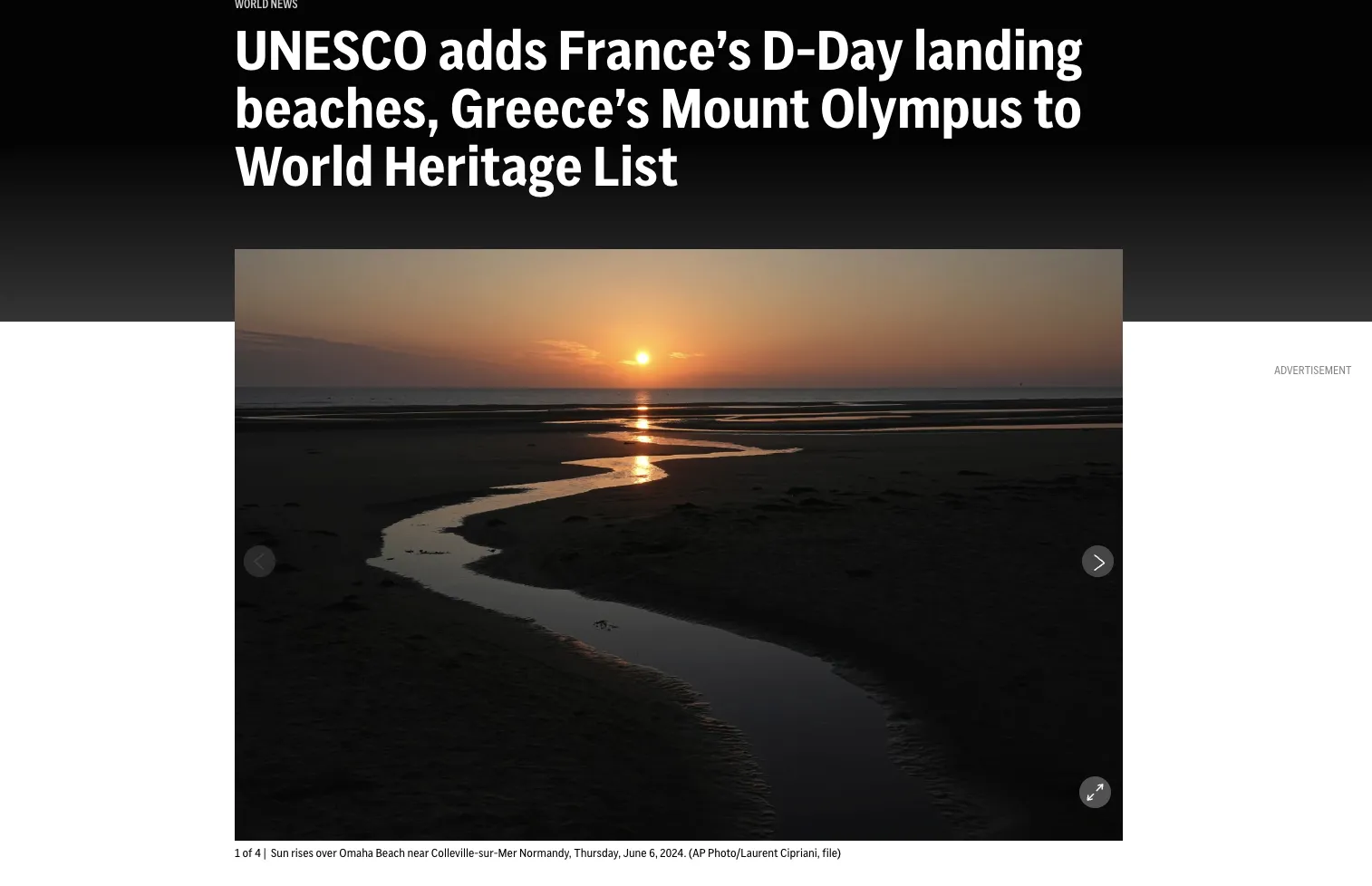
On July 27, the UNESCO Committee added two new sites of European significance to the World Heritage List. The list now includes the historic Normandy landing beaches associated with Operation D-Day during World War II, as well as Mount Olympus in Greece—one of the country’s most famous natural and cultural symbols.
The proposals were approved on Sunday at a meeting of the UN committee in South Korea, where dozens of nominations were considered.
The French nomination includes five Normandy landing beaches—Omaha, Utah, “Sword,” “Gold,” and “Juno”—where more than 150,000 Allied soldiers landed on June 6, 1944, as well as the site of the assault on Pointe du Hoc; all of these sites played a key role in the campaign to liberate Western Europe from Nazi occupation during World War II.
The International Council on Monuments and Sites (ICOMOS), which evaluates nominations submitted to the World Heritage Committee, noted that these sites contain significant remnants — ranging from German fortifications and bomb-scarred landscapes to Allied port facilities and sunken ships, – symbolizing “an event widely regarded as having restored freedom and marked the dawn of a lasting peace on the European continent.”
ICOMOS also called for strengthened measures to monitor and preserve these sites, citing potential threats posed by tourism, climate change, and rising sea levels, as well as the construction of wind farms near these areas, according to the AP.
Earlier, UNESCO acknowledged that three of Ukraine’s World Heritage sites are at risk.
As a reminder, the Ministry of Foreign Affairs criticized UNESCO for refusing to acknowledge the Russian shelling of the Lavra.
Earlier, two Russian drones deliberately attacked the Lavra and the Mystetskyi Arsenal, according to Zelenskyy.


