
The Kyiv Opera is opening its 45th theater season under extreme conditions marked by constant air raid alerts and the aftermath of Russian shelling. But this season in particular could become one of the most notable in the capital’s theatrical life.
Despite everything, the Kyiv Opera is sticking to its artistic plans: on September 11, the theater will present the long-awaited Ukrainian version of the rock opera “Jesus Christ Superstar,” the rights to which took nearly a year to secure.
In an exclusive interview with UA.News.
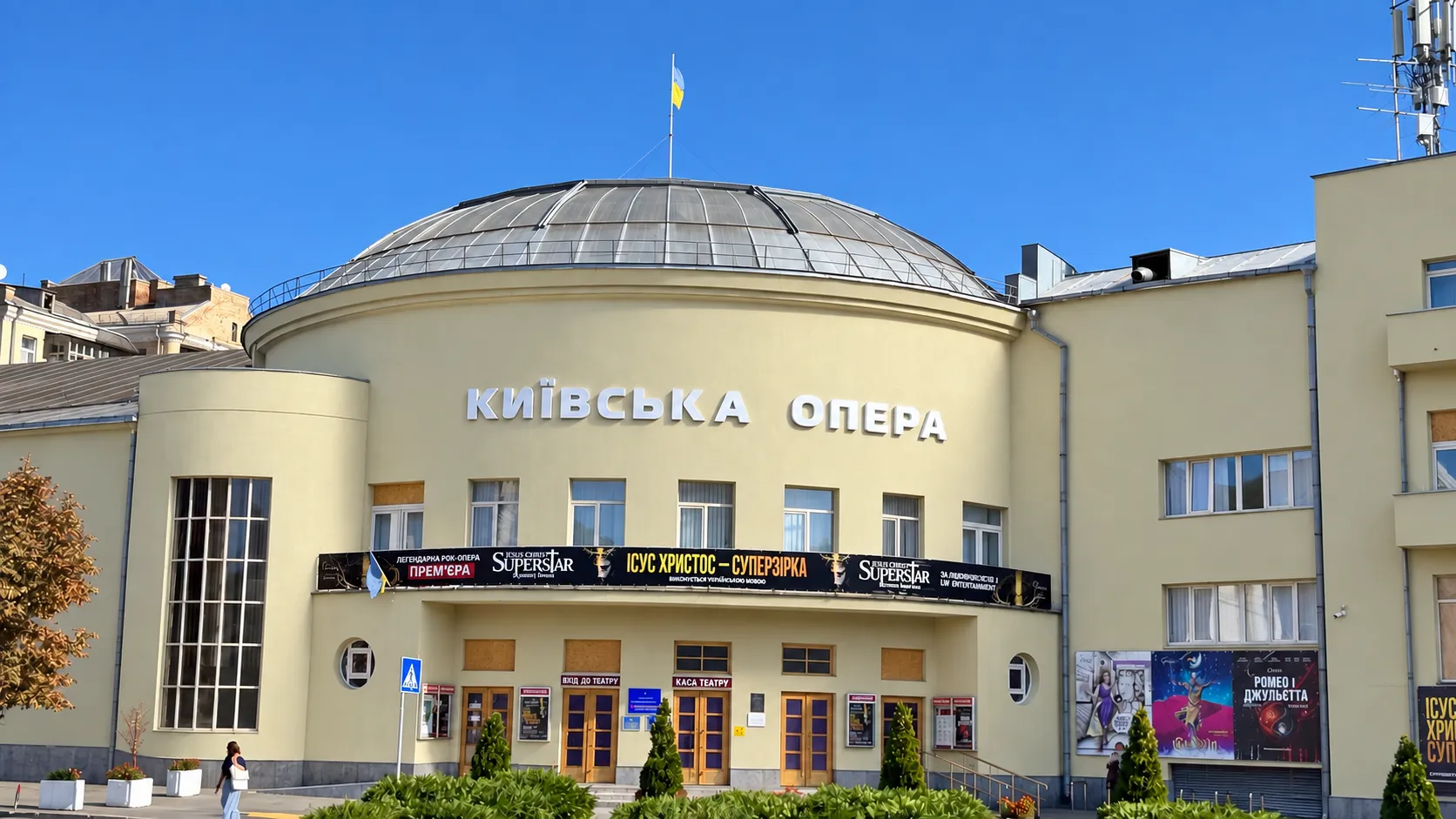
Opening the Theater Season Amid Constant Air Raid Alerts
Before the war and even during the COVID-19 pandemic, we used to hold grand openings for the theater seasons. I remember we staged ballet performances outdoors and even flew a drone to capture high-quality video.
We won’t be doing that now. First, we don’t really feel like celebrating and having fun to mark the opening of the theater season while a full-scale war is raging in the country.
Second, air raid sirens have been sounding almost every day in recent weeks. We’re genuinely worried and don’t know if we’ll be able to hold the three planned premiere performances on September 11, 12, and 13.
But we’re all in exactly the same situation: the audience, the administration, the actors, the ballet company, and the engineering and technical staff. We’re all in the same place and realize that an air raid siren could go off at any moment. When that happens, we have to do everything possible to ensure the safety of the audience and theater staff.

Photo: A scene from a rehearsal of the rock opera “Jesus Christ Superstar”
Premiere of the rock opera “Jesus Christ Superstar”: negotiations for the license
lasted nearly a year
This process was actually very long. I turned to a professional who specializes in such negotiations—Vladimir Voitovich from Australia.
It was also interesting for him to be part of our shared story with Lloyd Webber. We negotiated for nearly a year.
Unfortunately, Western organizations don’t always work as quickly as we expect. We might wait three weeks for a response. I’d call Volodymyr and ask, “Why aren’t they responding? Write to them again.” Eventually, we received a reply.
The negotiations were long. By the way, we were originally supposed to stage the show a year ago. We had a contract, and the premiere was scheduled for December.
But last year there was a harsh winter and major power outages. I realized that we wouldn’t be able to stage the performances properly, so I decided to postpone them until the fall—for the opening of the theater season.
We reached out to the rights holders again, explained the situation, and they kindly rescheduled our performances.
We currently have the rights for 40 performances. I expected the show to run for about a year—two or three performances a month. That’s actually how it’s turning out. I’m very glad we managed to obtain this license.
Sold-out premieres
Throughout its history, “Jesus Christ Superstar” has been performed in 42 countries around the world. It has been translated into many languages.
This is also very important for Ukraine. We can see this in the excitement: if we’re selling out three shows during the war, that’s a sign of success.
In recent weeks, people have been reluctant to buy theater tickets because they realize that even if they buy a ticket, the performance might have to be interrupted or rescheduled due to an air raid alert. I understand them perfectly.
That’s why I’m pleased, for now, that our premiere performances are sold out. Tickets sold out about two weeks ago.

Photo: Actors portraying Jesus—Danylo Kotok, Arseniy Zhuravel, Serhiy Tyagnyryadno
The production of the legendary rock opera and its connection to world music history
This has been a long-held dream of mine—one that’s been with me for over 30 years. Our generation grew up on this music. Andrew Lloyd Webber is a genius musical composer. I know of no one who can match him.
“Jesus Christ Superstar” was a true musical sensation in its day. It was the era of The Beatles and The Rolling Stones—bands that were extremely popular during my youth.
That’s why I really wanted to stage this particular rock opera, so that our theater could be part of this global musical history. And now, it seems, the stars have aligned so that we’re able to do just that.
This isn’t a canonical story, but a conversation about good and evil
As for the production, I can say for sure that there will be many satisfied viewers and, perhaps, many dissatisfied ones. This is not a canonical story.
In fact, all great stories are about good and evil. I wouldn’t directly link *Jesus Christ Superstar* to the war or say that it’s particularly relevant to Ukraine today.
It’s about something else. It’s already a world classic. As I mentioned earlier, the play has been staged in 42 countries around the world. And it wasn’t performed in the original language everywhere. It was translated into Polish, Czech, Hungarian, Japanese, German, Italian, French, and other languages.
In other words, this is our cultural connection to world culture and music, which shaped an entire generation. It’s the story of a world classic within a specific genre. We don’t ask how Shakespeare relates to the present day when we stage his plays. We stage Shakespeare because he is a classic.
Timeless works remain relevant because they speak to what is eternal. There is nothing more fundamental than good, evil, love, honesty, and sincerity. Everything else is merely details and derivatives of these concepts.
“Jesus Christ Superstar” will be performed in Ukrainian for the first time
In my opinion, we’ve put together a very strong cast. The auditions and all the effort we put in were not in vain. I’m confident the audience will appreciate it.
During the latest rehearsals, I heard that the choir sounds excellent. Our soloists are also exceptionally talented. The orchestra sounds great, and our sound design is top-notch. We also have a very strong production team.
The stage director is Vitaliy Palchikov, our theater’s artistic director. When I had to decide whom to entrust with the task of creating a great production, I had no doubts—I entrusted it to Vitaliy Palchikov.
The set designer is Philip Nirod, the choreographer is Anna Gerus, the music director is Yevgen Voronko, and the chorus master is Angela Maslennikova. It was also very important to me that the production have the right lighting design and that we get the visuals right. I wanted the visuals to be framed by a solid professional foundation. That’s why I invited Oleksandr Mezentsev as the lighting designer. And the costume designer is Bohdan Polishchuk. These are people who are quite well-known in the theater world.

Photo: Charles Gounod’s opera “Romeo and Juliet”
The
Uniqueness of the Repertoire
It’s important for our theater to be innovative and distinctive in terms of our repertoire.
I believe there’s no point in staging productions that are already being performed at many Ukrainian theaters. That’s why our repertoire includes many productions that are exclusive to our theater.
For example, Verdi’s *Falstaff* isn’t performed at any other Ukrainian theater. Neither is *Romeo and Juliet*. The ballet *The Magpie’s Wing*, the rock opera *Patriot*, and the opera *The Marriage of Figaro*—the same goes for them.
As for *Jesus Christ Superstar*, people often correct us when we say that this is the first production of its kind in Ukraine. The show has indeed been running in Odesa for several years, but in the original language—English.
We have our own version in Ukrainian, translated by Dmytro Todoriuk. That’s why we say that this is the first time this rock opera will be performed in Ukrainian in Ukraine.
Restoring the theater after the shelling in May: challenges still lie ahead
I want to say that our challenges are still ahead of us. We have 72 damaged windows. Even if some of them appear to be intact at first glance, in reality they’re just leaning against the frames. When the cold weather sets in, all the cold air will seep inside. This is dangerous because we won’t be able to heat the theater properly.
I really hope we’ll be allocated funds for new windows. Another issue is that we might not have time to order and install them.
So right after the premiere—literally starting Monday—we’ll begin sealing and insulating the windows. In part, this will mean we’ll be plunged into darkness.
For example, right now my office has plywood installed—there’s no glass. The windows themselves and their frames are damaged and simply held in place with screws.
That’s why I say: our difficulties are still ahead of us. But I’m not complaining by any means. I understand everything perfectly well. We are at war. I always say: it’s hardest for those on the front lines, those in the trenches, those who defend the country with weapons in their hands and, God forbid, are killed or wounded.
So we have nothing to complain about. We must do everything possible to keep working. When it comes to the theater—we must put on performances and wait for the audience.
There will be at least three premieres
this season
The first premiere is *Jesus Christ Superstar*. It will take place September 11–13. Then comes the New Year’s and Christmas holiday season. Of course, we’ll be presenting our *Hoffmann’s Nutcracker*.
It might not be politically correct to say this, but it’s true: we were among the first to write our own musical version of “The Nutcracker.” In fact, this trend continues today—various versions of “The Nutcracker” set to different music are appearing. Our composer Ivan Nebesny agreed to this project, and we brought it to life.
Performances will begin around St. Nicholas Day. The exact repertoire for December isn’t set yet, though the November schedule has already been finalized.
Starting in January, we’ll be preparing the ballet *Dracula* set to music by Alexander Rodin. I think we’ll premiere this ballet in February.
But there’s another very important project. In May, we participated in the “Tysyachovesna” grant program and received a grant to stage Yuli Meitus’s opera “Yaroslav the Wise.” It will be a special event.
We’ve been planning to stage this opera for a long time, but I didn’t want to premiere it on our stage. We don’t have a stage as large as, say, the National Opera’s. And I wouldn’t want to present this large-scale opera locally for the first time. Since the opera is about a Kyiv prince, and Yaroslav the Wise’s sarcophagus is located in St. Sophia Cathedral, we plan to hold the premiere of this production outdoors—on St. Sophia Square—on May 3, Kyiv Day.
Performance of the rock opera “Patriot” in Kharkiv
I really like Kharkiv. First and foremost, it’s Ukraine’s first capital. If you stand at the entrance to the park next to the theater, you might get the impression that you’ve stepped into some kind of fantasy world. It’s so beautiful, neat, and well-maintained there. There’s a zoo—which is even free—free public transportation, cleanliness, and order. Kharkiv deserves credit.
When it comes to the arts, the M. V. Lysenko Kharkiv National Academic Opera and Ballet Theater holds its own very well. Credit is due to Igor Tuluzov, the general director and artistic director. The entire theater organization operates at a high level of both organization and creativity. That’s very pleasing.

Photo: Petro Kachanov and Igor Tuluzov at “Skhid Opera Fest – 2026”
We didn’t initiate the performance of *The Patriot* on our own. We received a request for this production.
I asked Igor Tuluzov, “Maybe we should do a different production after all?” He replied, “No, no, no. I want this one specifically.”
Of course, we were a little nervous, because the audience decides everything. The performers and the administration are always afraid of failure. But the audience was so completely in sync with the performance that I think it was one of our best shows.
Even in Lviv, as far as I remember, the reaction was less emotional than in Kharkiv. That’s why the trip to Kharkiv was very successful and significant for our troupe.
Before the trip, I gathered everyone who was going and explained: we have to go to Kharkiv; we mustn’t be afraid. We’re going to the people who live there—to Ukrainians who continue to live in their city, even though Kharkiv is located just a few dozen kilometers from the border with Russia. I’m very glad that we had the opportunity to go there and present *Patriot*.
On my involvement as an expert in the “Tysyachovesna”
state grant initiative
This work took quite a bit of time. The expert evaluation consisted of several stages. First, I had to review the projects and assign scores. I reviewed 62 projects. To assign well-founded scores, I had to delve into each one, read everything thoroughly, and reflect on it.
In addition, there was an option to write a comment of at least 1,000 characters. If you multiply that by 62 projects, it comes to over 62,000 characters. We were given one month for the expert evaluation. The first stage was technical, the second was the expert evaluation, and the third was the pitching sessions—that is, the participants’ presentations.
I view this initiative and this cultural support quite positively. I also have a positive view of the team at the Ministry of Culture. They found the process interesting and worked with great dedication and enthusiasm.
The only thing I would change is the training of the experts and their understanding of what Ukrainian culture and the Ukrainian context need today.
There were several projects that, in my opinion, absolutely should have been selected because they addressed our history, particularly what happened during the NKVD era. People who say today that it doesn’t matter what language you speak—or who don’t want to switch to Ukrainian because they’re “so used to it”—need to know this. It’s about knowing history, specifically how many people were tortured to death by the NKVD and why they were persecuted. For example, people were detained if they used the Ukrainian word “citrina” instead of the Russian word “limon.” And when such projects aren’t approved, while others are, I just don’t get it. It seems to me that experts need to explain more clearly and narrow down the definition of what constitutes Ukrainian content and what kind of content is needed today.
Overall, everything was quite professional, proper, and well-organized. And most importantly—this support is necessary because Ukrainian culture truly needs help.
But we’re back to the concept of “Ukrainian culture.” Some of the projects that made it through the selection process, in my opinion, have only a tangential connection to Ukrainian culture.
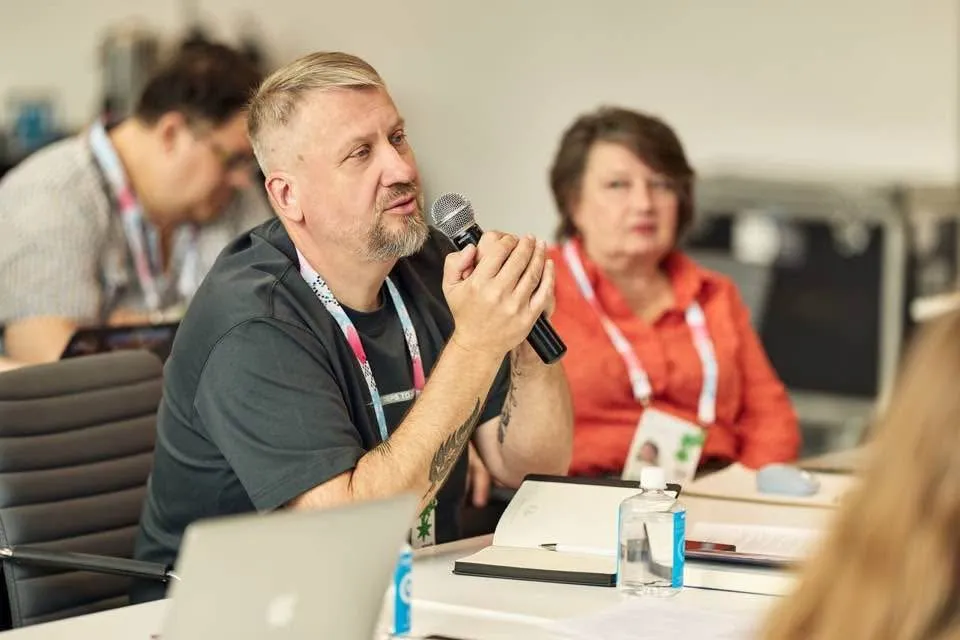
Photo: Petro Kachanov during a meeting of the expert commission for the “Tysiachovesna” state initiative in Ivano-Frankivsk
Ukrainian content is much more than just the language
We need to delve deeper into understanding what Ukrainian content actually is.
I’ve already written on Facebook: not all content published in the Ukrainian language is necessarily Ukrainian. This is a very profound and, at the same time, nuanced topic. It has a very fine line.
For example, when we discuss whether the Ukrainian audience today needs the Russian composer Tchaikovsky, many people believe it doesn’t matter. They say, “It’s beautiful, it’s professional—what does music have to do with politics and war?” However, I don’t see it that way.
Culture should provide us with certain meanings
If you’re creating a world-class musical and selling tickets—go ahead. That’s your business; you’re making money from it.
But when the state allocates funds for a project, it must be a deeply Ukrainian product that conveys certain ideological messages. And the audience must be able to grasp them.
If everything here were as homogeneous as, say, in Poland—where there’s one language, one culture, and one religion—perhaps we could experiment more. But even in Poland, they pay very close attention to this. They understand the importance of their own cultural identity.
So if we’re creating a much-needed grant program—and I’ll emphasize once again that I consider it extremely important—we need to “fine-tune” it a bit, specifically in defining what constitutes Ukrainian content.
On the Demand for “Tysyachovesna” and Adapting Culture to Wartime
Conditions
Virtually all regions of Ukraine were represented in the “Tysiachovesna” state grant initiative. In other words, the entire country was represented. Applicants who submitted all the necessary documents and met the technical requirements underwent a technical screening and were then evaluated by experts.
Everything was quite democratic and fair. The only thing I would change is to raise the passing score for the second, expert-evaluation stage. This is because, alongside interesting projects, there were also some rather weak ones that lacked any particular cultural or other value. But they were weeded out at the next stage.
Ukraine, as a nation, is surviving despite everything. And right now it is living a fully vibrant life, particularly in terms of culture and theater. We’ve already gotten used to the shelling. Unfortunately, people continue to die. But we’re no longer as afraid as we were in the early days of the full-scale war. We’ve adapted.
There’s a concept in marketing that applies to our situation as well: it’s not the strongest who survive, but those who know how to adapt. This is also very important for us. We must be able to adapt and do everything possible to win this war.




