
Magnetic Storm Forecast for May 13–14: What to Expect

An increase in solar activity is forecast for May 13–14, which may trigger geomagnetic storms. Such phenomena can sometimes affect the well-being of sensitive individuals, causing fatigue, headaches, and fluctuations in blood pressure.
Here is the forecast for magnetic storms over the next two days, based on data provided by NOAA’s Space Weather Prediction Center (SWPC). Geomagnetic activity is measured on a scale from 0 to 9. The planetary K-index is used for classification; a reading of 5 or higher indicates a strong magnetic storm.
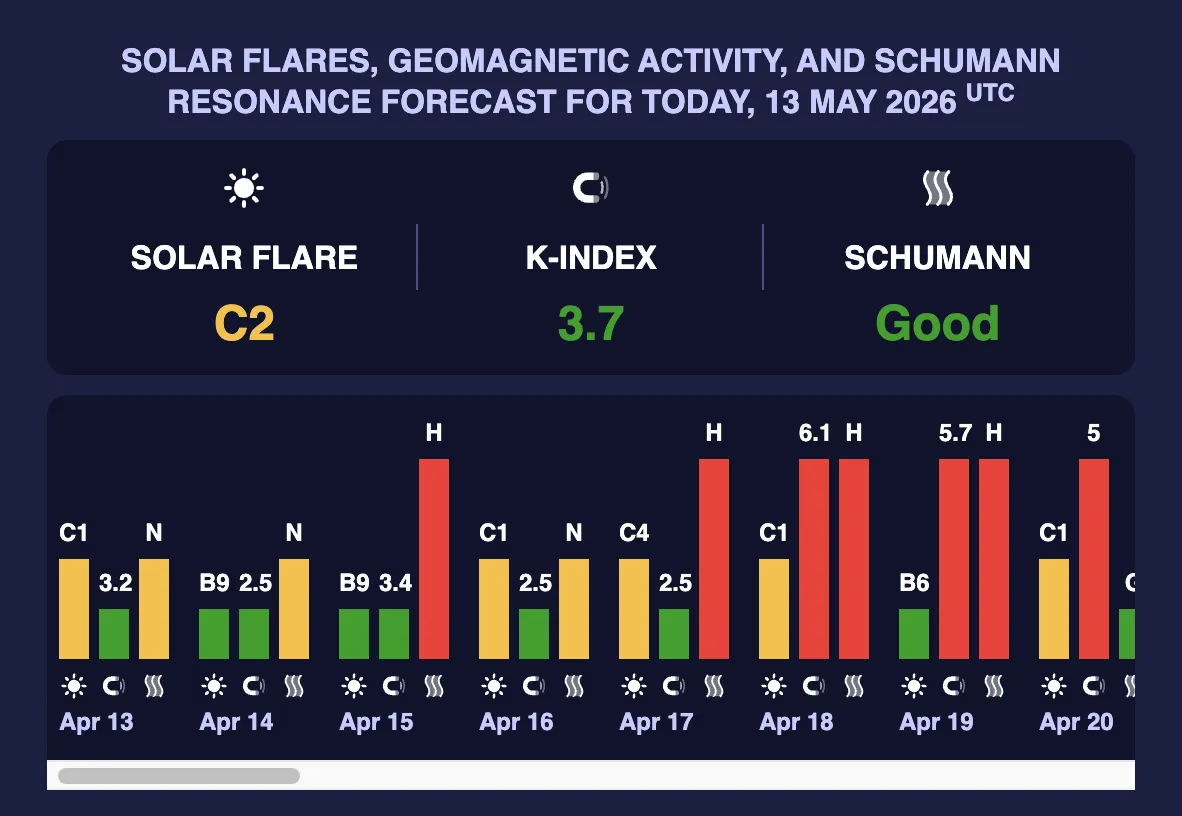
May 13. On Wednesday, May 13, solar activity with a K-index of 3.7 (green level) is expected, corresponding to weak magnetic storms.
May 14. On Thursday, May 14, solar activity with a K-index of 3 (green level) is expected, corresponding to weak magnetic storms.
It is important to note that magnetic storm forecasts may change, as solar activity researchers update their data every three hours. Therefore, we recommend regularly monitoring updates; all current information for today is below:
A magnetic storm is a phenomenon caused by regular flares and eruptions on the Sun, which release a significant amount of solar energy. It consists of charged particles (protons and electrons) that move rapidly in various directions, including toward Earth. When they reach Earth’s magnetosphere, activity occurs that scientists refer to as magnetic storms or solar storms.
To distinguish between magnetic storms, a power level index known as the K-index is used. Fluctuations ranging from K-index 1 to K-index 4 are considered minor and often go unnoticed by people on Earth. Any magnetic storms exceeding a K-index of 5 are classified as red-level storms, which can most significantly impact human life and lead to a decline in overall well-being. In addition, during high-level magnetic storms, communication sources such as cell towers, satellites, radio frequencies, and GPRS may experience disruptions. During magnetic storms that reach a K-index of 7 or 8, auroras can be observed.
Magnetic storms can affect people
Magnetic storms affect atmospheric pressure, which is why some people may experience headaches, fatigue, and stress. There are no specific medications for magnetic storms, but you can alleviate your symptoms by using over-the-counter medications.
You can help your body cope with magnetic storms by doing the following:
- Stick to a daily routine and healthy diet—get plenty of sleep and eat nutritious, healthy foods.
- Avoid spicy, salty, and fatty foods, as well as alcohol, and reduce your coffee intake.
- Drink herbal teas and plenty of water.
- Take walks in the fresh air; if possible, get out of the city. But avoid direct sunlight.
- Light physical activity will help improve your condition and boost your energy.
- Avoid conflicts and stressful situations.
- People with chronic illnesses are advised to get plenty of rest and keep necessary medications on hand.
- A contrast shower in the morning will help you feel more alert, and a bath in the evening will help you relax.
You might be interested in: Magnetic storms in May 2026: dates and intensity.
Hubble captures “space slug” in the Trifid Nebula
Also, NASA has announced the date of the first human flight to the Moon in 50 years.
A NASA satellite will fall to Earth after 14 years in orbit.


