

Just a few months ago, Drive Your Dream focused primarily on the rent-to-own model — long-term vehicle leasing with the option to buy the car later. Today, the company is simultaneously expanding its own inventory, restructuring its work with banks and investors, automating part of its sales process with artificial intelligence, and preparing for potential expansion beyond the UAE.
In recent months, Drive Your Dream has grown its inventory to around 55 vehicles, including nine Mercedes-AMG G 63s. At the same time, the company has started attracting customers through Gemini and other AI services, while its internal AI agent now participates in most conversations with potential buyers.
UA.News spoke with three Drive Your Dream representatives — Sergey Pavlyuk, Sergey Orobchenko, and Vyacheslav Kalaushin. Each is responsible for a different area, from financing, vehicles, and operations to AI, CRM, and sales automation.
The company significantly expanded its vehicle inventory in three months

One of the key decisions in recent months was to increase the number of vehicles the company can offer customers almost immediately.
Drive Your Dream places particular emphasis on cars that can be obtained with a minimal or even zero initial payment. The company considers this one of its main competitive advantages.
“We decided to expand our active inventory of vehicles available for purchase with zero or minimal down payment. For the customer, this significantly lowers the barrier to entry — they do not have to pay tens of thousands of dollars upfront,” Sergey Pavlyuk said.
Most of these are not brand-new showroom vehicles but cars with relatively low mileage. The reason is depreciation: a new car often loses the largest share of its value during the first years of ownership.
According to the company’s current estimate, Drive Your Dream’s total fleet value is around $8.2 million. Of this amount, approximately $4.2 million is tied up in vehicles already delivered to customers, while another roughly $4 million is in cars currently in stock and ready for delivery.
The G63 has become one of Drive Your Dream’s key vehicles
The company is placing a particular bet on the Mercedes-AMG G 63. At the time of the interview, there were nine of these vehicles in stock.
The team explains the choice by stable demand, the model’s liquidity, and its relatively predictable residual value.
“The G63 is one of the most sought-after cars in our segment. It is a straightforward product: customers want it, and for us it performs well in terms of demand, pricing, and residual value,” Sergey Pavlyuk said.
The company applies similar logic to the Lamborghini Urus and other premium models with stable demand on the secondary market.
AI already writes two-thirds of customer replies
One of the biggest changes at Drive Your Dream has taken place not in the fleet but in how the company interacts with potential customers.
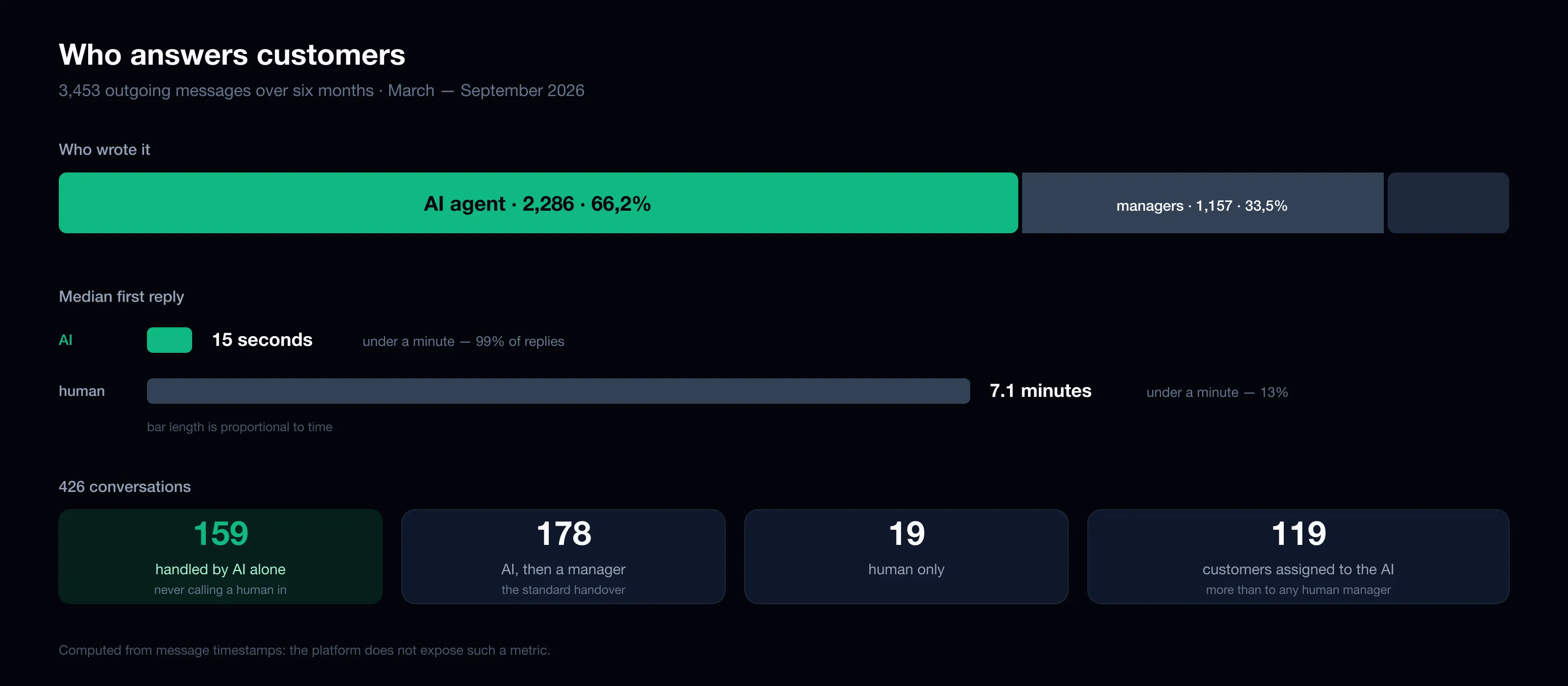
The internal AI agent has effectively become a separate member of the sales team. According to the company’s internal statistics for the period from March to September 2026, the system recorded 3,453 outgoing messages. Of these, 2,286, or 66.2%, were written by AI, while managers wrote 1,157.
The difference is even more noticeable in response speed. The median first-response time for AI is 15 seconds, compared with 7.1 minutes for a human manager. In 99% of cases, the agent responded in under a minute, while managers did so in 13% of cases.
“We want to automate the first line of interaction as much as possible. A person should step in where a real decision, negotiation, or physical interaction is required,” Vyacheslav Kalaushin explained.
Of 426 analyzed conversations, AI participated in 340. In 159 cases, it handled the conversation from start to finish without human involvement, while in another 178 cases a manager joined after the AI. The CRM currently assigns 119 customers to the AI agent — more than to any individual employee.
AI covered the hours when managers simply are not available
Response speed is only part of the automation effect. More important is when customers actually contact the company.
According to Drive Your Dream’s internal statistics, based on a standard Dubai work schedule of Monday through Friday from 9:00 a.m. to 6:00 p.m., only 38% of inquiries arrive during business hours. The remaining 62% come when the office is already closed. Around 28% of all messages arrive at night, between 10:00 p.m. and 6:00 a.m.
There are also two clear peaks in activity: around noon and around 8:00 p.m. According to the company, customers even write more often at 4:00 a.m. than at 9:00 a.m.
This is where the AI agent gives the company its biggest advantage: customers receive a response regardless of the time of day.
“In this case, it is not even about AI replying faster than a manager. Two-thirds of customers contact us outside working hours. Now a person writing at four in the morning gets almost the same level of response as someone writing at noon,” Vyacheslav Kalaushin explained.
The team also checked whether the system’s performance declined at night. According to their data, the median response time is about 19 seconds during the day and around 25 seconds at night — a minimal difference.
“For leasing, this literally means money. A person looking for a car at night almost never contacts just one company — they reach out to several in parallel. If you respond first, the chance of continuing the conversation is significantly higher,” Kalaushin said.
AI has already guided a customer through almost the entire sales cycle
Kalaushin cited a specific Porsche Macan case in which AI handled most of the interaction with the buyer.
At first, the customer was not entirely sure which Porsche they wanted, had budget constraints, and categorically did not want a white car.
The internal system handled objections, explained the terms, suggested alternatives, and helped with the choice.
“Around 90% of the entire sales cycle was handled by our internal AI system. A person joined only when physical interaction became necessary — showing the car and arranging a test drive,” Vyacheslav Kalaushin said.
As a result, the customer, who initially came looking for an installment purchase, ultimately declined financing altogether and bought the Porsche Macan outright.
“The person came for an installment purchase product and ultimately said, ‘I don’t need installments.’ We understood the need, conducted a test drive, explained all the details, and the customer saw that we were working with them as transparently as possible,” Sergey Pavlyuk added.
AI not only replies but also fills in the customer profile itself
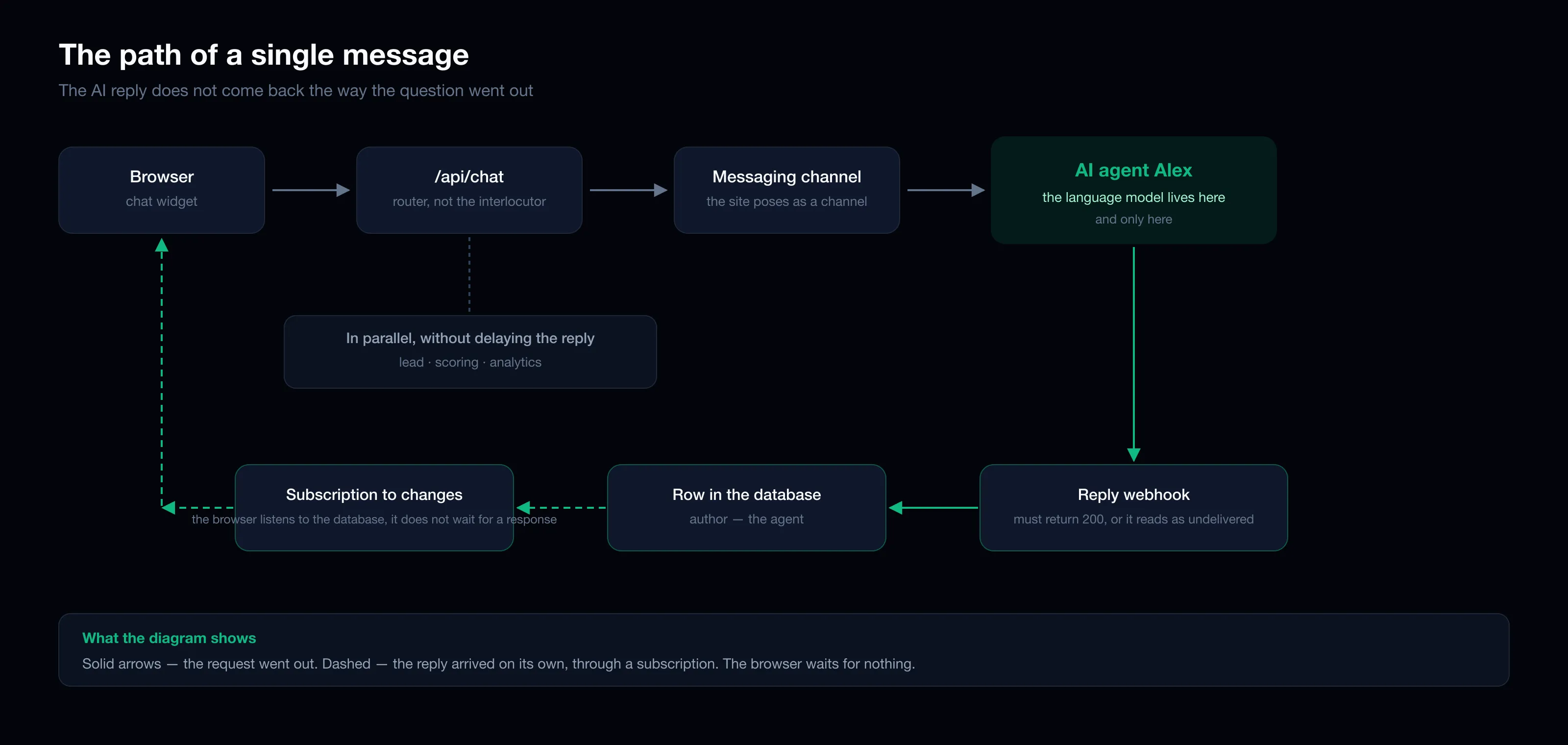
While a person communicates with the system, AI simultaneously builds their profile. Seven key parameters are automatically extracted from messages: language, type of request, vehicle, monthly budget, employment type, readiness to buy, and whether the bank has previously rejected the customer.
These data are simultaneously sent to the internal database, CRM, and tagging system that the company later uses to segment customers.
“For us, it was important not simply to install a chatbot. The system has to understand context, see what the person wants, and pass ready-to-use information to the manager,” Kalaushin explained.
Some rules were created based on real mistakes and conversations. For example, the system was specifically prohibited from interpreting numbers between 1990 and 2035 as a budget, so that the phrase “Pajero 2015” would not accidentally turn into a budget of 2,015 dirhams.
AI was taught not to invent information it cannot see
Another example occurred directly during the preparation of technical materials for the interview. A customer sent three shortened links to vehicles on Dubizzle. The system could not read the details of the listings and, instead of inventing specifications, asked the customer to send screenshots.
After that, AI identified the model, year, and price of each car and calculated an estimated payment, explicitly noting that final figures were possible only after valuation and inspection.
“For us, this is the correct behavior. The system should not pretend to know everything. If it lacks information, it should say so directly and ask for the necessary data,” Vyacheslav Kalaushin said.
The system determines when a customer is “ready”
In addition to messaging, Drive Your Dream uses behavioral scoring. Every action on the website adds points to a customer’s score. Viewing a specific car adds three points, moving to WhatsApp adds 25, and submitting a form adds 30. In total, the system has already evaluated 5,457 sessions.
After 70 points, a user automatically receives “hot” status. If their monthly budget is approximately $4,100 or more, they are also marked as VIP.
At that point, the manager receives a ready-made dossier: the vehicle the person is interested in, its mileage and status, up to three alternatives, a recommended next step, and even the first phrase for the conversation in the customer’s language.
The CRM knows when AI should hand the customer over to a human
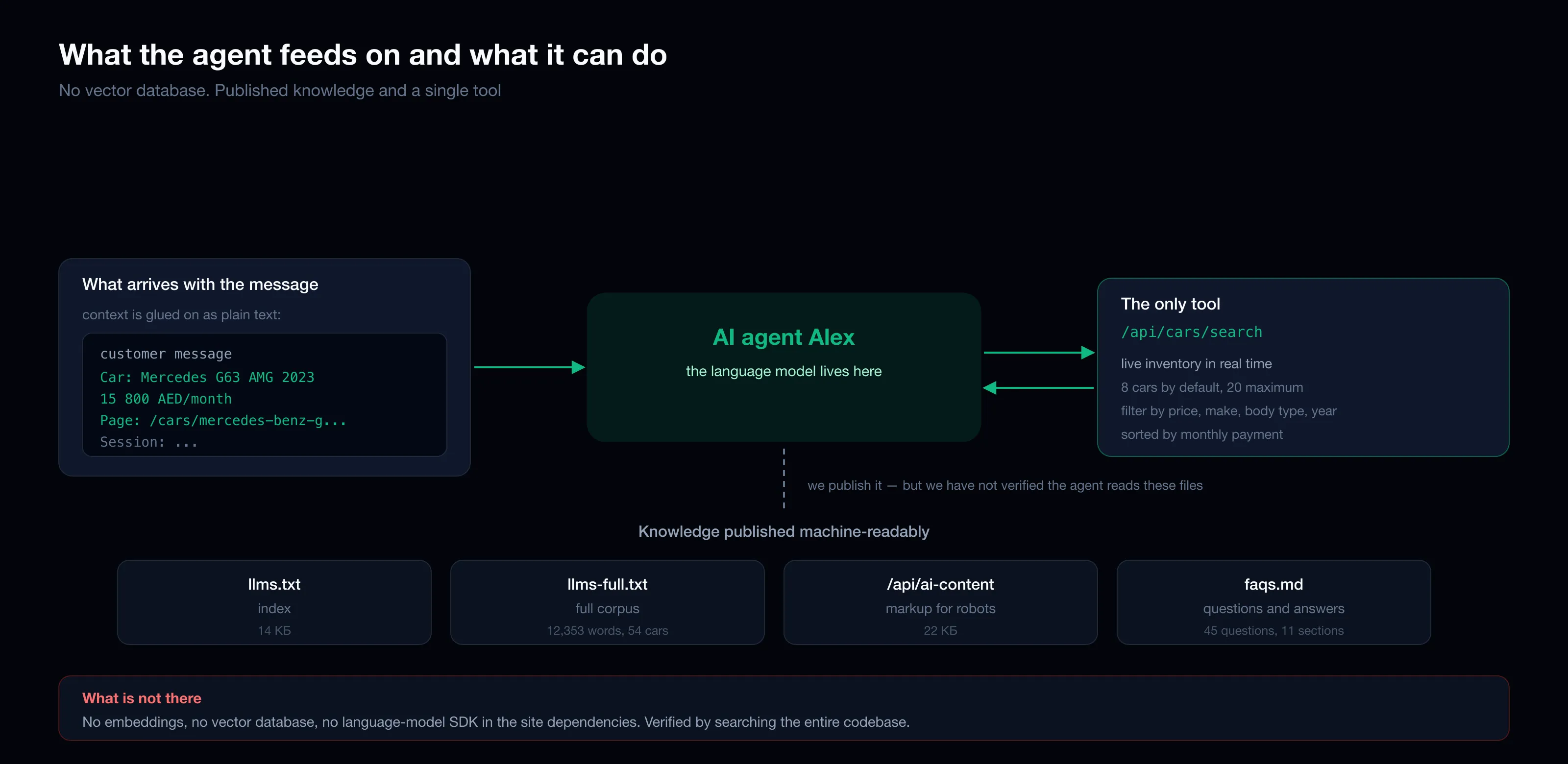
AI is integrated with Drive Your Dream’s internal ERP and receives up-to-date information about vehicles, their status, and company rules through an API.
At the same time, it has clearly defined limits of authority.
“If a customer wants to revise the terms, the agent checks what it can offer on its own. If that is not enough, the case is escalated to an employee, who then makes a decision together with the operations team,” Kalaushin explained.
Sensitive data are deliberately separated. In particular, information about payments from existing customers is stored separately, and AI does not have access to it.
The next stage is IP telephony. The company is already testing a system that should handle the first voice interaction with a customer in real time, record the conversation, and automatically generate a summary for the manager.
Drive Your Dream is betting not only on Google but also on AI search
Another area the team considers strategic is visibility in AI assistant responses.
Drive Your Dream estimates that around one-third of website visits now come from AI services, primarily ChatGPT. At the same time, the company emphasizes that this is an estimate rather than an exact analytics figure.
The reason is that AI assistants often do not pass referral information. In standard analytics systems, such a user may look like someone who visited the site directly.
“According to our estimate, around one-third of website visits now come from AI assistants, primarily ChatGPT. At the same time, it is impossible to determine the exact share because such visits often do not pass a referrer and appear as direct traffic in analytics,” Vyacheslav Kalaushin explained.
The second result of the Agent First approach is Drive Your Dream’s presence in Google AI Overview, the AI-generated answer displayed above the traditional search results.
According to the team, for relevant queries such as “g63 rent to own dubai,” the company may appear directly in the generated answer as a service provider.
“This is already a different logic from classic SEO. A user can get an answer without opening a single website at all. So it is important not just to be on the first page of Google, but to be a source that AI refers to when generating an answer,” Kalaushin said.
To achieve this, Drive Your Dream created a separate machine-readable layer for the website. In addition to llms.txt and llms-full.txt, the company opened AI content in a structured format, live search across its current vehicle inventory, as well as its own dataset on leasing costs.
This allows AI systems to work not with retellings from third-party aggregators but with the company’s own primary and up-to-date data.
The team also separately tested how visible Drive Your Dream is in AI assistant responses. They tested 40 purchase-intent queries: 30 in ChatGPT and 10 in Perplexity, in English, Arabic, and Russian. Each query was entered in a separate unauthenticated session so that the user’s previous history would not affect the result. The team recorded whether the AI mentioned the company, at what position, and how accurately it described the terms.
Drive Your Dream also emphasizes that it did not buy external links to increase domain authority, did not run paid search promotion, and spent no advertising budget on this area.
The clearest result came from Perplexity. For the query “which Dubai company approves a car lease in 24 hours without a bank?”, the service did not offer a list of alternatives but directly named Drive Your Dream as a company that says it can approve a car lease within 24 hours without bank involvement. Perplexity then provided the terms and a link to the company’s website.
In several other scenarios, Drive Your Dream either appeared first in the list or the company’s website was used as the source for the main answer. These included queries about leasing without bank approval or a credit check, arrangements for freelancers without a salary certificate, required documents, new residents without a UAE credit history, and zero down payment.
Another case involved the Mercedes G-Class. In response to a pricing query, Perplexity showed a price starting at approximately AED 16,909 per month, or about $4,600, and cited Drive Your Dream. At the time of the check, the company’s machine-readable catalog contained nine G-Class vehicles ranging from AED 16,909 to AED 25,055 per month — approximately $4,600 to $6,800.
The picture in ChatGPT was similar. For an Arabic-language query about rent-to-own in Dubai without a bank or credit check, Drive Your Dream appeared as a separate card above the main text response. For English-language problem-oriented queries, the company appeared in lists, comparison tables, or with a full description of its terms.
What matters especially to the team is that AI assistants reproduce not only the company’s name but also specific terms: contract duration, no AECB check, the list of required documents, and the structure of the annual payment. Drive Your Dream attributes this to the fact that these data are published on the website in machine-readable form.
“We saw a clear pattern: AI assistants find us when a person describes a specific problem — ‘the bank rejected me,’ ‘I don’t have a salary certificate,’ ‘I need a solution without a credit check.’ We built the website around exactly these real-world scenarios,” Vyacheslav Kalaushin explained.
The company even opened its own dataset for AI
On a dedicated leasing cost page, Drive Your Dream published its own set of primary data, which can be downloaded in CSV format.
It contains 54 rows and 13 columns.
The idea is to allow AI systems to rely not only on summaries from aggregators or third-party articles but to cite the company’s primary data directly.
The company has also divided AI crawlers into two categories.
Access is open to bots operated by AI vendors themselves — OpenAI, Anthropic, Perplexity, Google, and Apple.
At the same time, CCBot, cohere-ai, Amazonbot, and Bytespider are blocked.
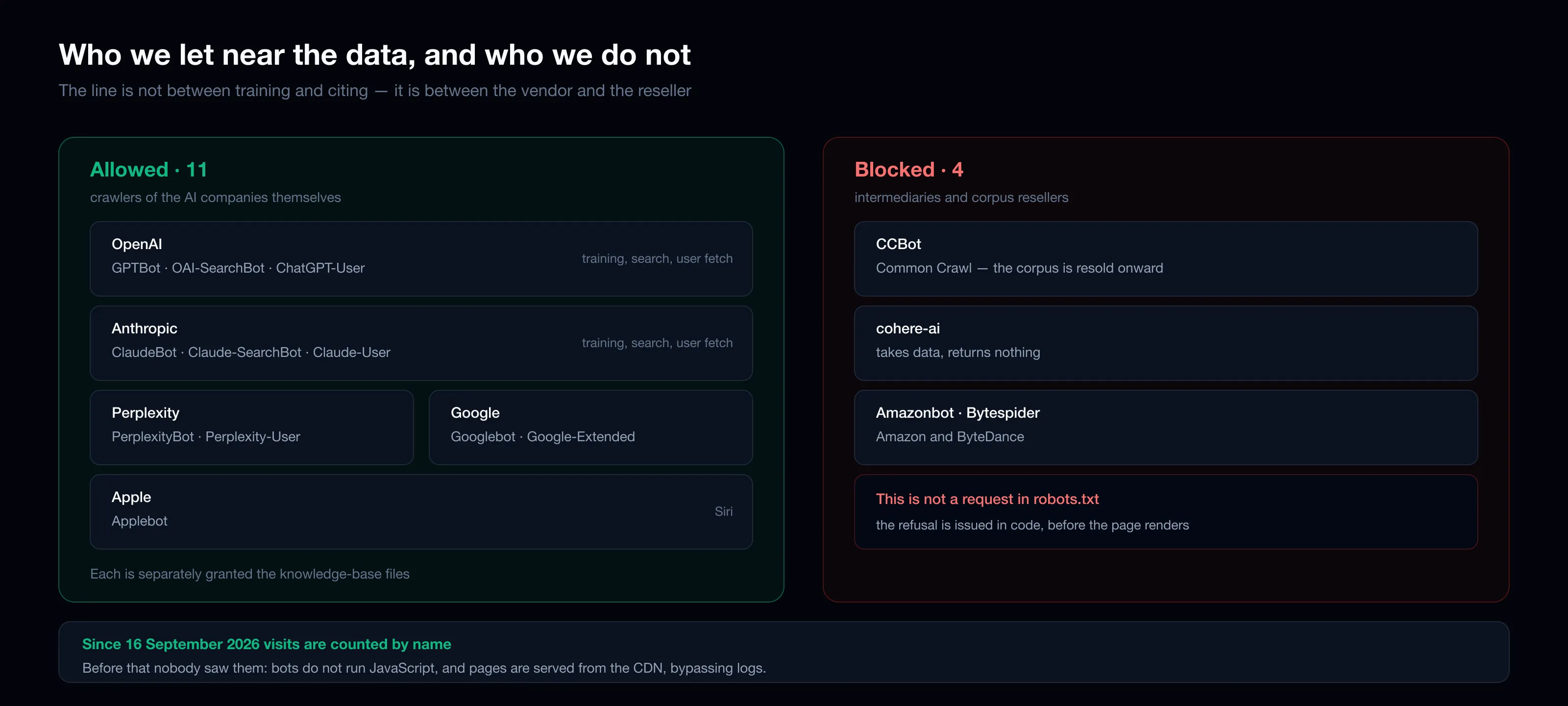
The team’s logic is simple: it is willing to provide information directly to AI companies, but not to intermediaries and large-scale content collectors.
The access rules can be checked directly in the public robots.txt. According to the company’s technical documentation, some bots are blocked at the code level before the page is even rendered.
Instead of standard pop-ups, the system first tries to understand the budget
Drive Your Dream has also abandoned traditional automatic pop-ups.
During testing, the team found that a standard “personal selection” could simultaneously include a Mini Cooper at around AED 2,921 per month — about $800 — and a G-Class at AED 19,983, or about $5,400.
The team concluded that this behavior did not mean the user was actually choosing between those two cars. Most likely, the person simply had not yet decided on a budget.
The system now shows the user a range and allows them to choose a comfortable amount, after which the catalog is automatically rebuilt.
Another detail is that an automatic recommendation appears at a score of 20 points, while a manager receives a customer alert at 25.
In other words, the company deliberately gives the person an opportunity to understand the offer independently before involving an employee.
Managers no longer assemble commercial offers manually either
Another automation concerns cards with specific offers.
A manager can select a vehicle on a phone, set the required terms, and automatically receive a ready-made card with the photo, model, monthly payment, initial payment, annual costs, and residual payment.
The figures are generated by the same function that calculates the terms on the website, so they should not differ across different channels.
In September, the team also discovered a third-party website that, according to the company, copied the Drive Your Dream catalog together with its photos and payment figures. After that, the company began automatically adding watermarks with its domain and phone number to photographs.
The most difficult part of operations is payments
Despite the technological innovations, some problems in the automotive business remain very traditional.
Sergey Orobchenko identifies timely payments as the main one.
“The hardest thing right now is payments. We want to move to automatic debiting so that we do not have to call the customer ten times and hear, ‘Yes, yes, the money will come tomorrow,’” he said.

The second area is parking, fines, and other payments that customers need to settle on time.
That is why the team sees automatic debiting from customer accounts as the next step.
Vehicle theft is not the main risk for this model
At first glance, one of the most serious risks for a business involving Lamborghinis, G-Class vehicles, and other expensive cars may seem to be theft.
However, Orobchenko considers this risk lower than in a traditional rent-a-car business.
The reason is the initial payment.
“If a person has already paid, say, 40% for a Lamborghini, it makes no economic sense for them to steal the car. They still would not be able to sell it on the black market in a way that makes the math work,” Sergey Orobchenko explained.
A new car can lose up to a third of its value in the first year
Drive Your Dream pays particular attention to depreciation.
According to Sergey Orobchenko’s estimate, a new car can lose approximately 20–30% of its value during the first year.
For used cars, the team uses a rough benchmark of around 1% of value per month.
“The first year is roughly minus 20–30% if the car is new. If the car is already used, you can roughly estimate around one percent per month,” Orobchenko explained.
That is why one- and two-year-old premium vehicles are especially attractive to Drive Your Dream.
“The customer is not paying a premium simply for having zero kilometers on the odometer. The first owner has already absorbed the largest depreciation, while our customer gets a quality asset with a more predictable residual value,” Sergey Pavlyuk added.
Among the models the team considers especially liquid are the Mercedes-AMG G 63 and Lamborghini Urus.
For brand-new cars, the company asks for a larger down payment
If a customer still wants a new car, the depreciation risk has to be offset with a larger upfront payment.
“If the car is new, we try to take around a 25% down payment or more. If the customer stops paying after just one month, the decline in the vehicle’s value is partly covered by their contribution,” Orobchenko explained.
The company emphasizes that the main task is to maintain a balance between the customer’s desire to get a vehicle with a low barrier to entry and the need to protect the capital of the company and its investors.
One future challenge is valuing a customer’s vehicle correctly when it is used as part of the down payment
Another risk is associated with situations where a customer contributes their own vehicle as part of the down payment.
Orobchenko believes this process should be standardized as much as possible.
“It may seem like a small detail, but the company owner has to control it. If an employee values the car incorrectly or reduces the down payment too much, the risk stays with the company,” he explained.
For this purpose, Drive Your Dream is testing automated preliminary vehicle valuation.
The system is expected to analyze open databases, market listings, depreciation rates, mileage, and common problems associated with a particular model.
The biggest management challenge is maintaining liquidity balance
For Sergey Pavlyuk, the main challenge in the business is not a specific car or an individual customer, but balancing cash flows.
“If you have five deals ready to go but no financing, that is bad. If you have money but no customers, that is also bad, because money costs money,” he explained.
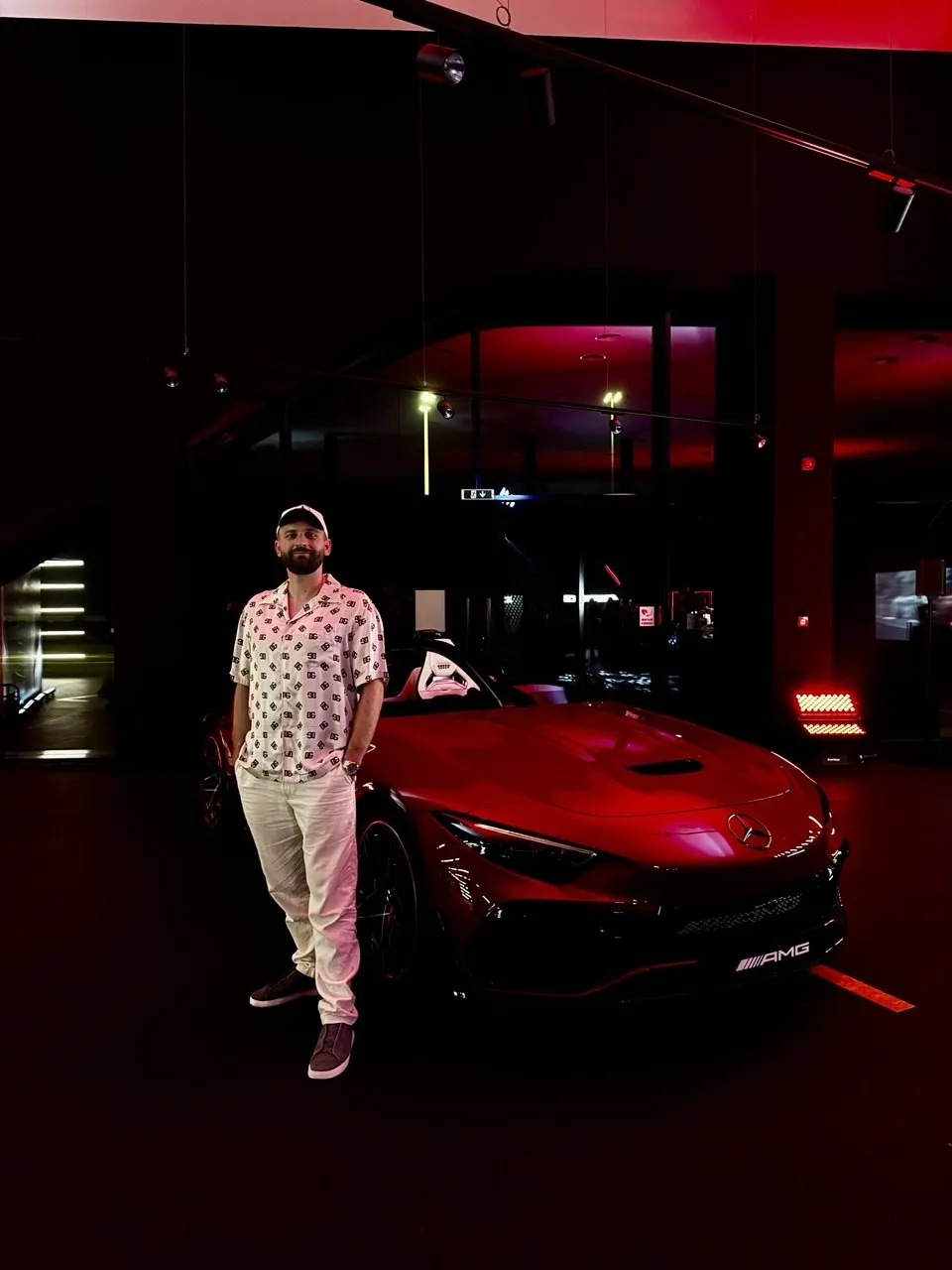
The company is constantly trying to maintain a balance between available capital, the number of customers, and the volume of vehicles in stock.
“The hardest part is balancing cash flows, market demand, and available capital correctly so that the money is always working and the customer gets the car quickly,” Pavlyuk added.
Qatar, Saudi Arabia, and Oman could become the next markets
Another goal is geographic expansion.
The team is already looking at Qatar, Saudi Arabia, and other countries in the region.
According to the interviewees, Drive Your Dream has a potential partner — the owner of a law firm with offices in several Middle Eastern countries, who is prepared to consider both legal and financial participation.
“This is especially important for us because legal risks are one of the most sensitive areas of this business: non-payment, fines, misuse of the asset, and potential theft. If you have a partner alongside you who is investing capital themselves and has offices in different countries across the region, scaling becomes significantly easier,” Sergey Pavlyuk explained.
Drive Your Dream wants to reach 100 active vehicles within a year
Each of the three interviewees has their own measure of success for the next 12 months.
For Sergey Orobchenko, the first goal is to move from around 55 vehicles to 100 active cars.
“The first milestone is one hundred cars. The second is a proper sales team and lead processing so that everything works quickly and systematically. The third is three to five large investors we work with on a regular basis,” he said.
For Sergey Pavlyuk, it is also important to develop the founders’ personal brands and use them to build additional trust in the business.
“If, through personal branding, we can directly or indirectly close 20–25 deals a year, I would consider that a very strong result. The best proof of product quality is when a customer votes for it with their money,” Pavlyuk said.
Vyacheslav Kalaushin focuses primarily on technology metrics and funnel efficiency.
Currently, according to him, around 20% of customers start a conversation with the company but later disappear. The goal is to reduce this figure to around 10%.
“We do not want to chase lead volume for its own sake. It is more important to optimize the funnel itself. If, at scale, every tenth application from the website turns into a real deal, that will already be a very strong result,” Vyacheslav Kalaushin concluded.


